With enterprise IT spending projected to reach $4.5 trillion in 2026, why does it still feel like every new invoice is a shot in the dark? You’ve likely felt the frustration of projects that miss deadlines or fail to solve the original business problem. It’s exhausting to watch costs climb while the communication gap between your leadership and technical staff remains wide. Achieving true technology alignment for business objectives is the only way to close that gap and regain control over your budget.
We believe your infrastructure shouldn’t just be an expense; it should be your most powerful asset. This guide shows you how to transform your IT from a reactive cost center into a strategic engine for growth. You’ll learn how to link your 2026 revenue targets directly to your digital roadmap. This approach ensures every investment improves employee productivity and secures your organization’s future through a stable, predictable foundation.
Key Takeaways
- Learn why closing the communication gap between technical teams and executive leadership is essential for operational stability.
- Discover how technology alignment for business objectives transforms IT from an unpredictable expense into a predictable growth engine.
- Identify the “Legacy Anchors” and communication silos that prevent your organization from reaching its 2026 revenue goals.
- Implement a structured five-step roadmap to audit your current infrastructure and align it with core corporate milestones.
- Understand how a vCIO provides the high-level strategic consulting necessary to lead your business through complex digital landscapes.
What is Technology Alignment for Business Objectives?
Technology alignment for business objectives is the disciplined process of ensuring that every piece of hardware, every software license, and every digital strategy directly advances your organization’s core goals. It marks the end of “IT for IT’s sake.” Too often, a significant disconnect exists between what technical teams build and what executives actually need to drive revenue. This “IT Gap” creates a friction point where leadership feels unheard and technical staff feel undervalued. We define technology alignment as the essential bridge that connects your daily operational tools to your long-term organizational success.
Historically, many businesses operated in a reactive “break-fix” cycle. You called for support when a server went down or a laptop wouldn’t boot. In 2026, this model is a liability rather than a strategy. Strategic alignment shifts the focus from merely keeping the lights on to using technology as a competitive lever. It requires looking at your 12-month growth plan and building the infrastructure today that supports that expansion tomorrow. When your technology alignment for business objectives is precise, your IT department ceases to be a cost center and becomes a primary driver of your success.
The Cost of Misalignment in 2026
Operating without a clear link between tech and strategy leads to more than just minor inconveniences; it creates measurable financial and operational risks. When your tools don’t serve your goals, you face several critical issues:
- Budget Waste: Organizations often hemorrhage funds through redundant software licenses and underutilized hardware that doesn’t serve a specific business purpose.
- Security Vulnerabilities: “Shadow IT” thrives when employees adopt unmanaged cloud services because the official tools are too slow or cumbersome, creating gaps in your security perimeter.
- Productivity Friction: Your team loses hours each week to tools that don’t talk to each other, leading to employee frustration and decreased morale.
The Tangible Benefits of Strategic IT Alignment
When you synchronize your technology with your business roadmap, the atmosphere changes from operational stress to strategic confidence. You gain a stable foundation that allows for bold moves. The advantages include:
- Agility: You achieve a faster time-to-market for new products because your systems are designed for rapid deployment and flexibility.
- Precision: Integrated systems provide real-time data, allowing you to make high-stakes decisions based on facts rather than intuition.
- Scalability: Your business can grow without the fear of technical bottlenecks, as your infrastructure is built to expand alongside your revenue goals.
The Three Pillars of Strategic IT Alignment
Purchasing the latest software suite rarely solves a fundamental disconnect between your vision and your technical execution. Lasting technology alignment for business objectives requires a cultural shift that starts at the executive level. Leadership must champion technology not as a necessary evil, but as a primary catalyst for success. When people, processes, and technology interact harmoniously, they create a stable, secure foundation that supports aggressive growth. This synergy ensures that every dollar spent on IT contributes directly to your bottom line.
The goal is to move beyond the siloed thinking of the past. In many organizations, the IT department operates in a vacuum, unaware of the sales team’s quarterly targets or the marketing department’s new campaign. Integrating these functions through strategic IT support allows your business to anticipate challenges before they disrupt your momentum. This proactive approach alleviates the operational stress that usually accompanies rapid scaling.
People: Culture and Technical Literacy
Technical literacy is the heartbeat of a modern organization. It isn’t enough to simply provide tools; your staff must be empowered to use them to their full potential. We often see businesses invest in powerful platforms only to use a fraction of their capabilities. Building a partnership between your IT team and your department heads ensures that technical solutions actually meet the needs of the people using them. When you communicate “the why” behind a change, you reduce resistance and foster a culture of proactive innovation. This alignment ensures your team feels confident and supported by the tools they use every day.
Process: Streamlining Operations Before Automating
Automating a broken process only makes it fail faster. Before you look for a technical solution, you must identify the manual bottlenecks that slow your team down. Many organizations find that Microsoft 365 optimization can solve these issues by replacing fragmented workflows with centralized, automated systems. Standardizing your operations ensures data accuracy and provides leadership with the visibility needed for high-stakes decision-making. Using technology to enable lean business processes keeps your organization agile and ready for the demands of 2026.
Technology: Selecting Tools that Scale
Purposeful procurement is the only way to avoid “shiny object syndrome.” In a landscape where enterprise IT spending is expected to reach $4.5 trillion in 2026, it’s easy to overspend on tools that don’t fit your long-term goals. We prioritize cloud infrastructure that offers the flexibility required for hybrid work environments while maintaining a rigid cybersecurity framework. Every new tool must scale with your revenue goals and integrate seamlessly with your existing stack. If you are unsure where to start your next upgrade, partnering with an experienced guide can help you make these decisions with confidence.
Identifying and Overcoming Common Alignment Gaps
Achieving technology alignment for business objectives often requires identifying the invisible barriers that stall progress. Research from Info-Tech Research Group indicates that 74% of IT strategies are ineffective, largely because CXOs feel their primary goals remain unsupported by technical teams. This disconnect usually stems from the “Communication Silo.” When technical teams operate without a clear understanding of the company’s 12-month revenue targets, they prioritize projects that offer high technical interest but low commercial impact. This misalignment leaves leadership feeling that their investments aren’t moving the needle.
Another significant hurdle is the “Legacy Anchor.” In established business hubs like Denver or Dallas, many organizations still rely on outdated systems that were never designed for the cloud-first requirements of 2026. These systems prevent modernization and consume a disproportionate amount of the budget just for basic maintenance. It’s time to shift the internal narrative away from the misconception of IT as a cost center. Technology should be viewed as an investment in future capacity, not just an overhead expense. When you view your infrastructure as a growth engine, you begin to make decisions that favor long-term scalability over short-term savings.
Shadow IT: The Silent Alignment Killer
Shadow IT occurs when employees adopt unapproved applications because official tools feel slow or restrictive. While this often comes from a place of productivity, it creates massive security risks and data silos. With global cybersecurity spending projected to reach $240 billion in 2026, unmanaged apps are a liability you can’t afford. Rather than simply banning these tools, we recommend bringing these processes back into the official IT roadmap. By understanding why your staff chose those apps, you can provide secure, approved alternatives that turn employee tech-savviness into a corporate asset.
Bridging the Executive-Technical Vocabulary Gap
Misalignment often boils down to a language barrier. Technical staff might focus on “uptime” and “latency,” while leadership cares about “revenue protection” and “customer experience.” A managed service provider near you acts as the essential translator between these two worlds. Through regular Business Technology Reviews (BTRs), we help you map technical performance directly to business KPIs. This ensures that every server upgrade or security patch is tied to a specific organizational outcome, providing the clarity you need to lead with confidence.
A 5-Step Roadmap to Align Tech with Your 2026 Business Goals
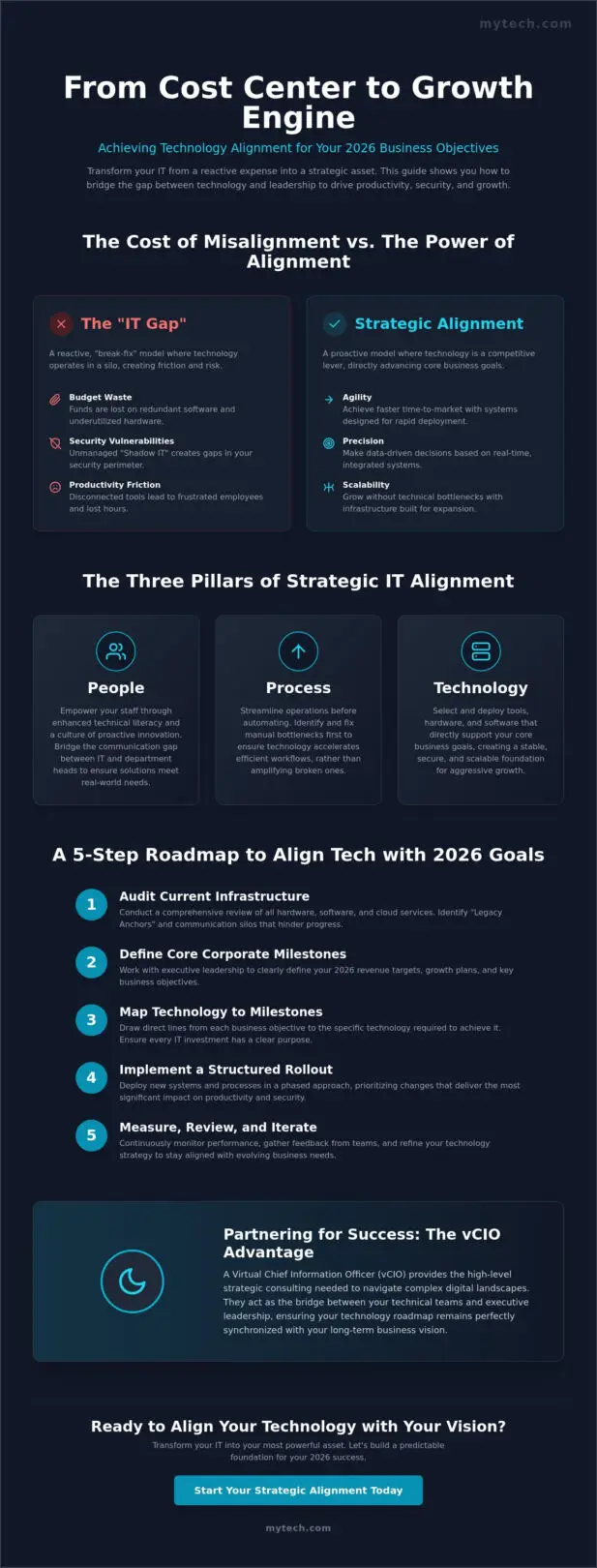
Moving from a reactive posture to a strategic one requires a structured framework. You can’t achieve technology alignment for business objectives by making isolated decisions in response to immediate crises. Instead, you must build a methodology that prioritizes long-term outcomes over short-term fixes. This roadmap provides the clarity needed to ensure your infrastructure evolves at the same pace as your revenue goals. It transforms the way you view your digital environment, moving it from an expense line to a growth catalyst.
Defining Objectives for Minneapolis and Denver SMBs
For mid-sized businesses in Minneapolis or Denver, technology must account for local market demands and labor availability. We recommend setting SMART goals for every initiative. For example, rather than simply “improving efficiency,” aim to “reduce order processing time by 15% through it services and support by the end of Q3.” This specificity ensures that every technical project has a clear, measurable impact on your organizational health and employee productivity.
The Importance of the Technology Roadmap
A roadmap provides the predictability that executives crave. It allows you to balance “keep the lights on” (KTLO) tasks with high-impact innovation projects. By looking 24 months ahead, you can avoid the “Legacy Anchor” mentioned earlier and plan for necessary upgrades before they become emergencies. This forward-thinking approach ensures that cybersecurity services in San Antonio and other critical protections are baked into your growth strategy from the start. If you’re ready to build a roadmap that actually drives results, contact our strategic consulting team today to begin your alignment journey.
Partnering for Success: How a vCIO Drives Technology Alignment
Most mid-sized businesses face the same digital complexities as Fortune 500 enterprises but often lack the budget for a full-time executive to manage them. A Virtual Chief Information Officer (vCIO) provides the strategic oversight necessary to navigate these landscapes without the traditional executive salary. This role is the linchpin for achieving technology alignment for business objectives. While your technical staff focuses on the health of your servers, a vCIO focuses on the health of your organization. They ensure every digital initiative supports your 12 to 24 month roadmap, turning your infrastructure into a predictable asset.
There is a fundamental difference between an IT vendor and a strategic partner. A vendor reacts to tickets; a strategic partner anticipates needs. We’ve seen this distinction transform local organizations. For instance, one partner moved from a fragmented system of manual spreadsheets to a fully integrated cloud environment. This alignment didn’t just fix their technical issues. It revolutionized their operational efficiency, allowing them to scale their output without increasing their headcount. By shifting the focus from maintenance to strategy, they turned their IT environment into a genuine growth engine that fueled their 2026 expansion goals.
The Mytech Approach to Strategic IT Consulting
We believe that stable infrastructure is the prerequisite for innovation. Our approach combines rigorous proactive maintenance with long-term strategic planning. By anchoring our relationship in managed it services in Minneapolis, we provide the reliable foundation you need to pursue bold business goals. We specialize in Microsoft 365 optimization and cloud migration to ensure your team remains productive and secure, regardless of where they work. This dual focus alleviates the operational stress that often holds businesses back from their full potential, creating a path for sustainable growth.
Taking the First Step Toward Alignment
Achieving true alignment begins with an honest look at your current state. A professional IT assessment uncovers the hidden vulnerabilities and redundancies that drain your budget and stall your progress. Armed with these insights, you can present a clear case to your leadership team about why a strategic shift is necessary. It’s about moving the conversation from “what does this cost” to “how does this help us grow.” We’re here to guide you through that transition, providing the discipline and experience required to lead your organization into a successful 2026. Schedule your strategic IT assessment with Mytech Partners today.
Securing Your Competitive Edge for 2026 and Beyond
Achieving true technology alignment for business objectives is the difference between a company that struggles with operational friction and one that scales with confidence. By balancing the three pillars of people, process, and technology, you transform your infrastructure from a series of technical fixes into a stable foundation for growth. Your 2026 roadmap shouldn’t be a wishlist; it should be a disciplined strategy that links every investment to a measurable revenue goal.
We’ve spent over 25 years helping organizations in Minneapolis, Denver, and across Texas move beyond the reactive cycle. Our dedicated vCIOs work as your strategic partners, ensuring your digital environment produces the business outcomes you need to lead your industry. Don’t let technical debt or communication silos hold your vision back. It’s time to build the infrastructure your future demands.
Your journey toward a more predictable and productive future starts with a single conversation. We’re ready to help you turn your operational tools into catalysts for long-term success.
Frequently Asked Questions
What is the first step in aligning technology with business goals?
The first step is defining your specific 12-month business goals before evaluating any technical tools. You must identify where you want the organization to be by the end of 2026, such as entering a new market or increasing revenue by a specific percentage. Once these objectives are clear, your technical roadmap becomes a tool to reach them rather than a series of disconnected projects.
How much does a technology alignment strategy cost for a mid-sized business?
The cost of a technology alignment strategy depends on the complexity of your current infrastructure and the scale of your 2026 goals. While we don’t provide flat industry pricing, the investment typically pays for itself by eliminating redundant software licenses and preventing costly project failures. Most businesses find that shifting to a proactive model reduces the overall financial stress of unpredictable break-fix invoices.
Can we achieve technology alignment without hiring a full-time CIO?
You can absolutely achieve technology alignment for business objectives without the expense of a full-time executive by partnering with a vCIO. A Virtual Chief Information Officer provides the same high-level strategic consulting and roadmap development at a fraction of the cost. This allows mid-sized businesses to benefit from seasoned leadership and disciplined technical oversight while keeping overhead manageable.
How often should our technology roadmap be updated?
We recommend reviewing your technology roadmap every quarter to ensure it stays in sync with shifting market conditions. While the roadmap should maintain a 12 to 24 month outlook, a quarterly cadence allows you to reprioritize initiatives based on your actual business performance. This agility ensures that your technical investments always support your most current organizational needs and revenue targets.
What are the signs that our business and IT are misaligned?
Common signs of misalignment include frequent IT budget overruns, employees using unapproved shadow IT applications, and technical projects that fail to solve the original business problem. If your leadership team feels that IT is an uncontrolled expense rather than a growth engine, it’s a clear indicator that your technical strategy and business goals are moving in different directions.
How does cybersecurity fit into technology alignment?
Cybersecurity is a core component of alignment because it protects the operational stability required for growth. In 2026, compliance requirements like the EU AI Act or CMMC Phase 2 make security a non-negotiable business objective. Aligning your security framework with your goals ensures that growth doesn’t create new vulnerabilities that could lead to devastating financial or reputational loss.
What is the role of the CEO in the technology alignment process?
The CEO plays a critical role by championing the cultural shift toward viewing technology as a strategic asset. Alignment fails when it’s treated as a task solely for the technical team. The CEO must ensure that department heads collaborate with IT leadership to create shared accountability for outcomes. This top-down support alleviates operational stress and fosters a culture of forward-thinking optimism.
How can Microsoft 365 help with business objective alignment?
Microsoft 365 optimization helps align technology with your goals by streamlining internal workflows and improving data visibility. When properly configured, these tools allow your team to work more efficiently and provide leadership with the real-time insights needed for high-stakes decision-making. We use these platforms to bridge the gap between your daily operations and your high-level strategic targets.