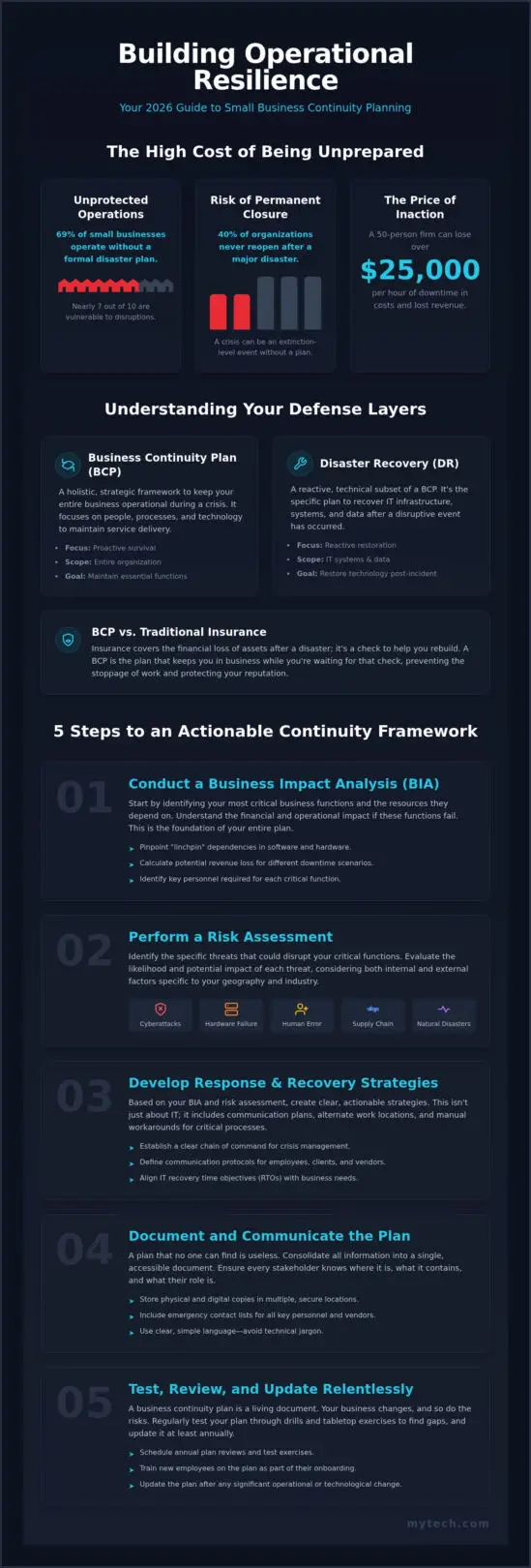
Did you know that 69% of small businesses currently operate without a formal disaster plan, even though FEMA reports that 40% of organizations never reopen their doors after a major disruption? It’s a sobering reality that underscores the vulnerability of many growing enterprises. You likely understand that a standard data backup isn’t enough to keep your team productive when a crisis hits, yet the perceived complexity of building a comprehensive business continuity plan for small business can feel overwhelming. We recognize the pressure of protecting your reputation while managing the high costs of potential downtime.
We’re here to help you move past the optimism trap and build a foundation of true operational resilience. This 2026 guide will teach you how to construct a strategic framework that protects your operations and data from unexpected interruptions. We’ll explore the essential steps to align your IT investments with your long-term business goals, giving you the confidence to lead your organization through any challenge. By the end of this article, you’ll have a clear, actionable roadmap to transform business continuity from a back-office task into a powerful catalyst for your company’s success.
Key Takeaways
- Understand why a modern business continuity plan for small business must prioritize operational survival and digital resilience over simple data backups.
- Learn how to identify your organization’s unique vulnerabilities through a targeted Business Impact Analysis that accounts for local infrastructure and environmental risks.
- Master the critical distinction between technical disaster recovery and the broader strategic framework of business continuity.
- Discover a five step process for building a proactive continuity team and documenting a clear response plan that remains accessible to every stakeholder.
- See how a strategic partnership helps you align technology with your primary objectives, turning operational stability into a competitive advantage.
Defining the Business Continuity Plan for Small Business Resilience
A Business continuity planning strategy is far more than a technical backup or an emergency contact list stored in a desk drawer. It is a proactive, living framework designed to keep your essential operations running during and after a crisis. While many leaders view these plans as defensive measures, a well executed business continuity plan for small business acts as a strategic foundation. It allows you to maintain service delivery when your competitors might be forced to pause. In local markets like Denver or San Antonio, this level of reliability becomes a powerful differentiator that builds lasting market share.
The landscape of 2026 demands a digital-first approach to resilience. With the rise of AI integration and increased regulatory scrutiny, such as the FINRA Rule 4370 examination sweep, the focus has shifted from simple recovery to demonstrable capability. It’s no longer enough to hope your systems will return; you must prove they can function under pressure. Moving from a reactive fix to a strategic foundation means you aren’t just responding to a fire. You’re building a structure that is inherently fireproof.
The High Cost of SMB Downtime
Financial impact is the most immediate consequence of operational failure. For a typical 50-person firm, an hour of downtime can represent a loss of over $25,000 in operational costs and missed revenue opportunities. These numbers escalate quickly, but the hidden costs are often more damaging. When your systems go dark, client trust begins to erode. In an era where 90% of small businesses may fail within a year if they don’t reopen immediately after a disaster, protecting your reputation is just as vital as protecting your data. Reliability is the currency of modern business, and downtime is a debt you can’t afford to carry.
BCP vs. Traditional Insurance
Business leaders often mistake commercial insurance for a complete safety net. While insurance is necessary to cover the financial loss of physical assets or liability, it doesn’t prevent the stoppage of work. It won’t answer your phones, process your payroll, or ship orders to your customers during a crisis. A business continuity plan for small business fills this gap by focusing on prevention and immediate operational survival. By integrating proactive IT and Managed Security Services, we help you lower your overall risk profile. This shifts the internal mindset from “how do we recover from the past” to “how do we continue into the future.”
Identifying Vulnerabilities: Risk Assessment and Business Impact Analysis (BIA)
Building a resilient organization requires more than just optimism. It demands an honest evaluation of where your business is most fragile. We start this journey by identifying the specific threats that could halt your progress. This isn’t about cataloging every possible inconvenience. Instead, we focus on the high-impact events that could fundamentally disrupt your ability to serve clients or generate revenue. By pinpointing these vulnerabilities early, you can direct your resources where they matter most.
Geography plays a significant role in your risk profile. For our partners in Denver, heavy winter weather and power grid stability are often top of mind. In San Antonio, the focus might shift to aging infrastructure or extreme heat events. Using Ready.gov’s business continuity resources as a baseline helps us categorize these external threats alongside internal operational risks. This localized approach ensures your business continuity plan for small business is grounded in reality rather than theory.
Conducting a Lean Risk Assessment
We recommend a lean assessment that targets the most frequent and damaging threats: cyberattacks, hardware failure, human error, supply chain disruptions, and natural disasters. Identifying your “linchpin” dependencies is the most critical step here. You must ask what software or hardware is absolutely vital for your daily output. Engaging professional it support and services allows you to audit these technical vulnerabilities with precision. This clarity helps you evaluate your current risk profile before a crisis occurs.
The BIA: Prioritizing Your Recovery
The Business Impact Analysis (BIA) is where strategy meets reality. It forces us to define two critical metrics: Recovery Time Objective (RTO) and Recovery Point Objective (RPO). RTO is the duration of time a business process can be down before the damage becomes unacceptable. RPO describes the maximum amount of data loss your business can tolerate. By categorizing processes into “Essential,” “Important,” and “Non-Critical,” you create a priority list for restoration. Not every file needs to be recovered in the first hour. Your business continuity plan for small business should focus on restoring the “Essential” functions first, such as payroll or customer-facing applications, to maintain your reputation and cash flow.
Business Continuity vs. Disaster Recovery: Understanding the Critical Differences
Many business leaders use the terms “disaster recovery” and “business continuity” interchangeably, yet they represent two distinct pillars of organizational resilience. While they share the goal of protecting your company, their focus and execution differ significantly. Disaster Recovery (DR) is the technical “how” of restoration, focusing on the systems that store and process your data. Business Continuity (BC) is the operational “what” of survival, ensuring your people and processes can function while those systems are being restored. A truly strategic business continuity plan for small business must integrate both to ensure no gaps exist between technical recovery and operational reality.
In 2026, the synergy between these disciplines and cybersecurity services in San Antonio is undeniable. When a security breach occurs, your DR protocols handle the technical cleanup, while your BC strategy manages the fallout with clients and keeps your staff productive. Following the Ready.gov business continuity plan framework helps clarify these boundaries. It ensures that your IT department isn’t just fixing a server in a vacuum while the rest of the company sits idle.
Disaster Recovery: The IT Backbone
The technical side of your resilience strategy focuses on the restoration of servers, cloud environments, and network connectivity. In an era where ransomware threats are increasingly sophisticated, your DR plan must prioritize off-site, immutable backups that attackers cannot delete or encrypt. Automation is the key to minimizing your downtime. By utilizing managed it services in Minneapolis, you can automate the failover process. This ensures that if a primary system fails, your backup environment takes over immediately, maintaining data integrity without manual intervention.
Business Continuity: The Operational Strategy
While IT works on restoration, your business continuity strategy focuses on your people and communication. This involves establishing alternative workspaces and ensuring your team can maintain productivity from anywhere. Microsoft 365 optimization is a vital component here, as it provides the cloud-based tools necessary for seamless remote collaboration. You must also have established channels to communicate with clients, vendors, and stakeholders when your primary email or phone systems are down. By focusing on the human element, you ensure that your business continuity plan for small business protects your reputation and maintains service levels even during a technical crisis.
5 Steps to Building an Actionable Business Continuity Framework
Creating a business continuity plan for small business is not a one-time project; it’s the development of a resilient culture. While the previous sections helped you identify risks and prioritize recovery objectives, this framework provides the structure to turn those insights into action. By following these five steps, you transform theoretical preparedness into a functional shield for your organization.
- Step 1: Form the Continuity Team. Select a diverse group that includes executive leadership and your IT partners. This team owns the strategy and makes the hard calls during a crisis.
- Step 2: Document the Plan. Your BCP should be clear, concise, and entirely non-technical. If a system fails, your team needs a manual that tells them exactly what to do without needing a computer science degree.
- Step 3: Establish Communication Protocols. Determine how you’ll reach staff, vendors, and clients. Reliability depends on having a clear hierarchy of who speaks and through which channels.
- Step 4: Execute Initial Training. A plan only works if your employees know it exists. Conduct walkthroughs so every team member understands their specific role when primary systems go offline.
- Step 5: Test, Review, and Update. Treat your BCP as a living document. Schedule regular reviews to ensure the plan evolves alongside your technology and business goals.
Communication: The First Line of Defense
Silence is the greatest enemy during a disruption. We recommend creating a “Crisis Communication” checklist that outlines pre-approved messaging for different scenarios. If your primary email server is compromised, you need secondary tools ready to go. Secure messaging apps or SMS-based alert systems ensure your team stays connected even when the corporate network is dark. Leadership plays a vital role here by projecting calm authority. When you communicate clearly and early, you prevent panic and maintain the trust of your stakeholders.
Testing and Iteration
A plan that isn’t tested is just a piece of paper. We advocate for “tabletop exercises” where your team simulates a specific crisis, such as a ransomware attack or a prolonged power failure in San Antonio. These rehearsals reveal gaps in your logic and help you refine your response before a real event occurs. As your organization grows, you must update your it support denver plan to account for new software, more employees, and shifting operational needs. Continuous improvement is what separates a static document from a truly strategic business continuity plan for small business.
If you’re ready to move beyond basic backups and build a foundation of true resilience, you can partner with our strategic consulting experts to design a custom framework for your future.
Strategic Partnership: How Mytech Partners Secures Your Operational Future
Managing a business continuity plan for small business in isolation often leads to overlooked vulnerabilities and fragmented systems. True resilience requires more than just a list of procedures; it demands a strategic alignment between your technology and your long-term organizational goals. We believe that business continuity and disaster recovery (BCDR) should not be a source of stress. Instead, it should provide the stable foundation that allows you to focus on growth and innovation with absolute confidence.
Our approach is built on a partnership model where we act as a seasoned guide through the complex digital landscape. With local offices in Minneapolis, Denver, Dallas, and San Antonio, we provide the regional expertise necessary to navigate specific local risks. We don’t just hand you a template. We work alongside you to ensure your operational tools are catalysts for success rather than assets that require constant, frantic management. This collaborative journey transforms your IT from a back-office expense into a disciplined governance discipline.
Managed BCDR: Peace of Mind as a Service
We provide continuous monitoring and proactive maintenance to ensure your recovery systems are always ready for deployment. A critical component of our service is the role of the vCIO (Virtual Chief Information Officer). Your vCIO helps build a multi-year technology roadmap that ensures your business continuity plan for small business evolves alongside the shifting cyber threats of 2026. By integrating Managed Security Services with your continuity strategy, we create a layered defense that protects your reputation and your bottom line. You gain the freedom to lead, knowing that your secure foundation is being managed by experts who are genuinely invested in your health.
Next Steps for Your Business
The transition from operational uncertainty to strategic stability begins with a clear understanding of your current position. We recommend scheduling a comprehensive assessment to identify your existing resilience gaps and technical vulnerabilities. This process often includes Microsoft 365 optimization to ensure your team has the cloud-based tools needed for seamless communication during any disruption. Don’t wait for a crisis to test your limits. Take the first step toward a more secure future today and protect your business with a strategic continuity partner.
Securing Your Path to Uninterrupted Growth
Resilience isn’t a destination; it’s a disciplined approach to organizational health that empowers your team to lead with certainty. By distinguishing between technical recovery and operational continuity, you’ve already taken the first step toward a more stable and predictable future. Remember that a successful business continuity plan for small business relies on actionable documentation and regular testing rather than static files that gather dust. This proactive stance transforms potential crises into manageable events, allowing your organization to maintain client trust and market momentum even during the most challenging disruptions.
With over 25 years of strategic IT experience and local support teams in Minnesota, Colorado, and Texas, we specialize in proactive BCDR management that aligns with your specific growth objectives. We’re ready to help you move past operational stress and toward a foundation of reliability and forward-thinking optimism. Our team is dedicated to ensuring your technology serves as a catalyst for your long-term success.
Connect with Mytech Partners to build your custom Business Continuity Plan today.
Your organization’s future deserves the confidence that comes from expert preparation and a dedicated strategic partner.
Frequently Asked Questions
What is the difference between data backup and business continuity?
Data backup is a reactive measure that stores copies of your files, whereas business continuity is a proactive strategy focused on maintaining operational uptime. While backups allow you to recover lost information, a business continuity plan for small business ensures your team can keep working during the restoration process. Think of backup as the spare tire and continuity as the roadmap that gets you to your destination without stopping.
Does a very small business really need a formal continuity plan?
Yes, smaller organizations often face higher risks because they lack the deep financial reserves of larger enterprises. A formal plan is essential for survival because it protects your reputation and ensures you don’t lose hard earned market share to more resilient competitors during a crisis. A structured framework allows even the smallest team to project calm authority and maintain service levels when disruptions occur.
How often should we update our business continuity plan?
You should review and update your plan at least once a year or whenever your business undergoes a significant operational change. This includes adopting new software, opening a new office location, or transitioning to a different work model. Regular updates ensure that your contact lists, technical dependencies, and recovery priorities reflect your current environment rather than outdated practices from previous years.
What are the most common threats to business continuity in 2026?
The most prevalent threats in 2026 include sophisticated AI-driven cyberattacks, hardware failures, and accidental human error. Small businesses must also account for regional risks like power grid instability or extreme weather events in local markets like Denver or San Antonio. Identifying these vulnerabilities early allows you to build a more resilient foundation that anticipates disruptions rather than simply reacting to them after they happen.
How much does it cost to implement a business continuity plan?
The investment in a business continuity plan for small business is typically a fraction of the cost of a single hour of downtime. While specific costs vary based on your infrastructure and recovery objectives, proactive planning is significantly more affordable than the emergency recovery fees and lost revenue associated with a total stoppage. We view this as a strategic investment in your company’s long-term stability and growth.
Can cloud services like Microsoft 365 replace a business continuity plan?
Cloud services are powerful tools for resilience, but they don’t constitute a complete plan on their own. While Microsoft 365 provides the infrastructure for remote collaboration, you still need a strategy to manage people, communication, and non-cloud dependencies. A comprehensive BCP integrates these cloud tools into a broader operational framework that dictates how your team responds when primary systems are compromised.
How do I start a BCP if I don’t have an internal IT department?
You don’t need an internal IT department to build a robust resilience framework. Most organizations find success by partnering with a strategic IT consultant who provides the experience and technical depth necessary to design a custom plan. This collaborative approach allows you to leverage expert guidance and proactive BCDR management while keeping your internal team focused on their primary business objectives.
What is a Recovery Time Objective (RTO) and why does it matter?
Recovery Time Objective (RTO) is the maximum amount of time your business can tolerate being offline before the damage becomes unacceptable. It matters because it dictates your technical requirements and budget priorities for restoration. By defining clear RTOs for your most critical functions, you ensure that your recovery efforts are aligned with your most urgent operational needs, preventing costly delays during a crisis.