The most expensive IT decision a growing business can make isn’t hiring a managed service provider. It’s continuing to operate without one. For many organizations, technology has quietly shifted from an enabler to a liability: unpredictable repair bills land without warning, ransomware threats grow more sophisticated every quarter, and internal staff spend more time triaging support tickets than driving the work that actually matters.
If that tension feels familiar, you’re not alone. Most business leaders recognize that their current approach to IT isn’t sustainable, but they hesitate to make a change because the investment feels uncertain. The question isn’t whether outsourcing IT is cheaper than hiring in-house. The real question is whether your technology is positioned to support where your business is headed next.
This article breaks down the strategic benefits of managed IT services so you can evaluate that question clearly. We’ll walk through how a proactive managed IT partnership replaces reactive chaos with financial predictability, strengthens your security posture, and frees your team to focus on growth rather than troubleshooting. By the end, you’ll have a grounded framework for deciding whether this model is the right fit for your organization.
Key Takeaways
- Replace the stress of reactive “break/fix” repairs with a proactive model that identifies and resolves system vulnerabilities before they impact your workflow.
- Secure your budget with predictable monthly spending, eliminating the financial shock of unexpected hardware failures or emergency support fees.
- Realize the full benefits of managed IT services by gaining immediate access to a team of specialists who provide the technical depth and scalability your growth demands.
- Build organizational resilience through layered security frameworks and continuous monitoring that defend against evolving cybersecurity risks like ransomware.
- Transform technology from a bottleneck into a catalyst for success by leveraging strategic guidance and a dedicated technology roadmap tailored to your specific goals.
What Are Managed IT Services? Moving Beyond the Break/Fix Cycle
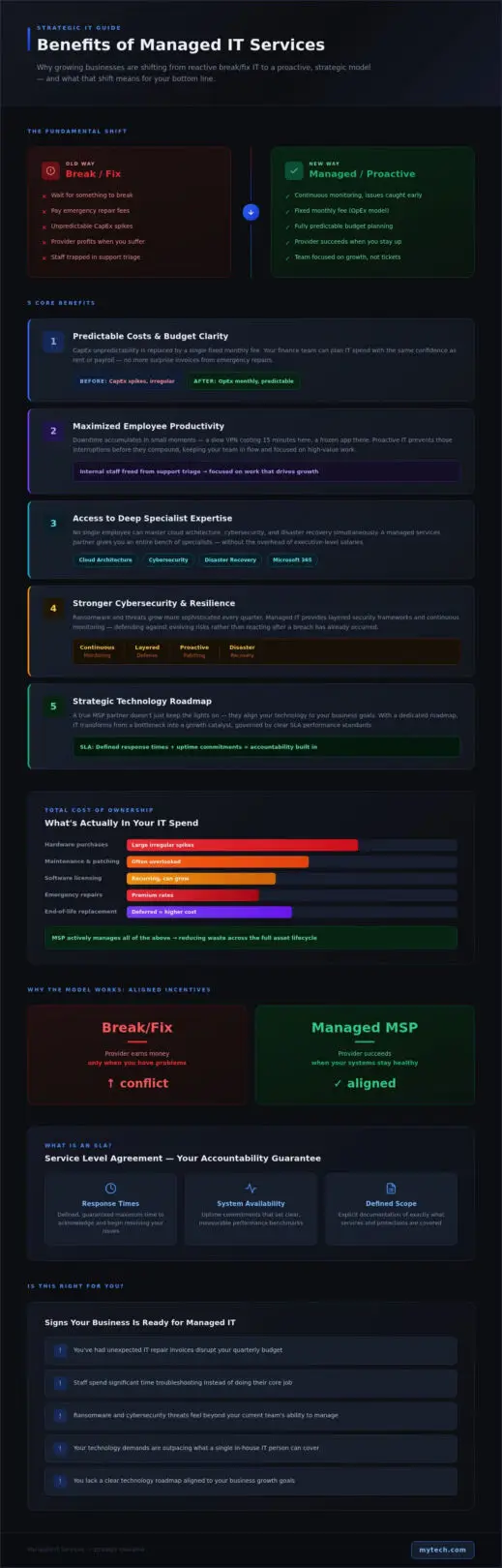
At its core, managed IT services represent a fundamental shift in how organizations handle their digital infrastructure. Instead of waiting for a server to fail or a network to crash, you partner with a provider that manages your technology through a proactive, subscription-based model. This partnership transforms your IT from a series of emergency repairs into a stable foundation for growth. One of the primary benefits of managed IT services is the transfer of operational risk. Your provider takes on the responsibility of keeping your systems running; their success is directly tied to your uptime.
Accountability in this model is governed by a Service Level Agreement (SLA). This document isn’t just a contract. It’s a commitment to performance standards. It defines exactly what you can expect regarding response times and system availability. By establishing these clear benchmarks, the MSP (Managed Service Provider) moves beyond the role of a vendor and becomes a strategic ally. They provide a layer of discipline that internal teams often struggle to maintain when they’re buried under daily tasks.
The Reactive vs. Proactive IT Mindset
Traditional IT often feels like constant firefighting. When something breaks, your team stops working, morale drops, and you pay a premium for emergency repairs. This “break/fix” cycle creates a conflict of interest: the technician only makes money when your business is in trouble. A proactive model flips this script. Through continuous monitoring, we identify and resolve potential failures before they disrupt your day. When your systems stay healthy, both you and your provider win. This alignment of incentives is one of the most significant benefits of managed IT services for growing organizations.
Why Modern SMBs are Outsourcing IT in 2026
The technological landscape in 2026 is vastly more complex than it was even a few years ago. Between sophisticated ransomware threats and the intricacies of Microsoft 365 optimization, it’s no longer realistic to expect a single in-house employee to master every discipline. Growing businesses need specialists in cloud architecture, cybersecurity, and disaster recovery simultaneously. By choosing to outsource, you gain a deep bench of expertise without the overhead of multiple executive-level salaries. For a deeper look at these shifting requirements, explore our strategic guide to IT support and services. This collaborative approach ensures that your tools aren’t just managed; they’re optimized for your specific business goals.
Key Financial and Operational Benefits of Managed IT
Unpredictable IT costs are one of the most persistent frustrations for growing businesses. A server fails on a Tuesday morning, and suddenly you’re facing an emergency repair invoice that wasn’t in any budget forecast. Multiply that by a few incidents per year, and the financial disruption compounds quickly. The shift to a managed services model addresses this directly by replacing that volatility with a structure your finance team can actually plan around.
Predictable IT Budgeting and ROI
Traditional IT spending falls under Capital Expenditure (CapEx): large, irregular investments in hardware, software licenses, and emergency labor. Managed services convert that into Operating Expenditure (OpEx), a fixed monthly fee that covers a defined scope of services. This distinction matters enormously for annual financial planning. When leadership can forecast IT costs with the same confidence as rent or payroll, technology stops being a financial wildcard and starts behaving like any other managed business function.
In the context of managed services, Total Cost of Ownership (TCO) extends beyond the purchase price of hardware to include maintenance, licensing, security patching, and end-of-life replacement, all of which a skilled MSP actively manages to reduce waste across the full asset lifecycle. With proactive lifecycle management, organizations avoid the costly pattern of running equipment well past its optimal lifespan, which typically increases failure rates and emergency repair costs simultaneously.
Maximizing Employee Productivity
Downtime is rarely a single dramatic event. It accumulates in smaller moments: a slow VPN connection that costs fifteen minutes, a frozen application that derails a client presentation, a password reset that takes three hours to resolve because no one is available. Across a team of thirty or fifty employees, these interruptions compound into a measurable annual loss of productive capacity.
A professional help desk changes that equation. Issues get resolved in minutes rather than days because the right specialist picks up the ticket immediately, not after your internal generalist finishes three other tasks. This responsiveness has a secondary benefit that’s easy to overlook: staff retention. Employees who aren’t constantly fighting their own tools are more engaged and less likely to leave. For a detailed look at how this support structure works in practice, managed IT support and services resources can help clarify what a well-designed help desk model actually delivers.
Standardized technology stacks also contribute here. When every workstation, application, and access protocol follows a consistent configuration, troubleshooting is faster, onboarding is smoother, and your team spends less cognitive energy adapting to inconsistent environments. That consistency, paired with cybersecurity best practices embedded at the infrastructure level, creates a stable foundation where your people can focus on the work that actually drives growth.
If you’re evaluating whether this model fits your organization’s current trajectory, exploring what a structured IT partnership looks like for businesses at your stage is a practical next step with Mytech’s managed IT services.
Accessing Expert Knowledge and Seamless Scalability
Hiring a single IT generalist and expecting them to master cloud architecture, cybersecurity threat response, network optimization, and Microsoft 365 administration simultaneously isn’t a strategy. It’s a gamble. One of the most compelling benefits of managed IT services is the immediate access to a full team of specialists, each with deep expertise in their own domain, for a fraction of what recruiting and retaining that talent individually would cost. You’re not paying for one person doing their best across five disciplines. You’re accessing a structured team where every role is filled by someone who does that work exclusively.
Bridging the IT Talent Gap
The competition for skilled IT professionals in markets like San Antonio, Dallas, and Denver is intense. Cybersecurity analysts, cloud engineers, and network architects command executive-level salaries, and the candidate pool is thin. When you do hire one, their departure creates an immediate single point of failure. An MSP eliminates that vulnerability entirely. The depth of bench means no critical knowledge walks out the door when someone resigns, and no gap appears in your security coverage while a position sits open for months.
This is particularly significant for organizations operating in high-risk threat environments. Mytech’s local presence in San Antonio and Dallas means clients benefit from specialists who understand both the cybersecurity services landscape in San Antonio and the regional compliance considerations that affect Texas-based businesses. That local expertise, grounded in NIST cybersecurity standards and frameworks, provides a level of contextual precision that a generalist hire simply can’t replicate.
MSPs also maintain vendor relationships and enterprise-tier licensing agreements that most SMBs couldn’t justify independently. That means your organization gains access to best-in-class monitoring tools, threat intelligence platforms, and cloud management software at a shared cost, without absorbing the full price of procurement and ongoing training.
Scalable Infrastructure for Growing Companies
Growth creates IT pressure fast. Opening a new office, onboarding twenty employees after a strong hiring quarter, or transitioning to a hybrid workforce model all require infrastructure changes that can take an understaffed internal team weeks to execute. A managed services partner handles that expansion systematically, with standardized provisioning workflows that compress onboarding timelines considerably.
Cloud infrastructure is the engine behind this flexibility. When your team is distributed across cities or working remotely, a well-architected cloud environment ensures consistent access, security, and performance regardless of location. Per-user and per-device billing models reinforce this agility; your IT costs grow proportionally with your headcount rather than requiring large capital commitments ahead of growth that hasn’t materialized yet.
The result is a technology foundation that scales with your ambitions rather than lagging behind them, which is exactly what the second benefit of managed IT services in this category delivers: not just access to expertise, but the structural flexibility to apply that expertise wherever your business moves next.
Strengthening Cybersecurity and Business Resilience
A firewall and antivirus software were once a reasonable defense. In 2026, they’re closer to a screen door on a submarine. Ransomware groups now operate with the organizational sophistication of mid-sized businesses, running affiliate programs, offering customer service to victims, and targeting SMBs precisely because those organizations tend to have weaker defenses than enterprise counterparts. Closing that gap requires a security posture built on depth, not a single line of defense.
Layered Defense and Threat Mitigation
Effective managed security operates across multiple simultaneous layers: endpoint detection and response, email filtering, identity and access management, network segmentation, and vulnerability patching, all working in concert. Underpinning this is continuous monitoring through a Security Operations Center (SOC), where analysts review threat signals around the clock and respond to anomalies before they escalate into breaches. Complementing this, Zero Trust architecture treats every user, device, and connection as untrusted by default, requiring continuous verification rather than assuming safety once someone is inside the network perimeter. Together, these controls represent the kind of structured, layered approach that defines one of the most critical benefits of managed IT services for organizations operating in high-risk environments.
Compliance adds another dimension. Organizations in healthcare, finance, or government contracting face regulatory obligations under frameworks like HIPAA and SEC guidelines. An experienced MSP doesn’t just help you pass an audit; it builds your infrastructure to meet those standards continuously, reducing the risk of a violation that carries both financial penalties and reputational damage.
Business Continuity and Disaster Recovery
There’s a meaningful difference between having a backup and having a business continuity plan. A backup stores your data. A continuity plan defines exactly how your organization keeps operating when that data becomes inaccessible, whether due to ransomware, a hardware failure, or a natural disaster.
MSPs formalize this through two specific metrics:
- Recovery Time Objective (RTO): The maximum acceptable time your systems can be offline before the business impact becomes critical.
- Recovery Point Objective (RPO): The furthest back in time you can afford to restore data without losing work that can’t be reconstructed.
Critically, a managed partner doesn’t just set these targets; it tests them. Regular recovery drills confirm that your backups are actually restorable and that your team knows the playbook before an incident forces them to learn it under pressure. That tested preparedness is what separates organizations that recover in hours from those that spend days rebuilding from scratch.
When your data protection strategy is structured, verified, and actively maintained, technology stops being a source of existential risk and becomes a stable foundation your leadership can build on with confidence. Explore Mytech’s Business Continuity and Disaster Recovery services to see how a tested recovery framework can protect what your organization has built.
The Strategic Advantage: Why Partnering with Mytech Matters
Most technology decisions get made reactively. A system fails, a vendor pushes an upgrade, a compliance deadline surfaces, and leadership scrambles to respond. That pattern isn’t a technology problem. It’s a planning problem. The final and most transformative of the benefits of managed IT services is what happens when your provider stops acting like a vendor and starts functioning as a strategic partner invested in where your business is headed, not just what broke yesterday.
Strategic IT Consulting and vCIO Services
A Virtual Chief Information Officer (vCIO) brings executive-level technology strategy to organizations that don’t need, or can’t justify, a full-time CIO on payroll. The role is fundamentally forward-looking. Rather than managing the help desk queue, a vCIO focuses on the decisions that shape your infrastructure over the next three to five years: which platforms to consolidate, where cloud investments will generate returns, how your technology roadmap aligns with your hiring plan, and what risks your current architecture quietly carries.
This strategic layer is operationalized through Quarterly Business Reviews (QBRs). These structured sessions create a dedicated rhythm for evaluating whether your technology is keeping pace with your goals. They surface misalignments before they become expensive corrections. If your team is growing into a new market, a QBR is where that expansion gets translated into a concrete infrastructure plan rather than a last-minute scramble. For organizations evaluating how to find the right fit, our guide to choosing a managed service provider near you walks through exactly what to look for in a partner who can deliver at this strategic level.
Mytech has delivered this kind of partnership since 2000. That depth of experience shapes how we approach every client engagement: not as a support ticket to close, but as a long-term relationship where your success is the actual metric.
Local Expertise with National Standards
Remote support resolves many issues efficiently. But there are moments when physical presence matters: a server room that needs hands-on assessment, a network configuration that requires on-site diagnosis, or a leadership conversation that’s simply more productive in person. Mytech’s offices in Minneapolis, St. Paul, Denver, San Antonio, and Dallas mean our engineers understand the regional business environments our clients operate in, not just the technical specs of their systems.
That local presence is paired with enterprise-grade standards. Clients in Texas benefit from specialists who understand the compliance landscape affecting Texas-based businesses. Clients in Minnesota and Colorado work with teams embedded in those markets. The result is a combination that’s genuinely difficult to replicate: national capability delivered with the accountability and responsiveness of a local partner.
We don’t position ourselves as a vendor you call when something breaks. We’re the benefits of managed IT services made tangible: a calm, experienced team that carries the operational weight so your leadership can focus on growth. Connect with Mytech to start a conversation about where your technology strategy should take you next.
Your Next Step Toward a Technology Foundation Built for Growth
The benefits of managed IT services ultimately come down to one shift: technology stops being something you react to and starts being something you lead with. Predictable costs replace financial surprises. A layered security posture replaces fragile, single-point defenses. And a dedicated vCIO ensures your infrastructure decisions stay aligned with where your business is actually headed, not just where it’s been.
Mytech Partners has guided growing businesses through that shift since 2000. With local offices in Minneapolis, Denver, San Antonio, and Dallas, and a dedicated vCIO assigned to every managed services partner, we bring both the strategic depth and regional accountability that remote-only providers simply can’t match.
Your technology should be a competitive advantage. If it doesn’t feel like one right now, that’s exactly the conversation worth having. Schedule your proactive IT assessment with Mytech Partners today and take the first step toward a foundation your team can build on with confidence.
Frequently Asked Questions About Managed IT Services
What is the average cost of managed IT services for a small business?
Managed IT services are typically priced on a per-user or per-device basis, with monthly fees varying based on the scope of services, number of endpoints, and security requirements your organization needs. Because pricing is customized to each business’s environment, we’d encourage you to request a direct assessment rather than relying on generic industry ranges, which rarely reflect what your specific infrastructure actually requires.
What matters more than a headline number is the total cost comparison. Factor in what you’re currently spending on emergency repairs, downtime losses, and the salary of any internal IT staff. For most growing businesses, a managed model costs less in aggregate while delivering significantly broader coverage.
How do managed IT services compare to hiring an in-house IT manager?
A single in-house IT manager brings one person’s expertise. A managed services partner brings a structured team of specialists across cybersecurity, cloud infrastructure, network management, and help desk support simultaneously. When your IT manager is unavailable, on vacation, or resigns, your coverage disappears entirely. That single point of failure doesn’t exist in a well-run MSP model.
The talent gap compounds this further. Recruiting qualified IT professionals in competitive markets is slow and expensive, and retention isn’t guaranteed. An MSP eliminates that hiring cycle entirely while providing deeper technical depth than most SMBs could justify building internally.
Is my data secure when using a managed service provider?
A reputable MSP strengthens your data security rather than introducing new risk. Providers like Mytech operate using layered security frameworks that include endpoint detection, identity and access management, and continuous monitoring through a Security Operations Center. Your data is protected by controls that most internal teams don’t have the resources or specialization to implement consistently.
Before engaging any provider, review their security policies, data handling agreements, and compliance certifications. Ask specifically how they segment client environments, how access to your systems is controlled internally, and what their incident response process looks like. A trustworthy MSP welcomes those questions.
Can managed IT services help with regulatory compliance like HIPAA or GDPR?
Yes. One of the practical benefits of managed IT services is that a skilled provider builds your infrastructure to meet regulatory standards continuously, not just during audit season. For organizations in healthcare, finance, or government contracting, this means your systems are configured to HIPAA, SEC, or other applicable framework requirements from the ground up.
This proactive approach reduces the risk of violations that carry financial penalties and reputational damage. Your MSP should be able to document your compliance posture, identify gaps before regulators do, and maintain the audit trail your organization needs to demonstrate ongoing adherence.
What happens if our systems go down after hours or on weekends?
After-hours and weekend coverage varies by provider and service agreement, so this is a critical question to ask before signing any contract. Review your SLA carefully to understand exactly what response commitments apply outside standard business hours and whether critical incident response is included or priced separately.
What a proactive managed model does regardless of timing is reduce the likelihood of unexpected outages in the first place. Continuous monitoring catches developing issues before they escalate into failures, which means fewer middle-of-the-night emergencies rather than simply promising to respond to them faster.
Do I still need to buy my own hardware if I have an MSP?
It depends on your service agreement and infrastructure model. Many MSPs help clients shift workloads to cloud environments, which reduces reliance on physical hardware and the capital expenditure that comes with it. For equipment that remains on-premises, your provider typically manages the lifecycle, recommending replacements before aging hardware creates reliability or security risks.
Some providers offer hardware procurement as part of their service model, while others advise on purchases you make independently. Clarify this scope early. The goal is to avoid running equipment past its optimal lifespan, which is a common driver of both unexpected failures and rising support costs.
How fast can an MSP respond to a critical technical issue?
Response times are defined in your Service Level Agreement and typically vary by issue severity. A critical outage affecting your entire organization should trigger a faster response commitment than a single-user software question. Ask any prospective provider to walk you through their tiered response structure and what escalation looks like when an issue isn’t resolved within the initial window.
The more meaningful metric, though, is mean time to resolution rather than mean time to first response. A fast acknowledgment that leads to hours of unresolved downtime doesn’t protect your business. Evaluate providers on how quickly issues are actually closed, not just how quickly someone picks up the ticket.
What is a vCIO and why does my business need one?
A Virtual Chief Information Officer is a senior technology strategist who works with your leadership team to align your IT investments with your business goals. Unlike a help desk manager focused on daily support, a vCIO looks three to five years ahead, building a technology roadmap that accounts for your growth plans, risk exposure, and budget constraints.
For growing businesses that don’t need or can’t justify a full-time CIO on payroll, this role fills a genuine strategic gap. Through structured Quarterly Business Reviews, a vCIO ensures your infrastructure decisions stay connected to where your organization is actually headed. The benefits of managed IT services are fully realized when this strategic layer is in place, turning technology from a cost center into a deliberate competitive advantage.