Estimated read time: 8 minutes
Strategic IT planning connects technology decisions to the future of the business. It gives leaders a practical way to align risk, growth, productivity, budgeting, artificial intelligence, and cybersecurity without turning the conversation into a parade of technical specifications. You do not need to know every detail. You do need to give the people building the plan enough business direction to make sound recommendations.
Key Takeaways
- Business leaders must define the outcomes, priorities, and risk tolerance that shape an IT strategy.
- A useful technology roadmap reflects the organization’s maturity and where the business plans to go next.
- Better use of existing applications can create value before the business buys another solution.
- Artificial intelligence readiness depends on organized data, clear governance, and team-level use cases.
- Cybersecurity improves through consistent, incremental action, not a one-time project.
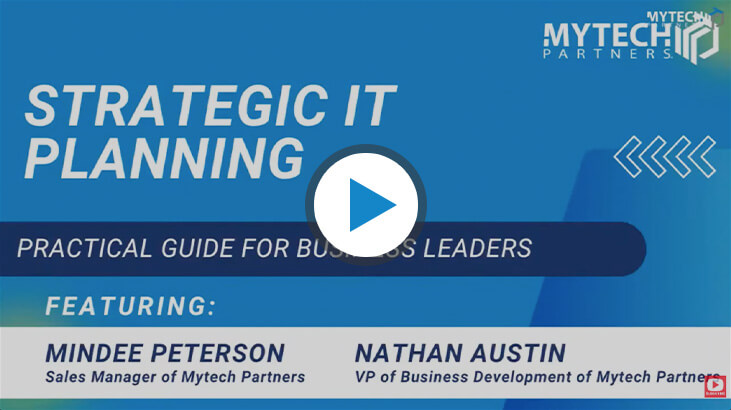
Click above to view the entire session
Why Must Business Leaders Shape IT Strategy?
Strategic IT planning is a business responsibility before it is a technology exercise.
Technology decisions influence risk, productivity, hiring, expansion, acquisitions, and client service. Yet the people asked to create an IT budget or roadmap are often given little visibility into the organization’s goals. Without that context, they can plan for replacements and renewals, but they cannot confidently recommend investments that support the next stage of the business.
Executive participation matters because risk tolerance is not purely technical. Regulations may establish some requirements, but leaders still need to decide what level of operational, financial, and security risk is acceptable. The Chief Executive Officer ultimately owns that risk, which makes the executive voice essential rather than optional.
The bold truth: if leadership is absent from IT planning, the organization is not creating a strategy. It is creating a technology shopping list.
That does not mean business leaders need to debate specifications or configuration choices. In the webinar, Nathan Austin drew a clear distinction: strategic planning should focus on what the business is trying to achieve, the return expected from its investments, and the risks it needs to mitigate. The technical details can follow once the destination is clear.
“Your voice is really important, and if strategic IT planning is done right, you’re not talking about the details of the technology.”
Nathan Austin, Co-Owner and Vice President of Business Development
How Should Business Maturity Change the Technology Roadmap?
The right IT plan depends on the business you are building, not the business you were three years ago.
A company focused on maintaining a stable operation will make different investments than one preparing for rapid growth, new locations, or acquisitions. The webinar describes this through business modes: startup, balance builder, value builder, and empire builder. The labels are less important than the underlying question: Is the organization trying to survive, maintain, grow steadily, or accelerate?
That answer changes planning decisions. A business that expects to stay roughly the same size may not need to invest for added scale. A business preparing to expand should consider whether today’s systems can support more people, more locations, and faster execution. Technology purchases often remain in place for three to five years, so a one-year view can be too narrow.
Our own experience illustrates the point. Early in our history, the priority was making the business work. Roughly ten years in, we began defining a more intentional strategy and standardizing recurring decisions. A new team member, for example, obviously needed a computer. Establishing a standard and a budget removed an unnecessary approval bottleneck and allowed the team to move.
A strategic plan creates that same clarity at a larger scale. It establishes what can be standardized, what needs executive review, and what should be prepared before growth arrives. Otherwise, every routine decision becomes a tiny board meeting, and nobody has time for that.
A practical planning lens
- Where is the business today?
- Where does leadership want it to be in one to three years?
- What growth, location, staffing, or acquisition changes are expected?
- Which risks could prevent the organization from reaching that destination?
- Which technology decisions must be made now because they will last several years?
How Can a Strategy Reduce Surprises and Decision Bottlenecks?
A working IT strategy replaces recurring surprises with visibility, standards, and intentional choices.
No leader enjoys discovering an unplanned technology expense after the budget is set. For a nonprofit or an organization accountable to a board, an unplanned investment can be especially difficult because approval may depend on whether the expense was anticipated. Strategic planning cannot eliminate every surprise, but it gives the organization a clearer view of lifecycle needs, renewal decisions, capacity constraints, and business initiatives.
The same planning discipline helps leaders delegate. As a company grows, decisions that once lived in an owner’s head become bottlenecks. Standards and budgets allow team members to act without waiting for a single decision-maker to return from a conference, a client meeting, or a well-earned vacation. The business moves faster because people know the guardrails.
A stable roadmap also protects continuity when roles change. Without an agreed direction, each new person may introduce a different preferred approach. Over time, the environment can become a collection of disconnected choices, what Nathan described as a “Frankenstein” structure. The business then pays twice: once through everyday friction and again when it must reinvest to make the pieces work together.
Progress becomes visible when fewer routine decisions require executive intervention, costs become easier to anticipate, and the technology conversation shifts from “What broke?” to “What are we trying to accomplish next?” That is the move from reactive support to strategic enablement.
Are You Getting Enough Value From the Tools You Already Have?
Before adding another application, measure how much value the business is getting from the ones it already pays for.
As organizations grow, departments can adopt overlapping applications without realizing that another team already has a similar capability. Even when duplication is not the issue, a business may use only a fraction of what an existing system can do. The webinar offers a straightforward exercise: estimate current utilization, estimate realistic maximum utilization, note the annual cost and number of users, then identify the most valuable gap to close.
The goal is not false precision. Leaders do not need to debate whether utilization is 33.2 percent. They need enough visibility to compare opportunities. Moving a widely used application from roughly 40 percent utilization toward a realistic 80 percent ceiling may produce more value than squeezing a nearly optimized system from 80 to 82 percent.
The provider will not reduce the bill because the organization uses only part of the product. The opportunity is to close the gap through training, workflow changes, integration, governance, or clearer ownership. Small improvements can reduce manual effort, improve consistency, and help a growing business handle more capacity without adding more work or more applications.
Sometimes the smartest technology move is not buying something shiny. It is finally using the good stuff already sitting in the cupboard.
What Does Artificial Intelligence Readiness Require?
Artificial intelligence readiness begins with clean information and a business use case, not enthusiasm alone.
The webinar’s internal policy example makes the issue tangible. While testing a human resources question-and-answer agent, our team received conflicting answers because both a current paid time off policy and an outdated version were stored in the source library. The system could see both documents, but it could not know which one represented the current truth. The problem was not the question. The problem was the information environment.
That is why artificial intelligence planning must include data structure, cloud readiness, security permissions, change management, and governance. If information is disorganized, duplicated, or outdated, automated answers can reflect that confusion. A messy information environment is like a messy garage: adding a powerful assistant does not magically label every box.
Another opportunity is moving beyond individual productivity. People may already use artificial intelligence to draft an email or work through an idea. The larger business return comes from identifying repetitive work across a team, department, or organization and designing a secure, repeatable workflow around it. That requires conversation, planning, testing, and review. It is closer to implementing a significant business system than flipping on a feature.
The practical next step is an artificial intelligence roadmap that identifies where the organization is today, which opportunities could create meaningful return, and what data or governance work must happen first. Head-in-the-sand is not a roadmap. Neither is chasing every new capability. The useful middle ground is deliberate experimentation tied to a business outcome.
How Should Leaders Approach Cybersecurity Without Getting Overwhelmed?
Cybersecurity becomes manageable when leaders treat it as an ongoing process of prioritized improvement.
Security feels overwhelming because it touches people, systems, devices, policies, physical processes, and outside requirements. No organization can solve every variable at once, and the environment continues to change. That is why the webinar rejects the idea of cybersecurity as a project with a final checkbox.
A better approach is to use a recognized framework, insurance questionnaire, or regulatory requirement to identify priorities, then make measurable progress each quarter. One quarter might focus on an incident response plan. Another might address access controls or ensure that Multi-Factor Authentication (MFA) is applied consistently. The specific sequence depends on the organization’s risk, obligations, and operating needs.
Policies and technical controls also need to match. A written password policy is not useful if the organization cannot enforce it through its technology environment. Business leaders and advisors should collaborate so policies reflect what is technically possible, recommendations reflect the organization’s tolerance for risk, and the final decision remains with the business.
Security does not need to become a fear campaign. It needs a cadence. Pick the next meaningful step, complete it, and repeat. Quarter-over-quarter progress will put the organization in a stronger position than waiting for a mythical day when every box can be checked forever.
What Is the Best Next Step?
Start with an honest picture of where the business is today and one clear step toward where it needs to go.
That step may be sharing next year’s growth plan with your technology team, reviewing application utilization, organizing information for artificial intelligence, or choosing one security improvement for the coming quarter. The value comes from connecting the action to a business outcome and building a repeatable planning rhythm around it.
If planning conversations remain focused on technical details, the bigger business questions can get lost. The goal is to connect technology decisions to priorities, risk, and long-term direction so leadership has a roadmap it can confidently act on.
Ready to elevate the conversation? Let’s talk.
Frequently Asked Questions About Strategic IT Planning
What is strategic IT planning?
Strategic IT planning aligns technology investments, risk decisions, budgets, and operating priorities with business goals. It focuses on where the business is going and what technology must do to support that direction.
Who should participate in strategic IT planning?
Executive leadership should provide business goals, expected changes, investment tolerance, and risk tolerance. Technology leaders can translate that direction into recommendations, timelines, standards, and budget considerations.
How far ahead should an IT strategy look?
The webinar recommends looking at least three years ahead because many technology decisions remain in place for three to five years. The plan should still be reviewed regularly as business priorities and risks change.
How can a business reduce surprise IT costs?
Identify lifecycle replacements, renewals, expected growth, planned locations or acquisitions, and capacity needs before the annual budget is finalized. A roadmap improves visibility and allows leaders to prioritize investments instead of reacting to them.
How does strategic IT planning support artificial intelligence?
It helps the organization assess data quality, governance, security, workflows, permissions, and potential use cases before expanding artificial intelligence. This creates a stronger foundation for reliable results and business-level return.
Why is cybersecurity part of strategic IT planning?
Cybersecurity affects operational risk, budgets, policies, insurance, and the organization’s ability to serve clients. Treating it as a recurring planning priority supports steady improvement without attempting to solve every issue at once.