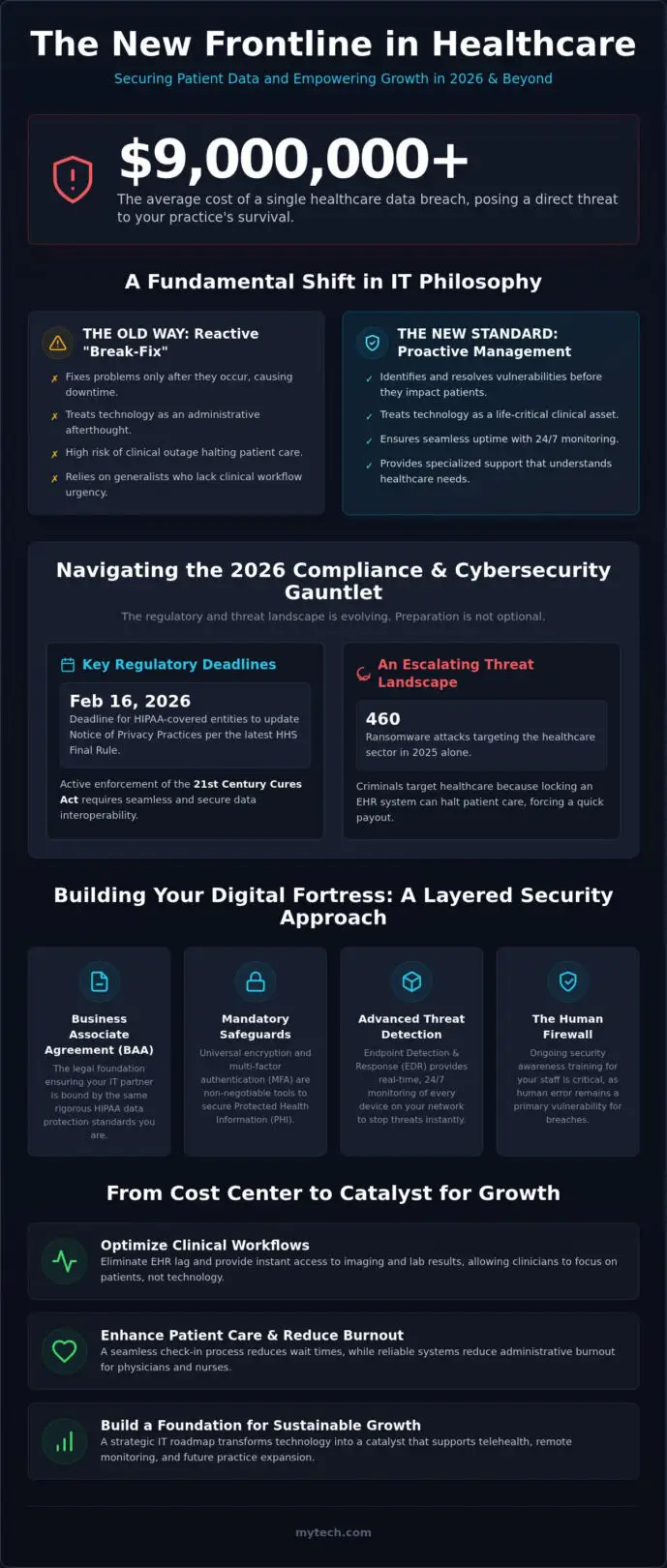
With the average cost of a healthcare data breach now exceeding $9 million, a single security lapse is no longer just a technical glitch; it’s a direct threat to your practice’s survival. You likely feel the weight of this reality every time you update your Notice of Privacy Practices or manage the latest EHR lag. It’s exhausting to balance high-quality patient care with the constant pressure of HIPAA compliance and the looming anxiety of a ransomware attack. Finding reliable it support for healthcare providers shouldn’t feel like a high-stakes gamble that keeps you up at night.
We believe your technology should serve as a silent, secure foundation that empowers your team rather than hindering them. This guide reveals how specialized IT support secures your sensitive patient data, automates complex regulatory requirements, and optimizes your clinical workflows. We’ll preview the critical 2026 landscape, including active enforcement of the 21st Century Cures Act, and provide a strategic roadmap to ensure your practice achieves seamless uptime and sustainable growth.
Key Takeaways
- Transition from reactive “break-fix” repairs to a proactive model that treats technology as a life-critical clinical asset.
- Learn how specialized it support for healthcare providers streamlines HIPAA compliance and prepares your practice for 2026 regulatory shifts.
- Identify the hidden costs and risks of relying on a single in-house generalist compared to the collective depth of a managed security team.
- Evaluate the performance benefits of cloud versus on-premise infrastructure to eliminate EHR lag and protect data integrity.
- Discover how a strategic technology roadmap transforms your IT from a cost center into a catalyst for practice growth.
Why Specialized IT Support is Critical for Modern Healthcare Providers
Specialized it support for healthcare providers represents a fundamental shift in how medical practices view their digital infrastructure. In 2026, technology is no longer an administrative afterthought; it is the central nervous system of patient care. Unlike a standard office where a server crash might only delay emails, a clinical outage can halt life-critical systems. This high-stakes environment has pushed the industry away from the old reactive “break-fix” model. Instead, modern practices prioritize proactive managed services that identify and resolve vulnerabilities before they impact a single patient.
The implementation of Health information technology (HIT) directly influences how patients perceive your practice. When systems run smoothly, clinicians spend more time looking at patients and less time fighting with unresponsive EHR screens. Efficient IT also underpins the success of telehealth and remote patient monitoring initiatives. These services require robust, secure connections to ensure that data from a patient’s home reaches the clinic accurately and without interruption. A strategic partner ensures these tools are catalysts for success rather than sources of operational stress.
The Cost of Downtime in a Clinical Setting
When your network goes dark, the financial impact is immediate. Beyond lost billable hours, your practice suffers reputational damage when patients are turned away at the front desk. Generalist IT firms often fail to grasp the specific urgency of medical workflows. They might treat a lobby printer issue with the same priority as a database error in the lab. Strategic healthcare IT requires 24/7 monitoring to ensure that your infrastructure remains resilient against technical failures. This constant vigilance allows you to maintain a stable foundation for growth.
Technology as a Catalyst for Patient Care
Technology should empower your team, not hinder them. Optimized network speeds allow for a seamless patient check-in process, which significantly reduces clinic wait times. When your infrastructure is high-performing, doctors gain instant access to imaging and lab results across the entire provider network. This efficiency does more than just help the patient; it reduces administrative burnout for nurses and physicians. By ensuring software responsiveness and secure communication, you provide your staff with the tools they need to focus entirely on clinical excellence.
Navigating HIPAA Compliance and Cybersecurity in 2026
The regulatory environment in 2026 demands more than just basic privacy measures. By February 16, 2026, all HIPAA-covered entities receiving substance use disorder records must have updated their Notice of Privacy Practices to align with the latest HHS Final Rule. This shift is just one example of how the compliance landscape continues to evolve. Partnering with a dedicated provider of it support for healthcare providers ensures your practice stays ahead of these deadlines without disrupting daily clinical operations. We help you manage these transitions with a sense of calm authority, turning complex mandates into manageable workflows.
A signed Business Associate Agreement (BAA) is the first step in any strategic partnership. This document legally binds your IT partner to the same rigorous data protection standards you follow. Beyond the paperwork, technical safeguards like universal encryption and multi-factor authentication (MFA) are now mandatory components of the HIPAA Security Rule. These tools create a secure perimeter around Protected Health Information (PHI), which remains the most valuable asset for cybercriminals on the dark web. With the average cost of a healthcare data breach now exceeding $9 million, these defenses are essential for your practice’s long-term health.
Healthcare organizations remain the primary target for ransomware because of the critical nature of their data. In 2025 alone, the sector faced 460 ransomware attacks. Criminals know that a locked EHR system can force a clinic to pay a ransom just to resume patient care. This is why a reactive approach is no longer viable. We focus on building a stable, secure foundation that prevents these disruptions before they start.
Implementing a Layered Security Approach
Modern defense requires moving beyond simple firewalls. We utilize advanced endpoint detection and response (EDR) to monitor every device in your network in real-time. Since human error remains a top vulnerability, ongoing security awareness training for your clinic staff is essential. Our teams provide specialized cybersecurity services in San Antonio and other local hubs to ensure your defenses are as resilient as they are responsive.
Compliance Audits and Risk Assessments
An annual Security Risk Assessment (SRA) is a non-negotiable requirement for medical practices. Managed providers do more than just run a scan; they document every safeguard to prepare you for potential Office for Civil Rights (OCR) audits. It’s vital to understand the difference between being “compliant” on paper and being genuinely “secure” in practice. While compliance satisfies the law, a true security posture protects your reputation and patient trust. If you’re unsure where your current defenses stand, a strategic IT consulting session can provide the clarity you need to move forward with confidence.
Managed IT vs. In-House Support: Finding the Right Fit
Deciding how to resource your technology needs is a strategic pivot point for any growing clinic. While hiring a dedicated internal technician might seem like the most direct path to control, it often introduces significant hidden costs. Beyond the base salary, a practice must account for benefits, ongoing training to keep pace with 2026 regulations, and the inherent risk of a single point of failure. If your sole IT person is unavailable during a system outage, your clinical operations come to a standstill. Choosing a partnership for it support for healthcare providers eliminates this vulnerability by replacing a single generalist with a collective brain trust of specialists.
A managed model provides access to a “team of experts” who possess deep knowledge in specific areas like cloud architecture, cybersecurity, and EMR optimization. This depth is essential when following HHS guidance on Health IT, which emphasizes the need for robust privacy and security measures. Furthermore, a managed partnership includes the strategic oversight of a Virtual Chief Information Officer (vCIO). This role is vital for long-term planning, ensuring that your technology roadmap aligns with your clinical goals and supports practice growth without the friction of constant hiring cycles.
When Does In-House IT Make Sense?
In-house IT is often most effective within a hybrid model where internal staff focus on proprietary medical hardware or immediate on-site hardware needs. This allows a specialized partner to manage the complex backend infrastructure and security protocols. Many organizations find that managed it services in Minneapolis and other major hubs provide the necessary support to supplement existing staff, allowing them to focus on high-touch clinical tasks rather than server maintenance.
The Managed Services Advantage for Clinics
The transition to managed services brings a sense of calm authority to your financial planning. Instead of bracing for unpredictable emergency repair costs, you benefit from a predictable monthly budget. This model also grants your practice access to enterprise-grade monitoring and security tools that would be cost-prohibitive to purchase independently. Perhaps most importantly, it ensures 24/7 help desk availability. Whether your on-call staff is working late or a weekend shift needs immediate assistance, the support is always there to maintain a stable, secure foundation for care.
Key Features of a High-Performance Healthcare IT Infrastructure
High-performance infrastructure serves as the backbone of clinical efficiency, ensuring that every digital tool in your practice works in harmony. For modern medical groups, the debate between cloud infrastructure and on-premise servers has largely shifted toward the cloud for its superior scalability and security. While on-premise servers offer physical proximity, cloud environments provide automated redundancy and encryption that are difficult to replicate locally. Specialized it support for healthcare providers helps you transition to these modern environments while maintaining strict data integrity and 24/7 accessibility.
Secure internal communication is another pillar of a stable clinical environment. Through Microsoft 365 optimization, your team can collaborate using encrypted tools that meet HIPAA standards. This ensures that sensitive discussions regarding patient care remain protected while allowing for the rapid exchange of information between departments. By building your infrastructure on a stable, secure foundation, you provide your staff with the freedom to focus entirely on patient outcomes.
EMR/EHR Integration and Performance
Your Electronic Medical Record (EMR) system is the most critical application in your daily workflow. Whether you use Epic, Cerner, or eClinicalWorks, your network must be optimized to handle large data transfers without latency. We focus on ensuring low-latency wireless networks in exam rooms so that clinicians don’t experience frustrating delays while updating patient charts. Troubleshooting the integration between medical devices, such as digital X-rays or vitals monitors, and your network is a core part of a high-performance setup. When these systems communicate flawlessly, patient wait times decrease and provider satisfaction rises.
Strategic Business Continuity Planning
Resilience is measured by how quickly you can recover from the unexpected. Strategic business continuity planning involves defining your Recovery Time Objective (RTO) and Recovery Point Objective (RPO). These metrics determine how much downtime your practice can tolerate and how much data you can afford to lose. Comprehensive it support and services must include off-site, encrypted cloud backups that sit outside your primary network to prevent data loss during a local failure.
Simply having a backup isn’t enough; you must regularly test your disaster recovery protocols to ensure clinical readiness. If a server fails during a busy morning shift, your team needs the confidence that patient records are accessible within minutes. This proactive approach to Business Continuity & Disaster Recovery ensures you never have to turn away a patient due to a technical failure. If you are ready to eliminate the stress of potential data loss, our team can help you build a resilient technology roadmap today.
Mytech Partners: Empowering Healthcare Growth Through Strategic IT
Choosing the right partner for it support for healthcare providers is a decision that defines your practice’s operational future. At Mytech Partners, we move beyond the role of a traditional vendor to act as a seasoned guide through the complexities of medical technology. Our consultative approach starts with understanding your clinical goals. We then align your technology roadmap to ensure your systems aren’t just running, but actively supporting your growth. We believe that a stable, secure foundation is the prerequisite for clinical excellence.
Our team brings a sense of calm authority to every engagement, alleviating the stress often associated with regulatory changes and security threats. By focusing on proactive Managed IT Services and Strategic IT Consulting, we provide the freedom you need to focus on what matters most: your patients. Whether we are optimizing your Microsoft 365 environment for secure communication or managing complex cloud migrations, our goal remains a share journey toward your success.
Our Local Commitment to Healthcare Communities
We believe that rapid, hands-on support is essential for high-stakes medical environments. Our local presence in Minneapolis, San Antonio, and Denver allows us to provide rapid on-site response when your team needs it most. We understand the specific healthcare landscape and state-level regulations in the regions we serve. This local expertise has helped numerous medical clients transition from fragmented, reactive setups to unified, high-performance infrastructures that enhance both provider satisfaction and patient outcomes.
Taking the Next Step Toward Clinical Stability
Beginning a partnership with us starts with a comprehensive technology assessment. During this initial consultation, we evaluate your current security posture, network performance, and compliance readiness. We then create a clear plan to address immediate vulnerabilities while building toward your long-term objectives. Our onboarding process is designed to minimize disruption, ensuring your staff can continue their work without technical friction. If you are ready to replace operational anxiety with a technology roadmap built for 2026 and beyond, we invite you to schedule your strategic IT assessment today.
Building a Resilient Foundation for 2026 and Beyond
Transitioning your practice to a modern, secure infrastructure is no longer a luxury; it’s a strategic necessity. We’ve explored how proactive managed services move your clinic away from the stress of reactive repairs toward a state of constant readiness. By prioritizing HIPAA compliance and high-performance EHR integration, you protect both your patients and your professional reputation. Finding the right it support for healthcare providers means choosing a partner who views your technology as a catalyst for clinical success rather than a cost center to be managed.
With over 25 years of experience in managed IT services, Mytech Partners serves as a seasoned guide through the evolving digital landscape. Our local support teams in Minneapolis, Denver, and San Antonio provide a dedicated focus on HIPAA compliance and cybersecurity to keep your operations stable. We invite you to Schedule a Strategic IT Assessment for Your Healthcare Practice today. Let’s work together to build a secure foundation that empowers your team to deliver exceptional care with total confidence.
Frequently Asked Questions
Is all IT support HIPAA compliant?
Not all IT support is HIPAA compliant. Many generalist firms lack the specialized administrative and technical safeguards required by federal law. True it support for healthcare providers involves rigorous data encryption, access controls, and regular audits to protect sensitive patient records. Without these specific protocols, your practice remains vulnerable to both security breaches and significant regulatory fines. We ensure every technician understands the high stakes of clinical data protection.
What is a Business Associate Agreement (BAA) and why do I need one?
A Business Associate Agreement is a mandatory legal contract between a healthcare provider and a service partner who handles protected health information. This document ensures that your IT partner accepts legal responsibility for maintaining HIPAA standards. You need a BAA because it protects your practice’s liability and guarantees that your technology partner is as invested in data privacy as your clinical staff. It’s a foundational requirement for any professional partnership.
How much does IT support for a healthcare provider typically cost?
Pricing for healthcare IT services depends on the complexity of your network and the number of providers on your team. Because of the high stakes and regulatory requirements, specialized support often requires a more comprehensive investment than standard business IT. We focus on providing a predictable monthly budget that covers everything from proactive maintenance to 24/7 security monitoring. This approach ensures your clinical stability without the shock of unpredictable emergency repair bills.
Can a managed service provider help with my specific EHR software?
A qualified managed service provider acts as a seasoned guide for your specific EHR or EMR platform. Whether you utilize Epic, Cerner, or eClinicalWorks, your IT partner should optimize your local network to reduce lag and ensure seamless data flow. They also manage the integration between your medical devices and the software, allowing your clinicians to focus on patient outcomes rather than technical errors. We act as your liaison with software vendors to resolve issues quickly.
What happens to my patient data if my IT provider’s office goes offline?
Your patient data remains safe and accessible if your partner utilizes a redundant cloud infrastructure. We prioritize Business Continuity and Disaster Recovery strategies that store your records in secure, off-site data centers. This means that even if a physical office or local server goes offline, your practice can continue to access critical records from any secure connection. Your data integrity is maintained through constant encryption and multiple backup layers that exist independently of our physical locations.
Does my clinic need on-site IT support or can it be done remotely?
Most day-to-day troubleshooting happens remotely to ensure the fastest possible response times for your staff. However, having local teams in cities like Minneapolis, Denver, and San Antonio is essential for hardware repairs and physical network upgrades. This hybrid model provides the best of both worlds: immediate help desk support for software glitches and the peace of mind that a technician can be on-site quickly for physical infrastructure emergencies. We balance speed with hands-on expertise.
How often should a medical practice conduct a security risk assessment?
You must conduct a formal Security Risk Assessment at least once every year to remain compliant with HIPAA regulations. It’s also best practice to perform a new assessment whenever your clinic undergoes significant changes, such as adding a new location or switching EHR vendors. These evaluations identify new vulnerabilities and ensure your defensive measures keep pace with the evolving threat landscape of 2026. Consistent auditing is the only way to maintain a secure foundation for your practice.
What is the difference between EMR and EHR in terms of IT support?
While the terms are often used interchangeably, an EHR is a more comprehensive record designed to move with the patient across different providers. For it support for healthcare providers, this means managing much more complex interoperability requirements. Supporting an EHR requires a deeper focus on secure data exchange and standardized APIs to ensure information flows safely between your practice and outside specialists or hospitals. We manage the technical complexity so your data remains mobile and secure.