Did you know that the average employee loses nearly nine percent of their annual work time just navigating between different applications? It’s a staggering figure that highlights a growing “productivity paradox” in 2026. While most leaders invest heavily in new tools, the result is often more friction rather than more output. We recognize that improving employee productivity with technology requires a shift in perspective. It’s not about the quantity of your software; it’s about how well those systems align with your team’s actual workflow.
You likely feel the strain of tool fatigue and the operational stress caused by constant IT interruptions. We agree that technology should serve your mission, not distract from it. This guide promises to help you transform your digital infrastructure from a source of frustration into a powerful catalyst for growth. We’ll show you how to break down data silos and build a streamlined, integrated environment where your tools finally “just work.” By the end of this article, you’ll have a strategic roadmap to achieve measurable increases in output and the freedom to focus on high-level strategy.
Key Takeaways
- Identify the “Productivity Paradox” and learn why excessive software often creates digital friction that slows your team down.
- Discover how improving employee productivity with technology relies on three essential pillars: seamless collaboration, intelligent automation, and strategic alignment.
- Master a “Value Audit” framework to evaluate your current tech stack and eliminate redundant tools that contribute to app fatigue.
- Follow a clear roadmap for infrastructure optimization that transforms your technology from a source of downtime into a stable foundation for output.
- Understand the role of Managed IT Services in removing operational stress, giving your leadership the freedom to prioritize growth over technical maintenance.
The Productivity Paradox: Why More Technology Doesn’t Always Mean More Output
For decades, economists and business leaders have observed a frustrating trend known as The Productivity Paradox. This phenomenon occurs when a company’s heavy investment in technology fails to translate into measurable output gains. In 2026, many organizations find themselves in this exact position. They’ve deployed the latest AI tools and cloud platforms, yet their teams feel more overwhelmed than ever. The problem isn’t the technology itself. It’s the digital friction that arises when tools are layered on top of one another without a cohesive strategy.
When we talk about improving employee productivity with technology, we must address the hidden costs of fragmented systems. One major issue is “Shadow IT,” where employees use unauthorized apps to bypass clunky internal processes. While these tools might solve a temporary problem for one person, they create isolated data silos for the organization. This forces team members to hunt for information across multiple platforms, destroying their focus and slowing down the entire firm. This fragmentation doesn’t just hurt the bottom line; it erodes employee morale as talented people spend their days fighting software rather than doing meaningful work.
Identifying Digital Friction in Your Current Workflow
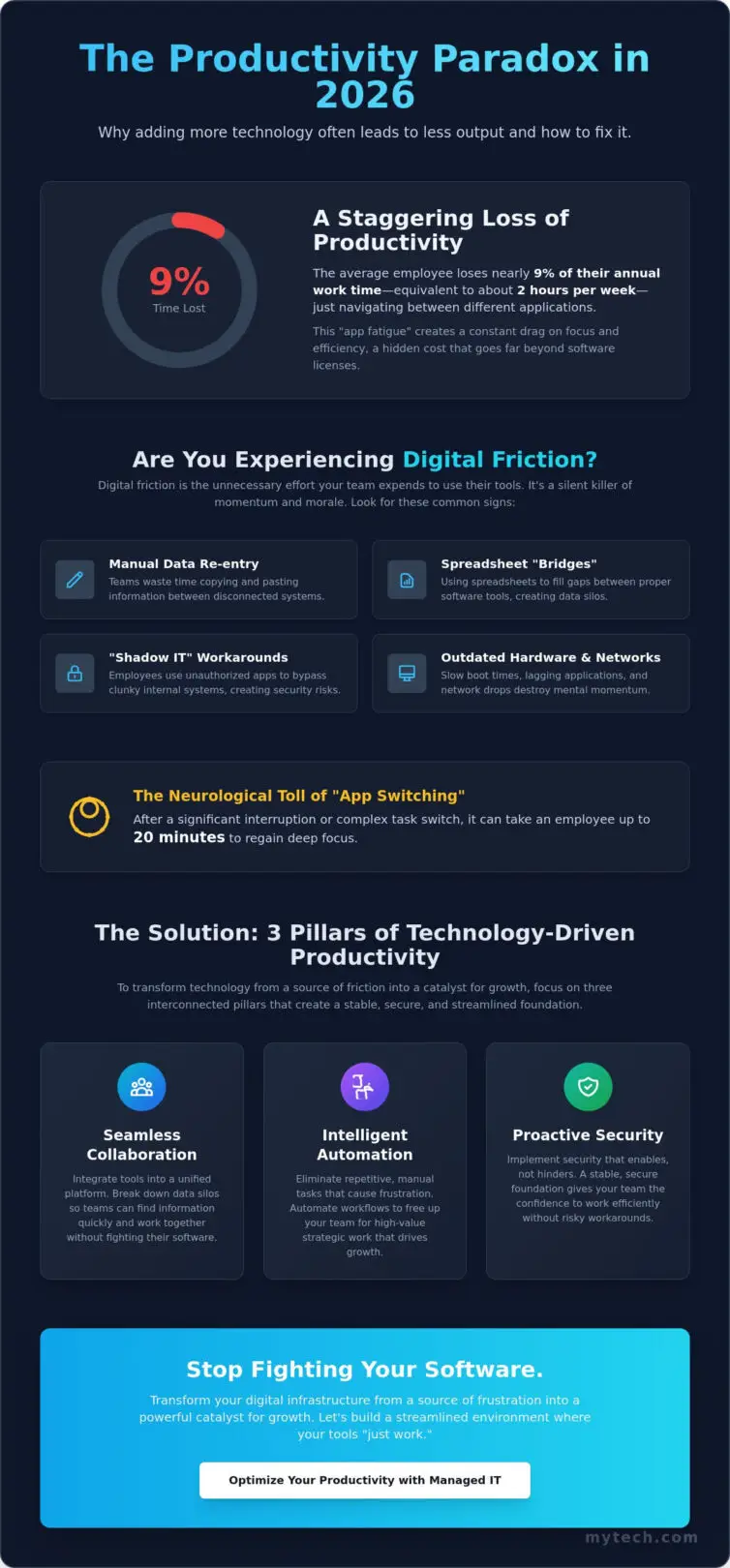
Digital friction is the unnecessary effort employees exert to use their work tools. You can spot this friction by looking for manual data entry between systems or teams that rely on spreadsheets to bridge gaps between software. Outdated hardware and slow network speeds also act as silent productivity killers. When a computer takes several minutes to boot or an application lags during a client call, the mental momentum is lost. We see this as a foundational issue that prevents even the most dedicated employees from reaching their potential.
The High Cost of the “App Switch”
Recent data from February 2026 suggests that employees lose about two hours per week specifically to “app fatigue.” This happens when workers are forced to toggle between dozens of tabs and programs to complete a single task. Research from WifiTalents indicates that the average worker spends nearly 9% of their annual work time just navigating different applications. This is a massive drain on resources that often goes unnoticed by executive leadership.
Every time an employee switches context, it takes time for their brain to refocus. Some studies suggest it can take up to 20 minutes to regain deep focus after a significant interruption or a complex task switch. This is why improving employee productivity with technology requires moving toward unified platforms. Instead of a dozen disconnected tools, your team needs a secure, integrated environment that just works. This stability allows them to stop managing software and start driving organizational growth.
The Three Pillars of Technology-Driven Productivity in 2026
Achieving a high-performance work environment requires more than just buying the latest software. To see real results, we focus on three essential pillars: seamless collaboration, intelligent automation, and proactive security. When these elements work in harmony, they create a “frictionless” experience where technology supports the team rather than getting in their way. Success in improving employee productivity with technology depends on how these pillars interact to reduce the mental load on your staff.
While many leaders view security as a necessary speed bump, we treat it as a productivity enabler. Proactive security ensures that protection doesn’t create roadblocks. If security protocols are too cumbersome, employees will naturally seek workarounds, which leads back to the risks of Shadow IT. By building a secure foundation that “just works,” you provide your team with the confidence to move quickly without fear of data loss or system downtime. Understanding technology’s role in the employee experience is vital here; a secure, stable system is the bedrock of a positive and efficient workplace.
Maximizing Microsoft 365 for Seamless Collaboration
Most businesses use only a fraction of their available tools. We help organizations move beyond simple email by shifting workflows into Microsoft Teams and SharePoint. This transition significantly reduces internal email volume and centralizes communication. Real-time co-authoring allows multiple team members to work on a single document simultaneously, which completely eliminates version control issues. For a deeper look at how integrated systems support your team, see our A Comprehensive Guide to IT Support and Managed Services in 2026.
Intelligent Automation and AI Integration
As of 2026, 80% of employees are already using AI at work to boost their output. We leverage tools like Power Automate to bridge gaps between disparate software systems, handling the repetitive, low-value tasks that drain your team’s energy. AI assistants now play a crucial role in drafting communications, summarizing lengthy meetings, and performing complex data analysis. However, automation is only effective when it’s built on a clean, secure data foundation. Without proper data hygiene, AI tools can produce unreliable results. If you want to ensure your systems are ready for these advancements, our team can provide strategic IT consulting to align your tools with your business goals.
By focusing on these three pillars, you transform your IT from a cost center into a strategic asset. This holistic approach ensures that improving employee productivity with technology is a sustainable, long-term achievement for your organization.
Evaluating Your Tech Stack: Tool Fatigue vs. Strategic Alignment
Many organizations fall into the trap of building a “feature-rich” tech stack that lacks a clear purpose. While a software suite might boast hundreds of capabilities, those features only add value if they solve specific operational challenges for your team. Success in improving employee productivity with technology isn’t measured by the number of subscriptions on your balance sheet. Instead, it’s defined by how well those tools align with your daily workflows. We recommend conducting a regular “Value Audit” to identify underutilized software and eliminate the “digital weight” that slows your organization down.
In 2026, the value of a tool is no longer determined by its individual performance in a vacuum. The most effective systems are those that integrate seamlessly with your existing infrastructure. When your CRM, communication platforms, and project management tools talk to each other, you remove the manual data entry that drains employee energy. Industry experts often highlight specific strategies for increasing employee productivity that focus on providing better, more integrated tools rather than simply adding more of them. Consolidating your stack reduces both licensing costs and the cognitive load on your staff.
Single-Purpose Apps vs. Integrated Ecosystems
Managing ten “best-in-class” apps often creates more overhead than it’s worth. Each standalone platform requires separate login credentials, distinct security configurations, and unique training sessions. This fragmentation creates significant security risks, as sensitive user data becomes spread across dozens of unmanaged platforms. By moving toward an integrated ecosystem, you simplify your security posture and drastically reduce the training burden on new hires. A unified environment allows your team to master one interface rather than ten, leading to faster onboarding and fewer technical errors.
Aligning Technology with Business Growth Goals
To move beyond tool fatigue, IT strategy must have a permanent seat at the executive table. Your technology should not be an afterthought; it is a primary driver of your business objectives. We work with leadership teams to create a technology roadmap that anticipates scaling challenges before they disrupt operations. This proactive approach ensures that your infrastructure grows alongside your company, providing a stable foundation for long-term success. For more insights on building a resilient plan, explore The Strategic Guide to IT Support and Services in 2026. By aligning your digital assets with your growth goals, you ensure that improving employee productivity with technology remains a strategic advantage rather than a constant struggle.
A Roadmap for Improving Productivity Through Technology Optimization
Transforming your organization’s digital environment requires a disciplined, step-by-step approach. We’ve established that improving employee productivity with technology isn’t about adding more tools; it’s about refining the ones you have. This roadmap provides a clear path to move from a reactive, fragmented state to a proactive, integrated foundation. By following these five steps, you ensure that every technical investment directly supports your primary business objectives.
- Step 1: Conduct a comprehensive IT infrastructure and security assessment. You can’t optimize what you haven’t measured. We begin by identifying bottlenecks in your current network and potential vulnerabilities in your security posture.
- Step 2: Identify and eliminate redundant or underutilized software. Building on the value audit discussed earlier, this step involves culling applications that overlap in functionality or fail to meet engagement benchmarks.
- Step 3: Standardize hardware and software across the organization. Uniformity reduces the support burden and ensures that every team member has a consistent experience, regardless of their location or role.
- Step 4: Implement a continuous training and feedback loop with employees. Technology only provides value when people know how to use it effectively. Regular check-ins help identify new areas of digital friction.
- Step 5: Partner with a Managed Service Provider for ongoing proactive maintenance. Professional oversight ensures your systems remain stable and secure, stopping downtime before it impacts your team’s output.
If you’re ready to begin this transition, our team offers Managed IT Services to handle the technical heavy lifting while you focus on organizational growth.
The Critical Importance of Employee Training
Even the most sophisticated tools fail to deliver results without a culture of continuous learning. We’ve observed that technology ROI is capped by the proficiency of the person using it. To overcome this, we recommend delivering bite-sized, relevant tech training that fits into a busy workday. Short, focused sessions on specific Microsoft 365 features or automation workflows are far more effective than annual, day-long seminars. This approach keeps your team’s skills sharp without causing “training fatigue.”
Measuring the Success of Your Productivity Tech
In 2026, forward-thinking leaders are moving beyond “hours worked” as a metric. We focus on outcome-based productivity, which prioritizes the value created rather than the time spent at a desk. To measure this, you should track help desk ticket volume as a leading indicator of digital friction. A spike in tickets often signals that a tool is causing more frustration than it’s worth. Additionally, using regular surveys to measure the “Digital Employee Experience” (DEX) provides qualitative data on how your technology foundation supports or hinders daily work. These insights allow us to make data-driven adjustments that keep your team moving forward.
Strategic IT Partnerships: Accelerating Productivity in Minneapolis, Denver, and Beyond
Many business leaders inadvertently find themselves acting as part-time IT managers. This “IT burden” pulls focus away from core objectives and stalls organizational growth. When you spend your afternoon troubleshooting a network glitch or researching software licenses, you aren’t leading your team. We believe that improving employee productivity with technology is only possible when leadership is free to focus on strategy. By partnering with a seasoned guide, you remove operational stress and regain the confidence that comes from a stable foundation.
Proactive maintenance is the cornerstone of this stability. Instead of waiting for a system to fail, we identify and resolve issues before they disrupt your team’s workflow. This shift from reactive to proactive care stops downtime before it stops your people. It ensures that your technology remains a catalyst for success rather than a recurring frustration. For businesses in competitive markets, this reliability provides a significant edge. Local presence in cities like Denver or San Antonio provides a level of strategic consulting that national SaaS brands cannot match. We understand the regional business landscape, which allows us to provide more relevant, actionable advice that aligns with your specific market.
From “Fix-It” IT to Strategic Business Alignment
The difference between a reactive help desk and a proactive technology partner lies in the depth of the relationship. While a help desk fixes what is broken, a strategic partner helps you plan for what is next. A vCIO (virtual CIO) acts as a high-level advisor for SMBs in Minneapolis, helping them navigate the complex digital landscapes of 2026. This role ensures that your IT budget isn’t just a list of expenses, but a series of strategic investments. We help you align your digital assets with your long-term roadmap, ensuring that every tool serves a purpose. For more specific insights into the Twin Cities market, see our Managed IT Services Minneapolis: The Strategic Guide for 2026.
Building a Stable Foundation for Future Success
We believe that robust cybersecurity is the prerequisite for sustainable employee productivity. If your team is constantly navigating clunky security workarounds or worrying about data breaches, they cannot maintain their focus. Our Managed Security Services provide the protection your team needs without creating unnecessary roadblocks. Combined with Business Continuity & Disaster Recovery, this ensures that your organization never loses its momentum. Stability creates the freedom your team needs to innovate and grow. We are ready to help you build this foundation and lead your digital transformation. If you want to see where your current systems stand, schedule a strategic technology assessment with Mytech Partners today. Together, we can ensure that improving employee productivity with technology becomes a permanent part of your organizational culture.
Transforming Your Digital Foundation for 2026
Success in the modern workplace requires a shift from simply acquiring tools to mastering strategic alignment. We’ve explored how improving employee productivity with technology depends on removing digital friction and building a stable, secure foundation. By focusing on integrated ecosystems rather than fragmented apps, you provide your team with the freedom to focus on high-level strategy. This transition isn’t just about software; it’s about creating a culture where technology serves as a silent partner in your organizational success.
Since 2000, Mytech Partners has served as a seasoned guide for businesses in Minneapolis, Denver, Dallas, and beyond. Our consultative approach prioritizes your long-term health through deep expertise in Microsoft 365 optimization and proactive cybersecurity. We’re ready to help you move beyond the productivity paradox and achieve measurable output gains. Empower your team with a strategic technology assessment from Mytech Partners today. We look forward to helping you build a resilient, forward-thinking environment where your people can truly thrive.
Frequently Asked Questions
How does technology actually improve employee productivity?
Technology improves output by automating repetitive tasks, centralizing information, and facilitating seamless collaboration. When tools are integrated, they remove the manual “busy work” that distracts employees from high-value objectives. By providing a stable foundation, technology allows your team to focus their mental energy on strategy and growth rather than technical troubleshooting. This shift creates a more purposeful and efficient work environment for everyone involved.
What are the best tools for improving employee productivity in 2026?
The most effective tools in 2026 are integrated ecosystems like Microsoft 365, which combine communication, document management, and automation. Leveraging Power Automate for workflow bridging and specialized AI assistants for data analysis are also top strategies. Rather than seeking isolated apps, focus on tools that offer deep integration and robust security features to minimize digital friction and simplify the daily user experience.
Can too much technology decrease productivity?
Yes, excessive technology often leads to “tool fatigue” and increased digital friction. When employees must switch between too many disconnected applications, they lose significant time to context switching. This fragmentation creates data silos and increases the training burden. True success in improving employee productivity with technology comes from a lean, purpose-built tech stack rather than a high volume of disconnected software subscriptions.
How do I measure the ROI of my technology investments?
Measure ROI by tracking outcome-based metrics such as project completion rates, response times, and employee engagement scores. You should also monitor technical indicators like help desk ticket volume and system uptime. If a new tool reduces the time spent on manual data entry or decreases technical interruptions, it’s providing a tangible return on investment. Strategic consulting can help you define these success markers more clearly.
What is the first step in optimizing my business tech stack?
The first step is conducting a comprehensive IT infrastructure and security assessment to identify current bottlenecks. You must understand how your team currently uses their tools and where they encounter the most frustration. This data-driven approach allows you to make informed decisions about which software to keep, consolidate, or eliminate based on actual business needs. It ensures your roadmap is built on a solid understanding of your unique environment.
How does remote work technology impact productivity?
Remote work technology impacts productivity by providing the flexibility and tools necessary for deep work outside a traditional office. 2026 research confirms that remote workers often log more productive minutes per day when supported by secure cloud services and integrated collaboration platforms. However, this success depends on having a stable technical foundation that prevents isolation and ensures seamless access to all necessary shared organizational resources.
Is AI really going to make my employees more productive?
Harnessing AI is a vital part of improving employee productivity with technology in 2026. AI can significantly boost output when it’s used to handle low-value, repetitive tasks like drafting summaries or analyzing large datasets. For AI to be effective, it must be built on a clean data foundation and integrated into existing tools to avoid adding to the training burden. Strategic implementation is the key to seeing real results.
Why should I use a Managed Service Provider instead of handling IT in-house?
A Managed Service Provider offers a level of proactive maintenance and strategic consulting that is difficult to maintain with a small in-house team. We focus on stopping downtime before it happens and aligning your technology with long-term growth goals. This partnership removes the “IT burden” from your leadership, allowing you to prioritize organizational health while we ensure your digital foundation remains secure, stable, and ready for future challenges.