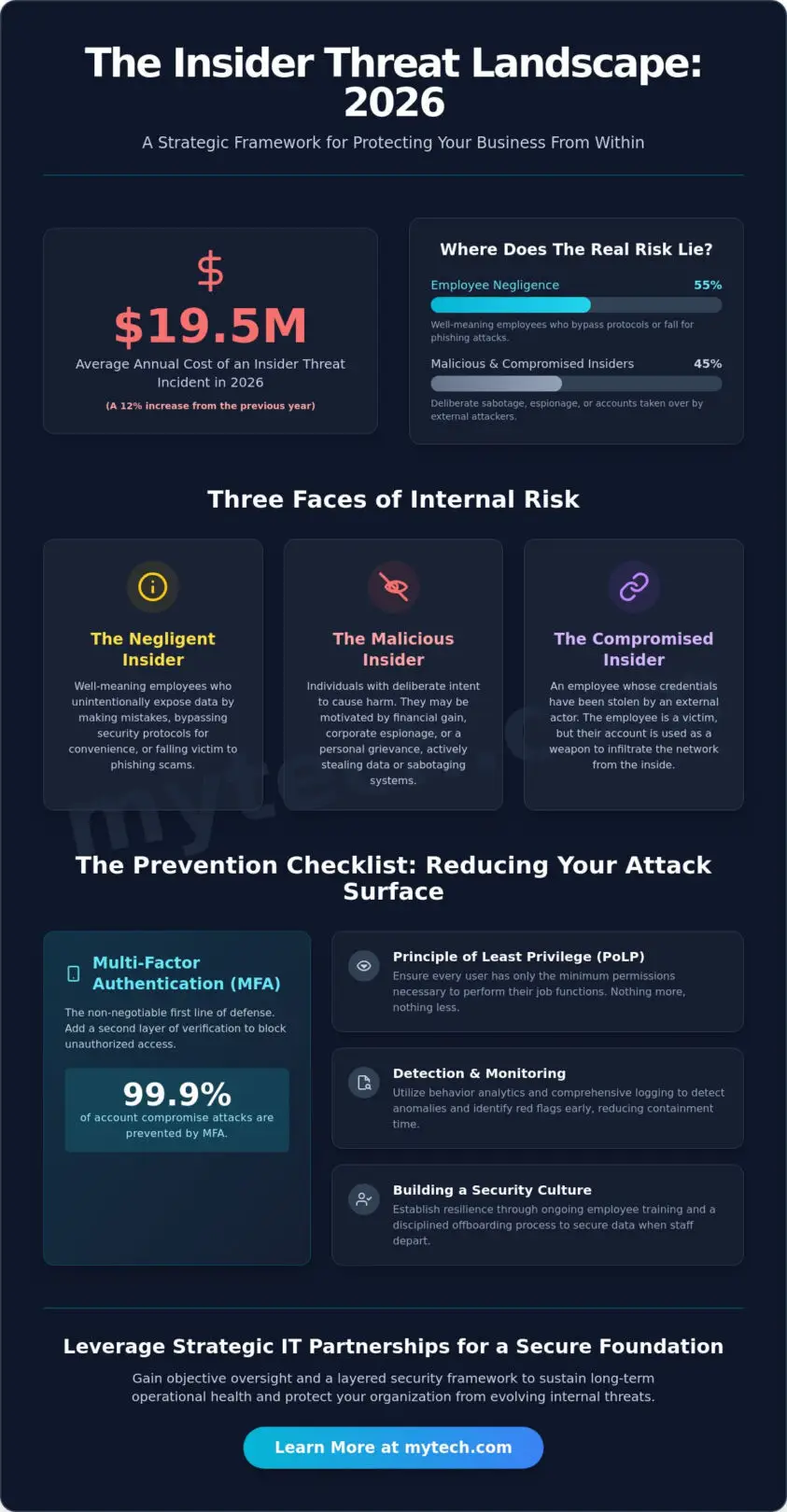
Did you know that the average annual cost of an insider threat has climbed to $19.5 million in 2026? It’s a staggering figure that highlights why learning how to protect business from insider threats has become a top priority for executive leadership. While external cyberattacks often grab the headlines, 55% of internal incidents actually stem from simple employee negligence rather than malice. This means your greatest vulnerability might not be a distant hacker, but a well-intentioned staff member making a single mistake.
It’s natural to feel a bit overwhelmed by complex security jargon or the fear that stricter protocols might damage the trust you’ve built with your team. You want a secure environment, but you also need your staff to feel empowered, not policed. We understand that effective security should act as a catalyst for success, providing the stable foundation your organization needs to innovate without fear.
This article provides a proactive strategic framework to safeguard your organization’s data and reputation by identifying, preventing, and responding to internal risks. You’ll gain a clear roadmap to secure your internal data through a balanced approach that maintains employee trust while ensuring full compliance with the latest 2026 industry standards.
Key Takeaways
- Identify the three distinct categories of internal risk, including negligent, malicious, and compromised insiders, to better understand your organization’s vulnerabilities.
- Implement technical safeguards like Multi-Factor Authentication and the Principle of Least Privilege to learn how to protect business from insider threats effectively.
- Utilize behavior analytics and comprehensive logging to detect anomalies early, significantly reducing the time it takes to contain potential security incidents.
- Build a resilient security culture through ongoing employee training and a disciplined offboarding process that secures sensitive data when staff members depart.
- Leverage strategic Managed IT partnerships to gain the objective oversight and layered security framework needed to sustain long-term operational health.
Understanding the Insider Threat Landscape in 2026
An insider threat isn’t always a shadowy figure attempting to sabotage your operations from a dark corner. Most often, it’s a trusted colleague, a former contractor, or a strategic partner. For a comprehensive overview of insider threats, we must look at any individual with legitimate credentials who causes harm to the organization. Unlike external attackers who must bypass perimeter defenses, insiders already have the keys to your most sensitive data. This makes detection incredibly difficult because their movements often mimic standard daily workflows. When an authorized user accesses a database, it doesn’t trigger the same alarms as a brute-force attack from an unknown IP address.
The risk profile has evolved rapidly as hybrid work becomes the standard for professionals in cities like Denver. Security teams no longer manage a single physical office; they manage a distributed network of home routers, public Wi-Fi connections, and personal devices. This decentralized environment creates new blind spots for IT departments. Understanding this shift is the first step in learning how to protect business from insider threats effectively. It requires a move away from traditional perimeter security toward a model that focuses on identity and behavior.
Malicious vs. Negligent: Where the Real Risk Lies
The “insider” label covers a broad spectrum of behavior, and it’s vital to distinguish between intent and accident. Malicious insiders act with deliberate intent, often driven by financial gain, corporate espionage, or workplace grievances. They might steal trade secrets or sabotage systems before departing for a competitor. However, 55% of incidents in 2026 involve negligent insiders. These are well-meaning employees who bypass security protocols for convenience or fall victim to sophisticated phishing. There is also the compromised insider, where an external actor steals legitimate credentials to move laterally through your network. In this case, the employee is a victim, but their account becomes the weapon.
The Business Impact of Internal Security Breaches
The fallout from an internal breach goes far beyond a temporary IT headache. Organizations face an average annual cost of $19.5 million per incident in 2026, which is a 12% increase from the previous year. Beyond the immediate financial drain of recovery and intellectual property theft, the long-term reputational damage can be devastating. Clients lose trust when they realize their data was exposed by someone within your own organization. Additionally, regulatory bodies governing HIPAA or GDPR do not distinguish between external hacks and internal mistakes. Fines for non-compliance can cripple a growing enterprise, making a proactive strategy essential for long-term health.
The Prevention Checklist: Reducing Your Attack Surface
Prevention starts with a shift in perspective. Instead of reacting to crises, we focus on shrinking the available attack surface. This proactive stance is essential for any leader wondering how to protect business from insider threats without eroding organizational culture. By establishing clear boundaries and automated safeguards, you create an environment where the right people have the right access at the right time; nothing more and nothing less. This structure doesn’t just block malicious actors; it provides a safety net for well-meaning employees who might otherwise make a costly mistake.
The bedrock of this approach is the Principle of Least Privilege (PoLP). It ensures that every user, from the CEO to the newest intern, only possesses the permissions necessary to perform their specific job functions. When combined with Multi-Factor Authentication (MFA), you create a formidable barrier. MFA is no longer optional; it’s the non-negotiable first line of defense that prevents 99.9% of account compromise attacks. For those seeking a deeper dive into these frameworks, the CISA Insider Threat Mitigation Guide provides a robust foundation for building these programs within your own organization.
Technical Controls to Implement Today
Automated technical controls remove the burden of security from your employees’ shoulders. Implementing automated password rotation and sophisticated credential management ensures that even if a password is leaked, its lifespan is limited. For businesses with remote teams in Minneapolis or Dallas, hardening endpoints is a critical priority. This includes enforcing encryption on company-issued laptops, disabling physical USB ports to prevent unauthorized data transfers, and restricting access to unapproved cloud storage platforms. Standardizing your environment through Microsoft 365 optimization allows you to apply these security protocols consistently across your entire workforce, regardless of where they log in.
Identity and Access Management (IAM)
Identity is the new perimeter. Implementing Single Sign-On (SSO) doesn’t just make life easier for your staff; it gives your IT team centralized visibility into every login attempt. We recommend a Role-Based Access Control (RBAC) framework to automate permissions based on job titles. This structure simplifies the process of regular access reviews by ensuring that permission creep doesn’t happen when employees change roles. Implementing these IAM strategies is a cornerstone of how to protect business from insider threats in a scalable way. If your current team is stretched thin, our Managed Security Services can provide the objective oversight and technical execution needed to keep these controls current and effective.
Detection and Monitoring: Identifying Red Flags Early
Prevention builds the walls, but detection acts as the security cameras that ensure no one is misusing their access. Even with the best controls in place, a proactive organization must maintain constant visibility over its digital environment. Effective detection isn’t about a lack of trust; it’s about creating a central nervous system that can sense anomalies before they escalate into a crisis. This layer of oversight is a critical part of how to protect business from insider threats, as it allows you to distinguish between standard daily operations and suspicious deviations.
User and Entity Behavior Analytics (UEBA) has become a cornerstone of modern security. Rather than relying on rigid, easily bypassed rules, UEBA uses machine learning to understand what “normal” looks like for every individual in your company. If a staff member who typically handles marketing files suddenly begins querying sensitive financial databases, the system flags the behavior for review. This automated intelligence works alongside robust logging and auditing. By keeping a detailed record of who touched what data and when, you create a transparent trail that simplifies incident response and ensures accountability across the board.
We also have to address the risk of Shadow IT. When employees use unapproved applications or personal cloud storage to complete their tasks, they create blind spots that bypass your security stack. These unauthorized tools often serve as the primary exit point for sensitive data. Bringing these activities into the light requires a balance between continuous monitoring and employee privacy. You don’t need intrusive surveillance to be secure. Instead, focus on monitoring the data and the systems rather than the individual’s every move. For leaders looking to build this balance, CISA’s Insider Threat Mitigation Guide provides an excellent framework for establishing a program that protects the organization while respecting the workforce.
Behavioral Red Flags to Watch For
- Login anomalies: Access attempts at 3 AM from a local Denver IP when that employee typically works a standard 8-to-5 schedule.
- Data movement: Sudden bulk downloads of proprietary client lists or the mass deletion of shared project files.
- Boundary testing: Frequent and unsuccessful attempts to access directories or folders that fall outside an employee’s specific role-based permissions.
Technical Indicators of Compromise
- Permission shifts: Accounts suddenly gaining administrative privileges or changed access levels without an approved IT ticket.
- Unauthorized software: The appearance of network scanners or remote access tools on workstations that don’t require them for business functions.
- Traffic spikes: Large, anomalous bursts of data being sent to personal Gmail accounts or external storage sites like Dropbox.
The Human Layer: Culture, Training, and Lifecycle
Technology establishes the framework, but your workforce is the primary occupant of that digital space. While we’ve detailed technical controls and monitoring strategies, the human layer remains the most dynamic variable in your security posture. Whether your team is operating in cities like Long Beach or San Antonio, building a resilient culture means moving beyond software and focusing on the individuals who interact with your data daily. Learning how to protect business from insider threats requires a comprehensive look at the employee lifecycle, ensuring every stage is handled with consistent discipline.
Security awareness training should be an ongoing dialogue rather than a tedious annual requirement. We recommend frequent, punchy sessions that help staff recognize social engineering or subtle account anomalies in real time. This approach fosters a “See Something, Say Something” environment where employees feel empowered to report mistakes without fear of retribution. When HR and IT work in lockstep, you can identify potential grievances or stress points early. This collaboration allows for a strategic response that protects the organization while supporting the long-term health of your partners and staff.
Strategic Offboarding Checklist
The moment a staff member decides to depart, their access profile becomes a potential vulnerability that requires immediate attention. Managing the critical 24 hours after a resignation or termination is essential for maintaining your data integrity. We recommend a disciplined approach to closing these loops:
- Immediate Revocation: Disable all primary logins, VPN access, and cloud permissions the moment a departure is finalized.
- Asset Recovery: Secure company-issued hardware, including laptops and mobile devices, along with physical access badges.
- Final Activity Audit: Review final-week activity for any unusual data movement or unauthorized file transfers to personal accounts.
Hiring for Security
Security starts with the first interview. Integrating your expectations into the onboarding process sets a professional and disciplined tone from day one. Consider these foundational steps:
- Background Vetting: Perform standard background checks for all roles that require access to sensitive client systems.
- Security Expectations: Clearly outline acceptable use policies and data handling responsibilities during the initial onboarding week.
- Periodic Reviews: Re-evaluate security clearances for sensitive roles as job responsibilities and access needs evolve over time.
If your current policies feel outdated for the 2026 landscape, the Mytech Partners Strategic IT Consulting team can help you build a human-centric framework that protects your long-term success and operational freedom.
Strategic Alignment: How Managed IT Secures Your Foundation
While internal IT teams handle the daily operational grind, an external partner provides the objective oversight necessary for a rigorous security posture. We bring a disciplined perspective that internal departments often lack simply because they’re too close to the people and processes they monitor. This separation of duties is a fundamental strategy for anyone exploring how to protect business from insider threats without creating friction within the team. By acting as a neutral third party, we ensure that auditing remains consistent, unbiased, and focused on the long-term health of the organization.
We view layered security as a catalyst for success rather than a series of roadblocks. When your infrastructure is built on a stable, secure foundation, your leadership team gains the confidence to innovate and expand into new markets. Our vCISO services transition your organization from reactive firefighting to a purposeful technology roadmap. This long-term alignment ensures that every tool you implement serves a specific business objective while simultaneously hardening your defenses against internal risks. It’s about creating an atmosphere where operational tools aren’t just assets to manage, but drivers of growth.
The Mytech Partners Approach to Insider Risk
Our methodology prioritizes the stability of your organization by aligning technical controls with your specific operational goals. Whether you’re scaling in Denver or optimizing a distributed workforce across Texas, we provide the calm authority needed to navigate sensitive security challenges. By utilizing managed it services minneapolis, you gain access to proactive monitoring that identifies anomalous behavior before it impacts your reputation. This partnership-focused model ensures your security posture stays ahead of the evolving 2026 threat landscape while maintaining the freedom your team needs to perform.
Next Steps for Your Organization
Securing your future begins with a clear baseline of your current digital environment. We recommend starting with a comprehensive assessment to identify where your data is most vulnerable and where permission creep has occurred. This provides the clarity needed to implement the strategic roadmap we’ve discussed throughout this guide. If you’re ready to move from uncertainty to operational freedom, it’s time to contact a managed service provider near me for a strategic consultation. We’re here to lead you through the complex digital landscape with the experience and discipline your organization deserves.
Building a Resilient Foundation for Your Growth
We have navigated the complexities of the modern threat landscape, from the initial technical barriers to the critical human layer. By integrating these strategies, you move beyond simple compliance and toward a state of true organizational resilience. This proactive approach alleviates the stress of the unknown, giving your leadership team the freedom to focus on primary objectives while knowing that your data remains secure within a stable framework. A secure foundation is not just about stopping risks; it is about creating the confidence to move forward with optimism.
Mastering how to protect business from insider threats is a shared journey that requires both tactical expertise and strategic vision. With over 20 years of experience in strategic IT consulting, we provide the seasoned guidance necessary to lead your organization through these complex digital landscapes. Our local support teams in Minneapolis, Denver, and Texas are committed to a proactive, security-first approach that ensures your managed services act as a catalyst for long-term success rather than a hindrance to your daily operations.
Take the next step toward a more secure and purposeful future. Secure your business foundation; connect with a Mytech Partners strategist today. We are genuinely invested in the long-term health of your organization and ready to help you build a stable environment where your technology and your people can thrive together.
Frequently Asked Questions
What is the most common type of insider threat?
The negligent insider remains the most frequent source of risk for modern organizations. In 2026, 55% of all internal security incidents stem from well-meaning employees who accidentally expose data through phishing or poor password hygiene. These individuals don’t intend to cause harm, but their actions create significant vulnerabilities. Identifying these gaps allows you to focus on education rather than just enforcement.
How can I detect an insider threat without spying on my employees?
You can maintain high visibility by focusing on data movement and system access rather than individual personal activities. User and Entity Behavior Analytics (UEBA) tools identify anomalies, such as bulk downloads or off-hours access, without monitoring private communications. This approach protects your sensitive information while respecting the trust and privacy of your workforce. It’s a strategic way to learn how to protect business from insider threats while maintaining a positive culture.
Does Microsoft 365 have built-in protection against insider threats?
Microsoft 365 offers a robust suite of integrated security tools designed to mitigate internal risks. Features like Data Loss Prevention (DLP) and Microsoft Purview allow you to flag sensitive information before it leaves your network. We specialize in Microsoft 365 Optimization to ensure these tools are correctly configured to meet your specific compliance needs. This creates a stable foundation that automates much of your defensive strategy.
What should I do if I suspect an employee is stealing data?
If you suspect data exfiltration, your first step should be to activate your pre-defined incident response plan. Avoid confronting the individual immediately; instead, work with your IT team to preserve digital evidence and document all suspicious activity. Consult your legal and HR departments to ensure your response aligns with employment laws. A calm, disciplined approach prevents further damage while securing the necessary information for a formal investigation.
How often should we conduct security awareness training?
We recommend moving away from annual sessions in favor of a continuous, monthly training model. Shorter, frequent micro-learnings keep security at the forefront of your employees’ minds without causing training fatigue. Regular phishing simulations also provide practical experience in identifying threats. This ongoing cadence transforms your staff into a proactive defense layer that evolves alongside the shifting digital landscape of 2026.
What is the “Principle of Least Privilege” and why does it matter?
The Principle of Least Privilege is a security framework where users only receive the minimum access levels necessary to perform their job functions. It matters because it significantly reduces your attack surface. If an account is compromised, the potential damage is limited to only the data that specific user could access. Implementing this model is a cornerstone of how to protect business from insider threats effectively.
Can a managed service provider help with insider threat detection?
A managed service provider offers the objective oversight and specialized tools that internal teams often lack. We provide constant monitoring and advanced analytics to spot behavioral red flags that might otherwise go unnoticed. This partnership allows your leadership team to focus on growth while we maintain a secure operational foundation. Our Managed Security Services act as a strategic extension of your organization, providing expert guidance through complex digital landscapes.
Is an insider threat always an employee?
An insider threat is defined by access, not just employment status. This category includes contractors, vendors, and strategic partners who have legitimate credentials to enter your systems. It also encompasses compromised insiders, where an external attacker steals a legitimate user’s login details. Recognizing this broader definition is essential for building a comprehensive security program that accounts for every identity within your digital ecosystem.