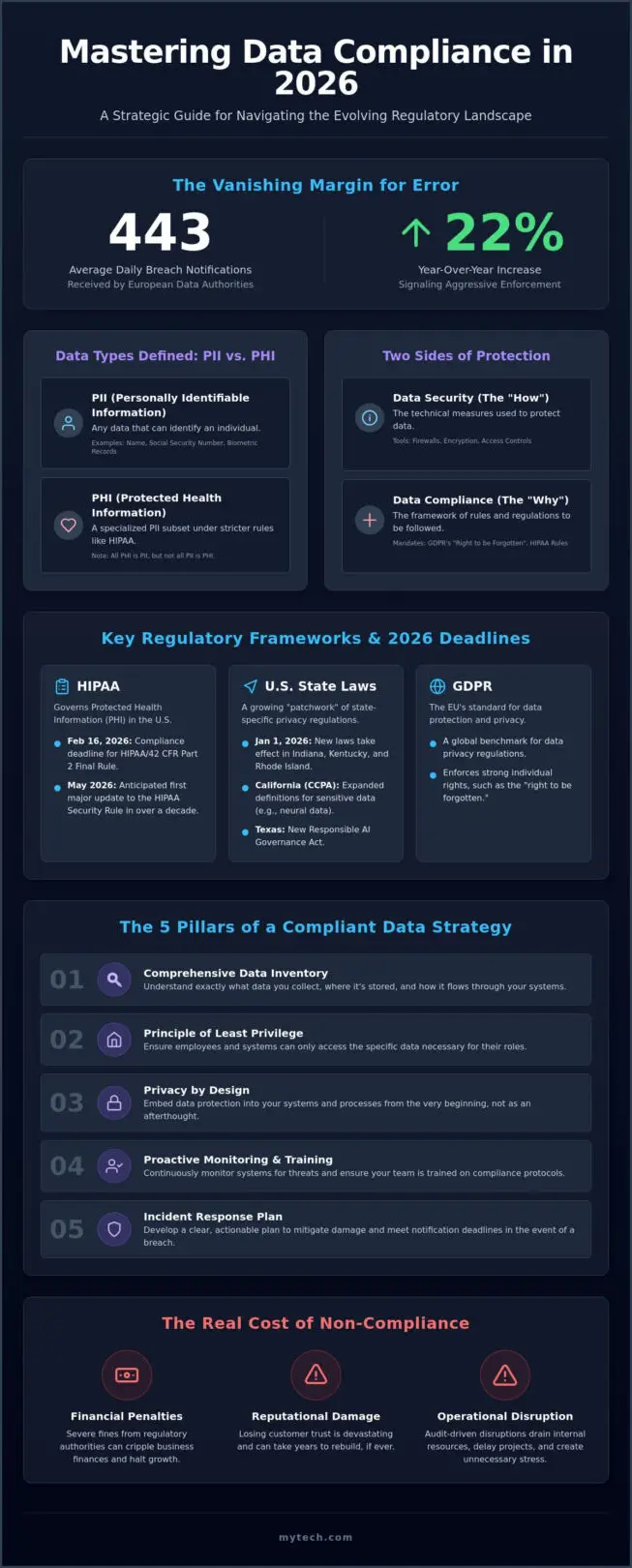
Did you know that European data protection authorities now receive an average of 443 breach notifications every single day? This 22% year over year increase proves that the margin for error in data management has vanished. You’re likely feeling the pressure of the growing patchwork of U.S. privacy laws, especially with new regulations in states like Indiana and Kentucky taking effect in 2026. Managing the evolving compliance requirements for handling customer data often feels like a moving target that drains your internal resources and creates unnecessary risk.
We’re here to help you transform that operational stress into a strategic advantage. This guide will show you how to master the complex regulatory landscape and implement a secure, compliant framework that protects your business and your reputation. We will explore the latest legislative shifts, including California’s expanded sensitive data definitions and the updated HIPAA Security Rule. By the end of this article, you’ll have a repeatable strategy to ensure your organization remains resilient, trustworthy, and ready for future growth.
Key Takeaways
- Discover how to navigate the complex compliance requirements for handling customer data by distinguishing between PII and PHI to ensure every record is governed correctly.
- Gain clarity on major regulatory frameworks like HIPAA, CCPA, and GDPR, understanding how regional legislative shifts impact your nationwide operations.
- Learn to implement the five pillars of a secure data strategy, starting with a comprehensive data inventory and the principle of least privilege.
- Identify the true financial and operational costs of non-compliance and how proactive monitoring prevents audit-driven disruptions.
- Explore how strategic partnerships with managed IT experts provide the continuous oversight needed to maintain a stable, growth-oriented foundation.
Understanding Compliance Requirements for Handling Customer Data in 2026
Data compliance is no longer a static checklist or a back-office burden. In 2026, we define it as the strategic management of sensitive information to meet both rigorous legal mandates and evolving ethical standards. It’s the framework that allows your business to operate with confidence. To master the compliance requirements for handling customer data, you must first recognize that this discipline covers everything from how you collect a single email address to how you store complex medical histories.
A foundational step involves distinguishing between different types of data. Personally Identifiable Information (PII) includes any data that can identify an individual, such as names, social security numbers, or biometric records. Protected Health Information (PHI) is a more specialized category governed by stricter rules like HIPAA. While all PHI is technically PII, the reverse isn’t true. Misclassifying these data sets often leads to significant regulatory gaps. Developing a deep understanding of information privacy ensures your team treats every piece of data with the specific level of care it requires.
The year 2026 marks a turning point because of AI-driven data processing. Automation now handles data at a scale and speed that manual audits can’t match. This reality demands a proactive approach. You can’t simply react to a breach; you must anticipate risks before they manifest. This is why “Privacy by Design” has become the modern standard for business IT. It means embedding data protection into your systems from the very first line of code or the initial setup of a new database.
The Difference Between Data Security and Data Compliance
Security and compliance are two sides of the same coin, but they serve different purposes. Security is the technical “how.” It involves tools like firewalls, encryption, and Managed Security Services. Compliance is the regulatory “why.” It’s possible to have a perfectly secure system that is still non-compliant. For example, your encryption might be unbreakable, but if you fail to honor a customer’s “right to be forgotten” under GDPR, you’re in violation. These disciplines must work in tandem to provide total business protection.
Why Compliance Matters for Your Business Growth
Strategic compliance acts as a powerful differentiator. When you can prove high levels of data integrity, you win larger contracts and build deeper trust with sophisticated partners. It alleviates the operational stress that usually accompanies an audit. Instead of scrambling for documentation, you rely on a stable foundation of organized records. This transparency allows you to lead your market with a sense of calm authority, knowing your growth is built on a secure and ethical base.
Major Regulatory Frameworks: HIPAA, CCPA, and GDPR
The regulatory environment in 2026 has transitioned from a period of introduction to one of aggressive enforcement. For organizations managing compliance requirements for handling customer data, the challenge lies in a fragmented landscape where state, federal, and international rules often overlap. While the proposed SECURE Data Act aims to create a national standard, businesses must currently navigate a “patchwork” of regulations to remain operational and trustworthy. Standardizing your compliance requirements for handling customer data ensures your business remains resilient against these evolving threats.
HIPAA and Healthcare Data in 2026
Healthcare providers in hubs like Denver and San Antonio face immediate pressure. As of February 16, 2026, all entities must comply with the HIPAA/42 CFR Part 2 Final Rule. This update aligns substance use disorder records with standard HIPAA protections, requiring a single patient consent for future disclosures. We also anticipate the first major update to the HIPAA Security Rule in over a decade by May 2026. These shifts make Business Associate Agreements (BAAs) more critical than ever. Your managed IT partners must sign these agreements to verify they meet the same rigorous standards for protecting electronic PHI (ePHI).
State-Level Privacy Laws: Beyond California
California remains a leader with its January 1, 2026 amendments, which now include neural data and stricter rules for automated decision-making. However, the focus has expanded. New laws in Indiana, Kentucky, and Rhode Island also took effect on New Year’s Day 2026. Texas has introduced its own Responsible Artificial Intelligence Governance Act, prohibiting certain harmful AI uses while applying existing privacy rules to AI-processed data. This fragmentation creates operational stress for businesses serving clients across state lines. We recommend adopting a unified compliant data handling strategy that meets the highest common denominator among these laws.
International reach brings GDPR into play, which saw over €1.2 billion in fines issued in 2025 alone. With the EU AI Act reaching full enforcement in August 2026, the cost of a misstep can reach €35 million. That’s a heavy price for a simple error. For service organizations, achieving SOC 2 Type II status serves as an excellent baseline to prove your commitment to data integrity. If the complexity feels overwhelming, it’s helpful to remember that our Strategic IT Consulting team can help you map out a clear path forward.
The 5 Pillars of a Compliant Data Handling Strategy
Transitioning from understanding laws to implementing them requires a shift in perspective. You can’t protect what you don’t know you have. Establishing a framework for compliance requirements for handling customer data begins with visibility and control. We focus on five core pillars: inventory, access, encryption, retention, and training. These elements create a repeatable system that moves your business from reactive panic to proactive stability.
Step 1: Conduct a Comprehensive Data Audit
A thorough audit uncovers where your data lives, who touches it, and how it moves through your network. A data audit is the essential first step to regulatory clarity. During this process, we often find “shadow IT,” which includes unauthorized apps or personal storage accounts where employees might store customer information without oversight. Mapping these data flows ensures that no sensitive record remains outside your protective umbrella.
Step 2: Implement Robust Access Controls
Once you’ve mapped your data, you must govern who can reach it. We advocate for the principle of least privilege (PoLP). This means employees only have access to the specific files needed for their roles. Multi-Factor Authentication (MFA) is no longer optional; it’s a baseline requirement for modern compliance. By using role-based access control (RBAC), you significantly limit the potential impact of a compromised account. Maintaining detailed logs provides the audit trail regulators expect during a review. For organizations looking to align with federal standards, reviewing the Department of Education’s security and privacy requirements offers a clear look at high-level expectations for access and monitoring.
Step 3: Secure Data Storage and Transmission
Your storage solutions must be as resilient as your policies. Leveraging advanced cloud services allows you to utilize built-in compliance features that are difficult to maintain on-premise. Encryption is the standard here. You must protect data at rest in your databases and in transit during communications. If you still maintain on-premise servers, physical security like locked racks and restricted room access remains a vital part of your compliance requirements for handling customer data strategy.
Finally, address the human element. Your staff can be your greatest vulnerability or your strongest defense. Regular training turns employees into a human firewall, capable of spotting phishing attempts before they lead to a breach. Pair this with a strict retention policy. Keeping data longer than necessary is a liability, not an asset. Dispose of old records securely to ensure your digital footprint remains lean and compliant.
The Real Cost of Non-Compliance: Risks and Objections
Ignoring the compliance requirements for handling customer data often leads to a false sense of security. Many business leaders believe their organization is too small to attract the attention of major regulators. This is a dangerous myth. Automated vulnerability scanners don’t care about your company size or your annual revenue; they search for unpatched systems and exposed databases. If your digital foundation is weak, you become an easy target for both cybercriminals and regulatory audits.
The financial penalties in 2026 have reached unprecedented levels. Regulators issued over €1.2 billion in GDPR fines in 2025 alone, and California recently imposed its largest CCPA fine to date. While these headline-grabbing numbers often focus on enterprises, the impact on a mid-sized business is often more devastating. A single breach can result in a total loss of customer trust that takes years to rebuild, assuming the business survives the initial fallout.
Fines are Only the Beginning
Legal fees and mandatory notification costs often dwarf the initial regulatory fine. You’re required to inform every affected customer, which frequently involves credit monitoring services and public relations management. We call this the “compliance tax.” Fixing a data handling problem after a breach is typically ten times more expensive than implementing the correct framework from the start. Perhaps most importantly, failing to meet compliance requirements for handling customer data can invalidate your cyber insurance policy. If you haven’t followed the agreed-upon safeguards, your carrier may deny your claim, leaving you to cover the entire recovery cost out of pocket.
The Productivity Gap Caused by Poor Compliance
Disorganized data management creates a significant amount of technical debt. When your team spends hours searching for specific records or manually verifying permissions, your productivity stalls. This inefficiency often leads to “panic-compliance.” This is the high-stress scramble that occurs when a major client requests a security audit or a regulator sends a formal inquiry. You can eliminate these operational bottlenecks by integrating strategic IT support into your long-term planning. A stable, compliant environment allows your team to focus on growth rather than damage control. If you’re ready to secure your foundation, our team at Managed Security Services can help you build a resilient strategy.
Strategic Compliance: How Managed IT Services Protect Your Business
Achieving total alignment with the latest compliance requirements for handling customer data is a significant undertaking that doesn’t have to be a solo journey. We position ourselves as a seasoned guide, providing the disciplined oversight needed to lead your organization through complex digital landscapes. By partnering with a Managed IT Services provider, you gain access to a stable, secure foundation. This allows you to focus on your primary business objectives with optimism and clarity, knowing your infrastructure is in expert hands.
Through the vCISO (virtual Chief Information Security Officer) model, we provide high-level strategic leadership and risk management without the burden of an executive salary. Your vCISO ensures that your technology remains tethered to tangible operational outcomes and specific regulatory goals. We help you navigate the 2026 legislative shifts we’ve discussed, such as the updated HIPAA Security Rule or the EU AI Act, with a focus on long-term organizational health rather than short-term fixes.
Proactive Maintenance vs. Reactive Compliance
True security comes from constant vigilance rather than occasional audits. We implement continuous monitoring as a 24/7/365 operational standard to ensure your compliance requirements for handling customer data are always met. This includes automated patching and updates that close vulnerabilities before they’re exploited by automated scanners. Regular security assessments ensure your framework stays current with the evolving legal environment. Our team providing managed IT services in Minneapolis and our other regional hubs offers the local expertise required to understand state-specific nuances while maintaining a global perspective.
Building a Tech Roadmap for Long-Term Compliance
By integrating compliance into your overall business strategy, we turn legal requirements into a catalyst for success. We help you build a comprehensive tech roadmap that scales as your data volume and regulatory needs grow. This proactive planning eliminates the frantic pace of high-pressure fixes and replaces it with a steady, deliberate rhythm of progress. It’s about building a future where your operations are both resilient and flexible, providing the freedom to innovate without fear of a breach.
Next steps are clear. If you’re ready to move from operational stress to a state of calm authority, we’re here to help. We invite you to Schedule a strategic IT assessment with Mytech Partners to begin building your secure, compliant future today.
Build Your Foundation for Secure Growth
Mastering the compliance requirements for handling customer data is the first step toward building a business that thrives on trust and resilience. We’ve explored how the 2026 regulatory environment demands more than just reactive security. It requires a disciplined approach to data inventory, strict access governance, and a proactive posture against emerging threats. By treating compliance as a strategic asset rather than a burden, you create the freedom to innovate without the constant stress of potential audits or breaches.
Since 2000, Mytech Partners has served as a seasoned guide for organizations navigating these complex digital landscapes. We bring decades of experience and deep expertise in HIPAA, SOC 2, and local US privacy laws to every partnership. With proactive managed security services operating across six major US hubs, we ensure your infrastructure remains a catalyst for success. It’s time to move past operational frustration and toward a future of stable, predictable growth.
Secure your business future with a strategic IT assessment from Mytech Partners. We look forward to helping you build a foundation that protects your data and empowers your team.
Frequently Asked Questions
What are the most common compliance requirements for US small businesses?
Most small businesses must follow a combination of state-specific privacy laws and federal consumer protection standards. The compliance requirements for handling customer data often include providing clear privacy notices, honoring opt-out requests, and conducting regular risk assessments. Even if you don’t fall under a specific law like CCPA, the FTC expects you to maintain reasonable security measures to prevent unfair or deceptive practices.
How does GDPR affect a company based in Minneapolis or Denver?
GDPR applies to your business if you offer goods or services to residents in the European Union or monitor their behavior. Geographic location in Minneapolis or Denver doesn’t exempt you if your digital footprint extends overseas. You must ensure you have a lawful basis for processing, provide data portability, and adhere to strict breach notification timelines to avoid the heavy fines issued by European authorities.
Can a managed service provider (MSP) help with HIPAA compliance?
A managed service provider plays a critical role in HIPAA compliance by implementing the technical safeguards required to protect electronic PHI. We sign Business Associate Agreements (BAAs) to formalize our shared responsibility for data integrity. Our Managed Security Services provide the continuous monitoring and encryption necessary to meet the rigorous standards of the HIPAA Security Rule, allowing your practice to operate with confidence.
What is the difference between PII and PHI in data handling?
PII is any data that can identify an individual, such as a social security number, while PHI specifically relates to health status or healthcare provision. Handling PHI requires adherence to HIPAA’s specific administrative and technical rules. Understanding this distinction is vital for mapping your compliance requirements for handling customer data, as the penalties and storage protocols for PHI are significantly more stringent than those for general PII.
How often should a business conduct a data compliance audit?
We recommend conducting a comprehensive data compliance audit at least once per year. However, you should trigger an immediate review if you implement new software, enter a new geographic market, or if relevant laws change, such as the new state laws effective in 2026. Regular audits prevent technical debt from accumulating and ensure your security framework remains a stable foundation for your organization’s growth.
What happens if my business is found to be non-compliant but hasn’t had a breach?
You can still face significant penalties even without a data breach. Regulatory bodies conduct random audits; additionally, major clients often require proof of compliance before signing contracts. Being found non-compliant can result in hefty fines, mandatory corrective action plans, and the loss of lucrative business opportunities. It’s far more cost-effective to proactively align with standards than to scramble during a surprise investigation.
Is a privacy policy the same thing as being data compliant?
A privacy policy is merely a public-facing disclosure of your data practices, not a guarantee of compliance. True compliance requires the operational implementation of the pillars we discussed earlier, such as access governance and encryption. While a policy is a legal requirement under many state laws, it must accurately reflect the secure, internal framework you’ve built to protect customer information and meet regulatory standards.
How does cloud storage impact my data compliance requirements?
Cloud storage shifts some technical burdens to the provider, but you remain responsible for how data is accessed and shared. This is known as the shared responsibility model. You must ensure your cloud environment is configured correctly to meet your specific compliance requirements for handling customer data. Utilizing managed Cloud Services ensures that encryption and redundancy are handled professionally while you maintain control over user permissions.