Estimated read time: 12–14 minutes
Editor’s note (July 15, 2026): On July 13, the Department of War suspended CMMC Phase 2 (the outside-assessment requirement referenced below as taking effect November 10, 2026), pending a 60-day program review. The underlying requirement to protect sensitive defense information hasn’t changed. See our companion post, “CMMC Phase 2 Is Suspended. Here’s What Actually Changed, and What Didn’t,” for the full breakdown.
Are you a manufacturer wondering if CMMC certification is necessary for your business, or are you the salesperson who just got asked about it on a call and didn’t have an answer? Either way, you’re in the right place.
Who this is for: IT decision-makers and CEOs evaluating the investment, CFOs who need to see the return on investment, and, increasingly, sales teams who are the first to hear “do you have CMMC?” from a prospect and don’t know how to answer it. If any of those describe you, keep reading.
Cybersecurity Maturity Model Certification (CMMC) Level 2 is no longer a “someday” issue. It’s being written directly into Department of Defense (DoD) contracts today. For manufacturers, subcontractors, and suppliers who handle sensitive defense information, certification isn’t just a compliance checkbox. It’s a door-opener. It determines who gets to bid, who gets excluded, and who wins the next contract cycle.
Here, Eric Vollbrecht and Jesse Jarvie from Mytech Partners break down what CMMC really means, what it costs, and why the organizations that move first are the ones who win.
Key Takeaways
- CMMC Level 2 means passing an independent, outside security review. Self-attestation alone isn’t enough, and once you’re certified, it’s good for three years.
- The math favors moving now. Certified contractors report 25–40% higher win rates on defense-related work and can often support 10–20% higher bid pricing, meaning a single additional contract award can recoup your entire first-year investment.
- Very few companies have actually finished the process yet. Typical prep time to get audit-ready runs 7–24 months, and early movers face a fraction of the competition they will a year from now.
- This isn’t only an IT conversation. Sales teams are often the first to hit the wall when a prospect asks “are you CMMC certified?” mid-deal, which means sales, IT leadership, and finance all need a shared, accurate answer before that question comes up again.
- You don’t have to commit to a multi-year program on day one. A standalone evaluation gives you a real gap analysis and a clear go/no-go decision before you spend anything further.
What CMMC Really Means for Your Business
CMMC is a federal requirement, not a best-practice suggestion. Any organization that handles Controlled Unclassified Information (CUI), sometimes also called Controlled Defense Information (CDI), for the DoD has to achieve and maintain Level 2 certification to stay eligible for those contracts. That includes not just traditional manufacturers, but engineering firms, professional services, legal firms, IT providers, and resellers anywhere in the defense supply chain.
Here’s the structure in plain terms:
| Level | What It Requires |
| Level 1 | Basic safeguards, self-assessment, for organizations handling only general federal contract information |
| Level 2 | 110 required security controls, verified by an accredited outside assessor (the level most SMBs may need) |
| Level 3 | Additional controls layered on top of Level 2, generally for prime contractors handling the most sensitive information |
Once certified, that status is good for three years, with a lighter annual check-in between formal assessments. And this isn’t a single hard deadline. It’s a phased rollout that started in November 2025 and is tightening steadily. Existing contracts already contain language that signals CMMC is coming at renewal, even where it isn’t required yet, and new contract solicitations are increasingly requiring it outright.
Bottom line: If CUI touches your business anywhere in the supply chain, this is a “when,” not an “if.”
The Real Cost of Certification vs. the ROI
Let’s talk numbers, because this is where the conversation usually gets stuck, and where it should actually get exciting.
Based on industry benchmarking (an analysis of 200+ organizations by IBSSCORP, covering what defense contractors are paying for CMMC Level 2 in 2026), here’s what a first-year investment typically looks like by company size:
| Organization Size | Year 1 Investment | Outside Assessment Fee | Annual Maintenance | Timeline |
| Small (1–50 employees) | $75K – $130K | $30K – $50K | $20K – $30K | 12–18 mo |
| Medium (51–200 employees) | $130K – $220K | $50K – $80K | $30K – $50K | 15–20 mo |
| Large (201–500 employees) | $220K – $300K | $80K – $120K | $50K – $80K | 18–24 mo |
| Enterprise (500+) | $300K – $500K+ | $120K – $150K | $80K – $150K+ | 20–30 mo |
In Mytech’s CMMC Consulting program, every phase of consulting, our compliance platform, and support through your official assessment lands at roughly $116,000 for Year 1 (this figure includes the estimated cost of the outside assessment fee), squarely inside the small-org benchmark and with no hidden add-ons.
Now here’s the part that makes this an easy conversation with your CFO: three separate things offset that investment, and any one of them alone can justify it.
- Higher win rates. Certified contractors see 25–40% higher win rates on defense and defense-adjacent bids. On a $1M annual pipeline, a 30% lift is $300K in incremental contract value, more than enough to cover the entire Year 1 cost on a single award.
- Bid price recovery. Industry data supports a 10–20% higher price on contracts where CMMC compliance is a demonstrated differentiator. At 14% on a $2M contract, the consulting investment is recovered at the contract level alone.
- Reduced competition. Only a small fraction of the roughly 80,000–90,000 contractors who need Level 2 have certified so far. With typical prep time to get audit-ready running 7–24 months, the contractors who start now are competing against almost nobody, a position that erodes every month more competitors catch up.
The investment is identical whether you start now or in a year. The only variable is who’s already certified when the contract opens for bid.
Why Early Movers Win
This is, in the plainest possible terms, a land grab. Organizations across the defense supply chain are racing to get certified so they can keep or win DoD work, and the field is still wide open.
A few reasons the early-mover advantage is bigger than it looks:
- Supply chain flow-down. Requirements don’t just affect prime contractors. They flow down through subcontracts. A furniture reseller or a regional service company can find themselves in scope simply because of who they sell to, often before they realize it.
- The real bottleneck is readiness, not assessor availability. Getting audit-ready typically takes 7–24 months of preparation. That means the gap between organizations who started early and those who haven’t is likely to widen before it narrows.
- The underlying requirement hasn’t moved, even where the outside-assessment mandate has been paused. Your obligation to protect sensitive defense or Controlled Unclassified Information (CUI) is still the law, and starting the prep work now still puts you ahead of the wave of contractors who’ll be racing to get ready once things resume on the government’s side.
Who Should Be in the Room (Not Just IT)
Here’s something the Mytech team has noticed directly from the field: the people reaching out about CMMC sometimes aren’t even the IT or executive leaders. They’re salespeople. They’re the ones hitting a wall mid-deal when a prospect asks, “are you CMMC certified?” and they don’t have a confident answer.
That makes this a conversation for more than one seat at the table:
- Sales leaders need to understand what CMMC requires, well enough to answer prospect questions, position certification as a competitive edge in the sales cycle, and know when a deal is genuinely at risk without it.
- IT decision-makers need to own the technical scoping and evidence-gathering that certification requires.
- CEOs and CFOs need the ROI case, the timeline, and the internal workload commitment before they’ll approve the investment, which is exactly why the numbers above matter as much as the technical detail.
If your sales team is fielding CMMC questions they can’t answer, or your leadership hasn’t yet connected “our prospects are asking about this” to “we should evaluate our own certification path,” that gap is worth closing before it costs you a contract.
A Structured Path, Not an Open-Ended Project
One of the biggest objections to CMMC is that it feels like a black hole: open-ended consulting with no clear endpoint. Mytech’s program is built specifically to avoid that.
We start with a standalone evaluation, not a commitment to the full program. For a flat fee, it delivers a full gap analysis, a picture of how sensitive information moves through your systems, and a mitigation plan. At the end of it, you make an informed go / no-go / wait decision with real data in hand, before spending another dollar.
From there, the full program moves through five stages: an initial evaluation, building out your policies and running a risk assessment, collecting evidence of your controls in action, final assessment prep, and then the official third-party assessment itself, with Mytech alongside you the whole way, including in the room for that final assessment.
Most clients move through the whole process in roughly 12–15 months at a steady pace, though it can run faster (as quick as 7–8 months) or slower (up to 2–3 years) depending on how your team wants to pace it. That pace can flex as your availability changes.
This is where our CLAS program comes in. CLAS (Cybersecurity Leadership & Advisory Services) is Mytech’s ongoing compliance consulting service: it’s how we track your policies, evidence, and documentation in one place (instead of scattered folders and spreadsheets), and it’s the same program that carries you forward after certification with regular check-ins, continuous monitoring, and audit-ready evidence for the full three-year cycle. You’re not buying a one-time project and then being on your own. CLAS, including the tools that come with it, is the ongoing relationship that keeps you ready.
A few other things make this different from a generic consulting engagement:
- We attend your official assessment and stand behind your documentation with you. You’re not walking into that room alone.
- Transparent, scoped pricing. Any remediation work and ongoing services are priced separately, with no scope creep folded into the consulting fee.
- A clear path to ongoing support. Once certified, CLAS keeps you audit-ready for the full three-year cycle.
Meet the Experts
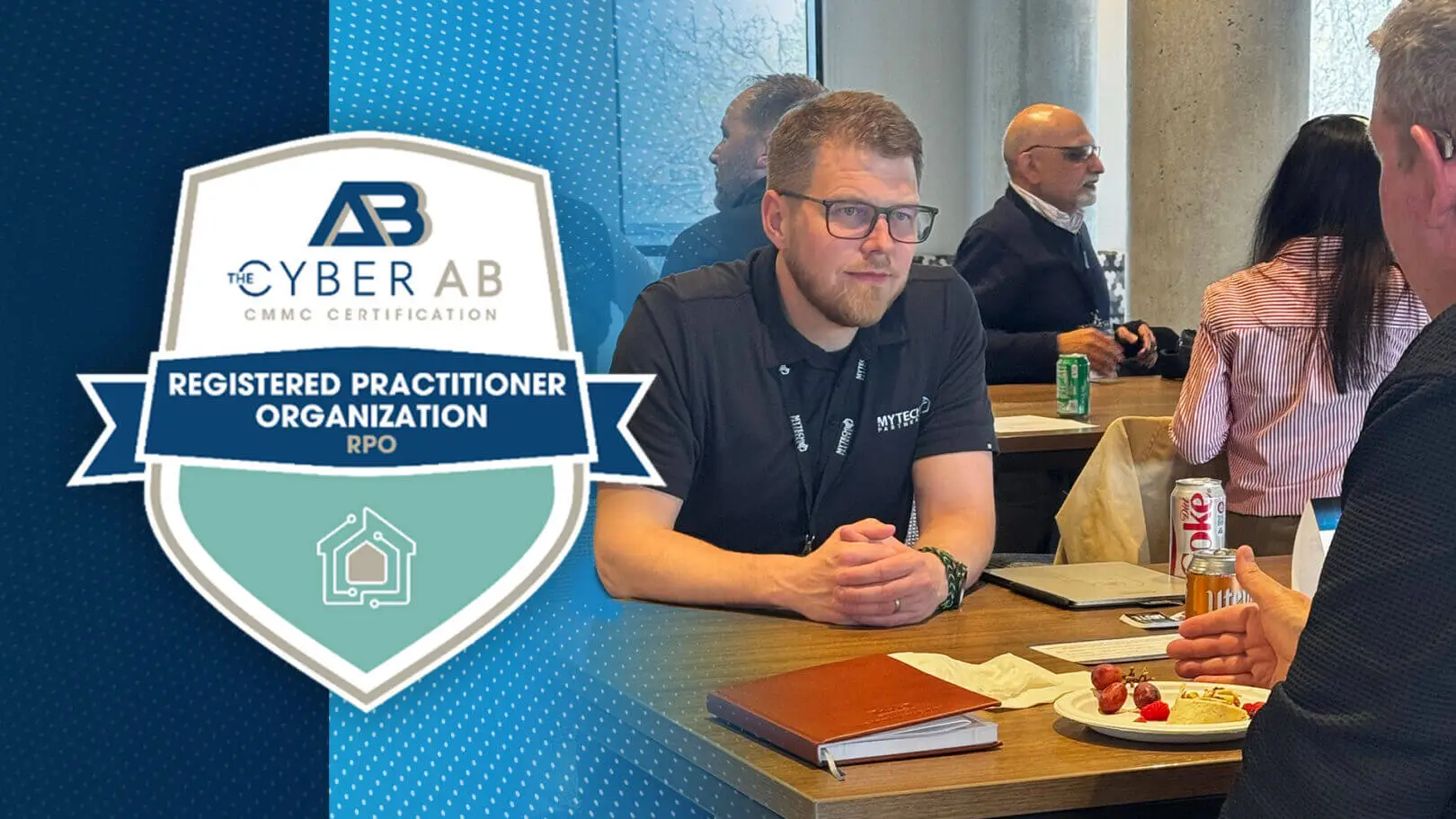
Eric Vollbrecht is Mytech Partners’ CMMC lead and an officially Registered Practitioner, credentialed to advise organizations through the certification process. Mytech itself holds Registered Practitioner Organization status — a credential worth checking for any provider claiming CMMC expertise, since not everyone marketing “CMMC experience” has made the real investment to back it up. You can verify any provider’s status yourself through the CyberAB marketplace.
Eric supports clients across all five Mytech locations, guiding manufacturing and defense-supply-chain clients through what CMMC requires and helping translate the technical requirements into a business case their leadership can act on.
At Mytech, he’s already guided clients including Great Lakes, Eaton, NPC Robotics and others currently in the works through the early stages of CMMC readiness, building on the numerous of other companies he’s helped with compliance work over the course of his career. Clients have responded well to the program because it gives them a clear, full picture of what’s ahead, rather than open-ended consulting with no endpoint in sight.
Jesse Jarvie, based out of Mytech’s Minneapolis/St. Paul branch, works alongside Eric on CMMC readiness for the region’s manufacturing and defense-supply-chain clients, helping translate the technical requirements into a business case leadership can act on.
FAQ
Do we actually have to do this?
Yes. If your contracts involve Controlled Unclassified Information (CUI), also increasingly referred to as Controlled Defense Information (CDI), CMMC Level 2 is a contract requirement, not optional guidance.
What happens if we just wait?
Certified competitors are already bidding. Implementation typically takes 12–18 months, so waiting has a direct, measurable revenue cost: every month of delay is a month a competitor can use to certify first.
Can’t we just self-assess?
No. Level 2 requires an independent outside assessment. Self-assessing for Level 2 work when you don’t actually qualify can expose your organization to False Claims Act liability if you’re later found non-compliant, since attesting to a compliance level you haven’t actually achieved counts as a false claim against the government.
Is the quoted price the full cost?
Mytech’s roughly $116,000 Year 1 investment covers all consulting phases, our compliance platform, and support through your official assessment (including an estimate for the outside assessment fee). Any remediation projects and ongoing services are scoped and priced separately.
How long until we’re actually certified?
About 12–15 months at a standard pace. Note that as of July 2026, the government has paused the outside-assessment requirement pending a 60-day review, but the underlying requirement to protect sensitive information hasn’tchanged, and starting now still puts you ahead of the queue once things resume.
What’s the internal workload really like?
“It’s structured and prescriptive, not open-ended, not open-ended. Mytech works with whatever internal contacts you have available. You don’t need to hire or dedicate a full-time compliance person to get through it.
Who should be involved in this decision?
Not just IT. Sales teams that are fielding CMMC questions from prospects, the IT leader who will own the technical scoping, and the CEO/CFO who need to see the ROI case all have a stake in getting this evaluated early.
Your Next Step
You don’t need to decide on the full certification program today. Start with an evaluation. It gives you a real gap analysis and a data-backed go/no-go decision, whether you’re the IT leader who needs the technical scope, the CFO who needs the numbers, or the sales leader who just needs an honest answer for the next prospect who asks.
Learn more about how Mytech helps manufacturers take a clear, practical path from initial evaluation to certification readiness, and explore our CLAS compliance program to see how ongoing support keeps you audit-ready long after certification.