
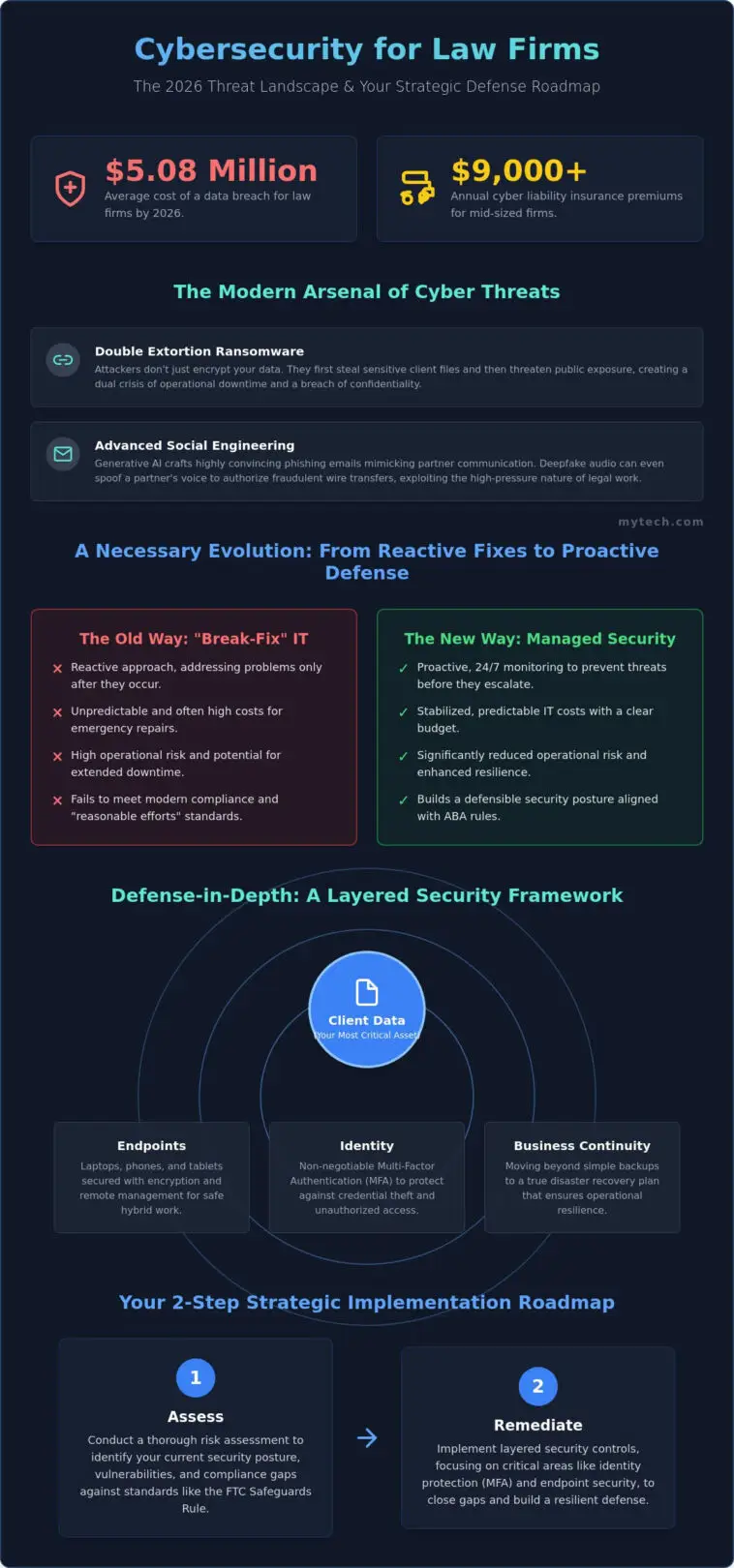
With the average cost of a data breach for law firms reaching $5.08 million in 2026, the question is no longer if your practice is a target, but how resilient your defenses truly are. You understand that protecting attorney-client privilege is the bedrock of your reputation, but as hybrid work remains the standard and cyber liability insurance premiums for mid-sized firms climb as high as $9,000 annually, managing cybersecurity for law firms feels increasingly complex. It is difficult to balance billable hours with the growing weight of digital risk.
We’re here to help you move beyond basic IT troubleshooting to a strategic, layered security posture that safeguards your most sensitive data and ensures strict regulatory compliance. You deserve the freedom to focus on your cases with the confidence that your digital foundation is secure. This shift allows you to view technology not as a frustration, but as a catalyst for your firm’s long-term success.
This guide provides a clear roadmap for security that aligns with ABA rules and stabilizes your IT costs. We’ll explore how to build a posture that protects client data 24/7, reduces operational risk, and restores your focus to what matters most: your clients and your practice.
Key Takeaways
- Discover why modern threat actors prioritize legal discovery files and how double extortion tactics have evolved to target law firms specifically in 2026.
- Learn how to implement a defense-in-depth framework that integrates cybersecurity for law firms across every endpoint, from the office server to remote laptops.
- Shift from the unpredictability of reactive “break-fix” repairs to a proactive managed security model that stabilizes IT costs and reduces operational risk.
- Master the distinction between simple data backups and true business continuity to meet stringent FTC Safeguards Rule requirements and protect attorney-client privilege.
- Follow a clear, two-step roadmap to assess your current compliance gaps and remediate vulnerabilities in identity and endpoint protection.
The 2026 Threat Landscape: Why Law Firms Are High-Value Targets
Law firms are no longer secondary targets; they are central hubs in the global data economy. In 2026, threat actors view legal practices as high-yield entry points into the corporate ecosystem. Why would a hacker attempt to breach a Fortune 500 company directly when they can access that same company’s intellectual property, M&A strategies, and litigation secrets by targeting their law firm? This shift has made cybersecurity for law firms a strategic necessity rather than a back-office IT concern. The risk is tangible. With the average cost of a legal sector breach reaching $5.08 million, a single security lapse can threaten the very existence of a practice.
Ransomware tactics have matured into a sophisticated “double extortion” model. Hackers don’t just lock your systems; they exfiltrate sensitive discovery files and threaten public exposure. This creates a dual crisis of operational downtime and a catastrophic breach of confidentiality. Viewing security as a mere IT expense is a dangerous oversight. Instead, we must treat it as a disciplined risk management strategy. As global information privacy laws continue to evolve, the burden of compliance sits squarely on the shoulders of firm leadership. ABA Model Rule 1.6 demands that lawyers take “reasonable efforts” to prevent unauthorized access to client data. In 2026, “reasonable” has a high bar that simple antivirus software cannot meet.
The Evolution of Social Engineering in the Legal Sector
Hackers now leverage generative AI to craft phishing attempts that are nearly indistinguishable from legitimate partner communications. By mimicking specific writing styles and professional cadences, they trick associates into clicking malicious links or bypassing internal controls. Business Email Compromise (BEC) remains a primary threat, especially during escrow transfers or settlement payments. We’ve even seen the rise of deepfake audio used to spoof a partner’s voice during urgent consultations to authorize fraudulent wire instructions. These attacks succeed because they exploit the high-pressure, deadline-driven nature of legal work. Relying on employee intuition is no longer enough; you need a stable, secure foundation of technical safeguards to catch what the human eye misses.
Attorney-Client Privilege in the Digital Age
The digital era has complicated the traditional understanding of privilege. In some jurisdictions, a failure to implement adequate security measures can be argued as a waiver of attorney-client privilege. If a firm doesn’t take proactive steps to protect its data, courts may find that the expectation of confidentiality was not maintained. The true cost of a breach extends far beyond regulatory fines. It’s the permanent damage to your reputation and the loss of client trust that often proves most expensive. “Good enough” IT is no longer a defensible position in a malpractice suit or a board-level inquiry. We believe that a proactive, layered defense is the only way to provide the confidence your clients expect and your practice requires.
The Layered Security Model: Protecting the Firm From the Inside Out
Effective cybersecurity for law firms is built on the principle of defense-in-depth. This strategy creates redundant layers of protection, ensuring that if one safeguard fails, others remain to block the intrusion. We view this as a series of protective rings surrounding your most critical asset: client data. By moving beyond a single point of failure, you build a resilient environment that maintains confidentiality even under sustained pressure. This strategic approach transforms your IT from a simple utility into a robust shield for your practice.
Your firm’s digital perimeter is no longer confined to your physical office. In 2026, the endpoint layer represents the front line of defense. Every laptop, tablet, and smartphone used by your associates must be secured with enterprise-grade encryption and remote management tools. This is essential for maintaining a secure hybrid work environment where data is accessed from various networks. Proactive management ensures that these devices are patched and monitored regardless of their location, giving your team the freedom to work from anywhere without increasing the firm’s risk profile.
Identity remains the primary target for modern hackers. Multi-factor authentication (MFA) is the bare minimum requirement for any firm seeking to protect its reputation. Beyond simple security, implementing MFA is a strategic financial decision. Insurance providers often reward this posture with a 5% to 15% reduction in cyber liability premiums. We ensure that identity management is seamless, allowing your team to work efficiently while ensuring that only authorized personnel can access sensitive case files.
Data protection requires encryption for files both at rest on your servers and in transit during communication. This ensures that even if a breach occurs, the information remains unreadable and useless to unauthorized parties. As you refine these layers, our managed security services provide the oversight needed to ensure these tools are correctly configured and consistently updated. This stable foundation allows you to focus on your clients, knowing that the technical details are handled with precision.
Managed Detection and Response (MDR) for Legal Teams
Passive antivirus software is insufficient against the sophisticated threats of 2026. Legal teams now require Managed Detection and Response (MDR) to identify anomalies that automated tools might miss. MDR is a proactive hunt for threats rather than a reactive alert system. By utilizing a 24/7 Security Operations Center (SOC), we monitor your environment in real-time. This allows us to isolate and neutralize threats before they escalate into full-scale breaches, providing a level of vigilance that an internal IT person simply can’t maintain alone.
The Human Element: Building a Culture of Security
Technology is only as strong as the people who use it. We help you build a culture of security by providing awareness training specifically designed for high-pressure legal environments. Instead of generic lectures, we use simulated phishing tests to measure and improve your firm’s resilience against social engineering. Establishing clear protocols for handling sensitive data ensures that security becomes a natural part of your daily workflow. This collaborative approach turns your staff into your strongest line of defense, rather than your greatest vulnerability.
Managed Security vs. Break-Fix: Choosing the Right Strategic Partner
Reactive IT, often called the “break-fix” model, creates a cycle of operational stress that few modern practices can afford. When systems fail, billable hours vanish instantly. The hidden costs of this approach include not just emergency repair fees but also the long-term impact of data loss and eroded client trust. For a profession built on deadlines and precision, waiting for something to break before fixing it is a high-risk gamble. Effective cybersecurity for law firms requires a shift toward a proactive model where potential issues are neutralized before they disrupt your workflow.
Choosing Mytech Partners provides the predictability your firm needs to scale with confidence. Instead of unpredictable invoices and frantic calls to support, you gain a stable foundation with fixed monthly costs. This partnership allows Mytech Partners to align your technology with your specific business objectives. Whether you’re expanding your practice in Minneapolis, Denver, or San Antonio, having a local partner who understands your regional market adds a layer of accountability that national call centers can’t match. We don’t just manage your tools; we act as a disciplined guide for your digital journey.
A strategic partner focuses on the freedom and confidence that come from a secure environment. This forward-thinking optimism suggests that your operational tools are catalysts for success rather than assets to be managed. By integrating Managed Security Services into your daily operations, you reduce the friction of technical frustrations. This allows your team to focus on high-value legal work while we maintain the integrity of your digital infrastructure.
The Role of a vCISO in Legal Practice
A Virtual Chief Information Security Officer (vCISO) provides high-level strategic guidance without the overhead of a full-time executive. This role is essential for bridging the gap between legal ethics and technical implementation. Your vCISO ensures that your security posture evolves alongside changing regulations and emerging threats. To understand how this fits into your broader organizational goals, explore The Strategic Guide to IT Support and Services in 2026.
Evaluating an IT Support Company for Your Firm
When vetting a potential partner, you must ask if they truly understand ABA compliance and the nuances of attorney-client privilege. Generic IT support isn’t enough for the legal sector. You need a team that prioritizes cybersecurity for law firms and offers rapid response times for your local office or hybrid staff. Finding a managed service provider near me ensures that you have on-site assistance when it matters most, reducing downtime and maintaining the continuity of your practice.
Compliance, Business Continuity, and Disaster Recovery
Compliance in 2026 is a complex tapestry of federal mandates and state-specific regulations. For many practices, the FTC Safeguards Rule represents a significant hurdle. If your firm handles activities “financial in nature,” you must maintain a written information security plan (WISP) and designate a qualified individual to oversee your program. This isn’t just about avoiding a 30-day notification window for breaches affecting 500 or more consumers. It is about building a defensible security posture that withstands scrutiny. Strategic cybersecurity for law firms integrates these requirements into daily operations rather than treating them as annual chores.
Many leaders confuse data backups with true business continuity. A backup is simply a copy of your files. Business continuity is the ability to maintain operations when your primary systems fail. We help you define your Recovery Time Objective (RTO) to determine exactly how fast your team must be back online to meet court deadlines and client expectations. An effective Incident Response Plan satisfies insurance carriers and provides your staff with a calm, clear roadmap during a crisis. This preparation replaces panic with a disciplined process, ensuring your firm remains resilient.
If you want to ensure your practice can withstand any digital disruption, explore our Business Continuity & Disaster Recovery services to build a resilient future.
Securing Microsoft 365 and Document Management Systems
Your document management system is the heart of your practice. We optimize Microsoft 365 environments by implementing strict conditional access policies. This ensures that remote attorneys can only access SharePoint or OneDrive through secured, compliant devices. By fine-tuning these settings, you prevent unauthorized data exfiltration without hindering your team’s productivity. For deeper insights into cloud optimization, see A Comprehensive Guide to IT Support and Managed Services in 2026.
Regional Compliance Nuances: TX, CO, and MN
Firms in Dallas and San Antonio must navigate the Texas Data Privacy and Security Act, which imposes specific obligations on how personal data is processed and protected. In Denver, the Colorado Privacy Act (CPA) requires rigorous data assessments and clear consumer disclosure. Minneapolis firms face an evolving Minnesota landscape that increasingly mirrors these strict standards. We understand these regional differences and help you align your cybersecurity for law firms with the specific laws governing your local jurisdiction, providing peace of mind regardless of where you practice.
Implementing Your Strategic Cybersecurity Roadmap
Transitioning from the defensive layers and compliance mandates we’ve discussed into a functional strategy requires a disciplined, phased approach. We don’t believe in overnight overhauls that disrupt your billable hours. Instead, we follow a strategic roadmap that builds resilience over time. This process ensures that cybersecurity for law firms becomes an integrated part of your firm’s culture rather than a series of reactive patches. By following a structured path, you gain the freedom to grow your practice with the confidence that your digital foundation is stable and secure.
Our implementation process follows four critical steps:
- Step 1: Conduct a comprehensive security and compliance assessment. We establish a baseline by evaluating your current technical controls and administrative policies.
- Step 2: Remediate immediate gaps. We prioritize high-risk vulnerabilities, such as unpatched endpoints or missing multi-factor authentication, to secure your perimeter quickly.
- Step 3: Establish a long-term technology roadmap. We align your IT investments with your firm’s specific growth goals, ensuring your tools support your long-term vision.
- Step 4: Continuous monitoring and quarterly strategic reviews. Security isn’t a one-time project. We provide ongoing oversight and meet regularly to adjust your strategy as new threats emerge.
Why a Strategic IT Assessment is Your First Move
You can’t protect what you don’t know exists. An assessment often reveals “shadow IT,” such as unauthorized cloud storage apps or unmanaged personal devices that associates use for work. We compare your current posture against industry benchmarks and the regulatory requirements we detailed in previous sections. A strategic assessment functions as a diagnostic tool to identify operational risks rather than a sales pitch for new hardware. This clarity allows us to invest your budget where it will have the greatest impact on risk reduction.
Partnering with Mytech Partners for Long-Term Resilience
We act as a seasoned guide for firms navigating the complex digital landscape of 2026. Our team provides managed it services minneapolis practices rely on for proactive maintenance and strategic alignment. We bring that same local expertise and disciplined approach to our partners in Denver, San Antonio, and Dallas. We understand that your reputation depends on confidentiality. Our promise is to provide the reassuring, growth-focused support you need to eliminate operational stress. Together, Mytech Partners ensures that cybersecurity for law firms remains a catalyst for your success, providing a secure environment where your practice can thrive for years to come.
Building a Foundation for Long-Term Confidence
The complexity of the 2026 digital landscape requires a transition from reactive maintenance to a resilient, layered defense. By choosing a strategic partnership over the unpredictability of break-fix repairs, you safeguard the confidentiality that is essential to the legal profession. Effective cybersecurity for law firms is a proactive discipline that ensures your practice remains compliant and your attorney-client privilege stays protected. This strategic shift allows you to focus on your cases with the freedom that comes from a stable foundation.
Mytech Partners brings over 25 years of experience to this journey, acting as a seasoned guide for professional services organizations. Our local offices in Minneapolis, Denver, San Antonio, and Dallas provide the hands-on support necessary to navigate regional compliance nuances and ABA-compliant security frameworks. We focus on creating a stable environment where your technology acts as a catalyst for growth rather than a source of operational stress. By working together, we ensure your firm is prepared for the challenges of today and the opportunities of tomorrow.
Schedule Your Strategic IT Assessment with Mytech Partners Today
We look forward to helping you achieve the peace of mind and operational excellence that come from a secure, high-performing practice.
Frequently Asked Questions
Does my small law firm really need a vCISO or dedicated security services?
Every firm, regardless of size, benefits from strategic oversight to navigate the complex 2026 threat landscape. A vCISO acts as a disciplined guide, ensuring your security measures align with ABA ethical obligations. This approach prevents you from overspending on unnecessary tools while closing critical gaps in your defense. It’s about building a stable foundation that allows you to scale your practice without increasing your risk profile.
What are the most common cyber threats facing law firms in 2026?
Modern threats have evolved into sophisticated, AI-driven attacks that bypass traditional filters. We see a significant rise in double-extortion ransomware where hackers specifically target sensitive discovery files to leverage public exposure. Business Email Compromise also remains a persistent threat, often appearing as legitimate requests from partners to authorize fraudulent wire transfers. Effective cybersecurity for law firms must address these specific behavioral risks with active monitoring.
How does cybersecurity insurance affect my firm’s IT requirements?
Insurance carriers now treat technical safeguards as non-negotiable prerequisites for coverage. In 2026, failing to implement multi-factor authentication or Managed Detection and Response can lead to denied applications or significantly higher premiums. We help you meet these stringent IT requirements to ensure your policy remains a reliable safety net. This proactive alignment reduces your operational stress and secures the long-term financial health of your practice.
Is Microsoft 365 secure enough for confidential legal documents?
Microsoft 365 is a powerful platform, but it requires expert optimization to meet legal confidentiality standards. Out-of-the-box settings often lack the granular controls needed to prevent unauthorized data exfiltration. We implement conditional access policies and advanced encryption to ensure your document management system remains a secure vault. This setup provides your team with the freedom to collaborate while maintaining a robust defense against external intrusions.
What happens to attorney-client privilege if our data is breached?
A data breach doesn’t automatically waive privilege, but it creates a significant legal risk if a court determines “reasonable efforts” weren’t taken. Judges increasingly scrutinize whether a firm followed established cybersecurity for law firms frameworks before deciding on the status of compromised data. Protecting privilege requires more than just good intentions; it demands a documented, layered defense. This strategic preparation is your best argument for maintaining confidentiality after an incident.
How much should a mid-sized law firm spend on cybersecurity?
Your investment should be viewed as a risk management strategy rather than a simple line item. Instead of focusing on a specific dollar amount, we recommend prioritizing essential layers like identity protection and continuous monitoring. This approach ensures your budget directly addresses the most likely threats to your billable hours. Investing in a managed security model provides predictable costs and prevents the catastrophic financial impact of a multi-million dollar breach.
What is the difference between a data backup and a disaster recovery plan?
A data backup is simply a static copy of your files stored in a separate location. Disaster recovery is the broader strategic framework that defines how your firm resumes operations after a system failure. We focus on Recovery Time Objectives to ensure your team is back online within hours, not days. This distinction is critical for meeting court deadlines and maintaining the trust of your clients during a digital crisis.
How can I train my attorneys to recognize AI-generated phishing attempts?
Training should move beyond generic videos to include realistic, AI-generated phishing simulations. We teach your attorneys to identify subtle anomalies in writing styles and to verify urgent requests through a secondary, trusted channel. This collaborative approach builds a culture of security where every staff member becomes a vigilant protector of client data. Empowering your team with these skills turns your human element into a strategic asset rather than a vulnerability.