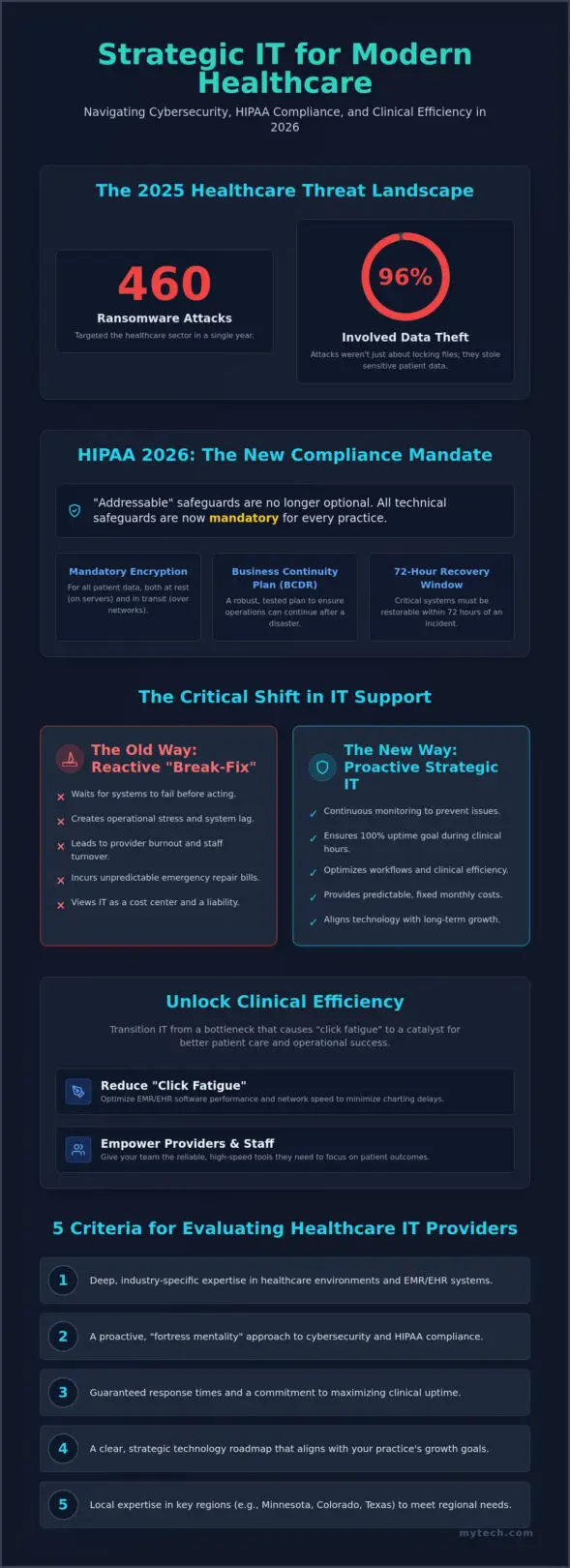
In 2025, the healthcare sector faced 460 ransomware attacks, and a staggering 96% of those incidents involved the theft of sensitive patient data. For medical practices, these figures represent more than just data points; they reflect the constant pressure to protect patient trust while maintaining high-speed clinical operations. We understand that the fear of HIPAA non-compliance fines and the frustration of system lag during patient charting can make technology feel like an obstacle rather than an asset. Specialized it support for healthcare providers should do more than just fix broken hardware. It should act as a stable, strategic foundation for your practice’s growth.
This comprehensive guide explores how a proactive approach to technology secures your records against evolving threats and ensures your practice meets the mandatory 2026 HIPAA technical safeguards. You will discover how to achieve 100% uptime during clinical hours and transition from reactive troubleshooting to a strategic roadmap that optimizes your clinical workflows. We will walk through the essential steps to turn your IT infrastructure into a reliable catalyst for better patient outcomes and long-term operational success.
Key Takeaways
- Shift from reactive “break-fix” cycles to a strategic model that aligns your technology with long-term clinical and growth objectives.
- Navigate the mandatory 2026 HIPAA technical safeguards and learn how specialized it support for healthcare providers defends against sophisticated ransomware threats.
- Optimize your clinical workflows by reducing “click fatigue” through high-performance network configurations and seamless EMR/EHR software integrations.
- Evaluate potential technology partners using five specific criteria, focusing on industry-specific expertise and reliable response time guarantees.
- Leverage local expertise in Minnesota, Colorado, and Texas to ensure your practice maintains maximum uptime and meets regional regulatory requirements.
The Critical Role of Strategic IT Support for Modern Healthcare Providers
Modern medical practices require more than a technician who answers the phone when a server crashes. In 2026, it support for healthcare providers has evolved into a high-level partnership that aligns technical infrastructure with clinical goals. Effective Health information technology (HIT) serves as the backbone of every patient interaction, from the initial check-in to the final billing cycle. When technology functions as a silent, reliable partner, providers can focus entirely on patient care rather than troubleshooting software glitches.
Strategic Healthcare IT is the intersection of compliance, uptime, and clinical efficiency.
Reactive “break-fix” models consistently fail in high-pressure medical environments. Waiting for a system to fail before addressing it creates unnecessary operational stress and risks patient safety. A proactive model ensures that technology acts as a catalyst for patient satisfaction rather than a bottleneck. Reliable systems foster an environment where clinicians feel supported and patients feel confident in the care they receive. It is about moving beyond the help desk to achieve true strategic alignment.
Why ‘Good Enough’ IT is a Liability in Healthcare
Settling for mediocre IT performance creates hidden costs that drain a practice’s profitability. A 15-minute delay in patient charting might seem minor, but when multiplied across an entire medical staff, it results in hours of lost productivity and late nights for providers. This persistent friction contributes directly to provider burnout and high staff turnover rates. Outdated infrastructure isn’t just a technical problem; it’s a human resources problem. By transitioning from operational stress to a stable, secure foundation, practices reclaim the freedom to grow without the weight of technical debt.
The Managed Services Advantage for Medical Groups
Managed IT services offer a level of predictability that traditional hourly support cannot match. Instead of facing unpredictable emergency repair bills, medical groups benefit from fixed monthly costs that make budgeting simple and transparent. Our approach focuses on continuous monitoring, which allows our team to catch server issues or security vulnerabilities before the first patient of the day even arrives. This level of foresight is a hallmark of Strategic IT Support: A Comprehensive Guide for Growing Businesses in 2026, which emphasizes the value of a dedicated technology roadmap. Investing in proactive it support for healthcare providers ensures that your tools remain assets, not obstacles. We act as your seasoned guide, leading you through complex digital landscapes with discipline and experience.
Navigating HIPAA Compliance and Cybersecurity in 2026
The regulatory environment for medical practices has reached a critical turning point. As of 2026, the flexibility previously allowed under “addressable” HIPAA safeguards has been eliminated. Every covered entity must now implement specific technical safeguards, regardless of their practice size. This shift reflects the reality of a landscape where 460 ransomware attacks struck the healthcare sector in 2025 alone. When you partner with a provider for it support for healthcare providers, the focus must move beyond basic maintenance toward a “fortress” mentality that protects Electronic Protected Health Information (ePHI) at every level.
Healthcare remains the primary target for cybercriminals because patient records are incredibly lucrative on the dark web. Modern attacks are no longer just about locking files; 96% of ransomware incidents now involve data theft to extort practices further. To stay ahead, organizations should follow the standards promoted by the U.S. Office of the National Coordinator for Health Information Technology (ONC). We believe that true security comes from a layered approach that includes mandatory encryption, both at rest and in transit, and a robust Business Continuity and Disaster Recovery (BCDR) plan. Patient safety depends on your ability to restore critical systems within the now-required 72-hour window following an incident.
Proactive Security vs. Reactive Recovery
Proactivity is the only effective defense against sophisticated phishing and AI-generated threats. Implementing Multi-Factor Authentication (MFA) across all systems is no longer optional; it’s a mandatory requirement for 2026 compliance. We also conduct annual penetration testing and biannual vulnerability scanning to identify weaknesses before they can be exploited. However, technology is only part of the equation. Your staff members are your first line of defense. Regular training sessions ensure that every employee recognizes the subtle signs of a phishing attempt, turning a potential vulnerability into a position of strength.
Managing Compliance Without Sacrificing Productivity
Staying compliant shouldn’t create a bottleneck for your clinical team. By automating compliance audits and optimizing tools like Microsoft 365, we help you maintain high standards without adding administrative burdens. Secure file sharing and streamlined workflows allow your staff to focus on care rather than complex security protocols. If you’re looking to strengthen your defenses, our Cybersecurity Services in San Antonio: A Strategic Guide for 2026 provides a deeper look at regional strategies. Our goal is to provide the freedom and confidence that come from a secure foundation. You can explore our managed security services to see how we integrate these protections into your daily operations.
Optimizing Clinical Workflows: IT as a Tool for Better Care
Technology should never be a barrier between a clinician and their patient. While security and compliance provide the necessary foundation, the true measure of it support for healthcare providers is how effectively it streamlines daily operations. When your Electronic Medical Record (EMR) or Electronic Health Record (EHR) software integrates seamlessly with your hardware, the entire clinical team gains back valuable time. We focus on ensuring these systems talk to each other without friction, preventing the technical silos that often lead to data entry errors and frustrated staff.
One of the most significant yet overlooked challenges in modern medicine is “click fatigue.” This phenomenon occurs when slow networks and high-latency systems force providers to wait for screens to load or navigate through redundant menus. By optimizing network performance and prioritizing low-latency connections, we help your team move through patient charting with speed and precision. High-performance it support for healthcare providers ensures that your tools respond as quickly as your clinicians think, allowing them to remain present with their patients rather than wrestling with a spinning loading icon.
Mobility and accessibility have also become essential for bedside care. Through Mobile Device Management (MDM), we empower your staff to use tablets and handheld devices securely as they move between exam rooms. This mobility is supported by robust telehealth stability, which maintains high-quality patient connections for hybrid care models. Whether a consultation happens in person or via a video link, the technical experience must remain consistent and reliable to preserve the quality of the patient-provider relationship.
Maximizing the Value of Your Microsoft 365 Investment
Many practices only scratch the surface of what Microsoft 365 can do. We help you leverage SharePoint and Teams to create a secure, HIPAA-compliant environment for internal communication and document sharing. By automating repetitive administrative tasks with cloud tools, your practice can reduce the manual workload on front-office staff. This cloud infrastructure is designed to be as resilient as your physical office, ensuring that your data remains accessible even if local hardware issues arise. Our goal is to turn your existing software into a powerful engine for clinical efficiency.
Strategic IT Consulting: The vCIO Advantage
A vCIO acts as a seasoned guide for clinical digital landscapes, providing the strategic foresight needed to navigate complex technical transitions with confidence. Rather than simply “keeping the lights on,” our strategic IT consulting focuses on developing a three-year technology roadmap that aligns with your practice’s growth goals. This allows you to budget for innovation and plan for necessary upgrades long before they become emergencies. By treating technology as a strategic asset, we help you build a forward-thinking practice that is prepared for the future of medicine.
Evaluating Healthcare IT Providers: 5 Essential Criteria
Selecting a partner for it support for healthcare providers is a consequential decision that impacts your practice’s long-term health. It is not enough for a provider to understand general networking; they must possess deep, industry-specific expertise. You should ask if they speak the language of CPT codes and HL7. A partner who understands the nuances of medical billing and data interoperability can resolve issues faster and more accurately than a generalist technician. This specialized knowledge ensures that your technology remains a catalyst for care rather than a source of administrative friction.
Reliability is measured by what happens when things go wrong. Response time guarantees are critical in a high-pressure clinical environment. If your pharmacy system goes down at 2 PM on a Tuesday, you cannot afford to wait for a call back the next morning. We believe that a true partner provides clear, actionable service level agreements that prioritize clinical uptime. Furthermore, you should evaluate a provider’s own security maturity. If they do not practice what they preach within their own organization, they cannot effectively build a fortress around your patient data.
Local presence remains a vital component of successful IT management. While many tasks can be handled remotely, some situations require “boots on the ground.” Whether you are based in Denver, San Antonio, or Minneapolis, having local experts available for hardware failures or onsite strategic reviews provides a layer of security that remote-only firms cannot offer. This regional context allows your partner to understand the specific regulatory landscape of your area, ensuring your practice stays ahead of local compliance requirements.
The Difference Between a Vendor and a Partner
A transactional vendor reacts to your problems, but a strategic partner anticipates them. We focus on a consultative approach that prioritizes your organizational health over simple ticket resolution. This shift from a transactional help desk to a collaborative journey creates an atmosphere of reliability and forward-thinking optimism. To help you navigate this choice, we have developed The Ultimate Guide to Choosing a Managed Service Provider Near You in 2026. We invite you to schedule a strategic consultation with our team to see how we align technology with your clinical objectives.
Red Flags to Watch for in Healthcare IT Contracts
Transparency is the foundation of any successful partnership. You should be wary of contracts that include vague security protocols or a lack of clear Business Associate Agreements (BAA). If a provider is hesitant to sign a BAA, they aren’t prepared for the responsibilities of healthcare data privacy. Watch out for hidden fees for “out-of-scope” work that should be covered under a proactive managed model. A disciplined partner will provide transparent reporting and regular strategic review meetings, ensuring you always have a clear technology roadmap and no surprises on your monthly invoice.
Partnering for Success: Local IT Support in Minneapolis, Denver, and Texas
A strategic technology roadmap is most effective when it accounts for the specific regional challenges your practice faces. Whether you’re operating in Minnesota, Colorado, or Texas, local context matters for healthcare regulations and operational continuity. Our team understands that a clinic in Minneapolis has different environmental and infrastructure considerations than one in San Antonio. By providing localized it support for healthcare providers, we ensure that your technology isn’t just a generic service, but a tailored asset that aligns with your specific clinical and business objectives.
We believe our role is to act as a seasoned guide through the complexities of modern medical technology. Our approach is grounded in a sense of calm authority, designed to alleviate the operational stress that often keeps practice managers and physicians awake at night. Instead of focusing on technical frustrations, we emphasize the freedom that comes from a stable, secure foundation. This partnership allows your leadership team to shift their focus from troubleshooting to growth, knowing that your infrastructure is managed by a disciplined team invested in your long-term health.
Onsite Support When it Matters Most
While remote monitoring catches most issues before they escalate, certain critical situations require immediate, physical intervention. We provide rapid onsite response for clinics across Minneapolis, St. Paul, Denver, and San Antonio. Having a partner who knows your physical office layout and the local ISP landscape can mean the difference between a minor hiccup and a full day of lost appointments. We also prioritize business continuity through local data center options and onsite backups, ensuring that your patient data remains accessible even during localized outages or hardware failures.
Your Journey Toward Operational Excellence
Operational excellence is a continuous journey rather than a one-time setup. Our onboarding process is designed to make the transition to Managed IT seamless for your staff, minimizing disruptions to patient care. Once the foundation is secure, we move into a cycle of continuous improvement. As your practice grows, we evolve your technology to meet new demands, whether you’re adding providers or expanding to new locations. This proactive model is the cure for reactive stress, providing a clear path forward for your organization. To begin this transition, you can schedule a strategic IT assessment for your healthcare practice today. We look forward to helping you turn your technology into a powerful catalyst for success.
Choosing the right it support for healthcare providers is about more than just finding a technician; it’s about finding a partner who shares your commitment to excellence. We invite you to experience the confidence that comes from a professional, reassuring approach to managed services. Together, we can build a technology environment that supports your clinicians, protects your patients, and secures the future of your practice.
Securing Your Clinical Future Through Strategic Partnership
The landscape of healthcare technology in 2026 demands more than just maintenance; it requires a disciplined strategy that protects patient data and optimizes every clinical interaction. We have explored how proactive it support for healthcare providers turns operational tools into catalysts for success. By meeting mandatory technical safeguards and streamlining EHR workflows, your practice gains the freedom to focus on what matters most: patient outcomes. It’s time to move beyond reactive troubleshooting and embrace a forward-thinking technology roadmap.
With over 25 years of strategic IT experience and local expert teams in Minnesota, Colorado, and Texas, Mytech Partners provides the specialized healthcare compliance frameworks necessary for modern medicine. We act as your seasoned guide, ensuring your technology remains a stable foundation for growth rather than a source of stress. This collaborative approach provides the reliability you need to thrive in a high-pressure environment.
Empower your practice with a stable, secure foundation—connect with Mytech Partners today. We look forward to joining you on this journey toward operational excellence.
Frequently Asked Questions
What is the difference between standard IT support and healthcare-specific IT support?
Healthcare IT support requires a deep understanding of medical regulations and the high-pressure nature of clinical uptime. Unlike standard support, specialized it support for healthcare providers focuses on HIPAA technical safeguards and the nuances of data interoperability. We act as a seasoned guide to ensure your systems remain compliant while supporting the specific demands of a fast-paced medical environment.
How does a Managed Service Provider (MSP) help with HIPAA compliance?
An MSP implements the mandatory technical safeguards required by the 2026 HIPAA updates, including multi-factor authentication and mandatory encryption. We provide the necessary Business Associate Agreements (BAA) and conduct regular security risk assessments to identify vulnerabilities. This proactive approach ensures your practice meets federal standards without adding an administrative burden to your clinical staff.
Can you support our specific EMR/EHR software like Epic, eClinicalWorks, or NextGen?
We manage the underlying technical infrastructure that these platforms require to function reliably. While we don’t develop the software itself, we ensure your network, hardware, and security protocols are optimized for your specific EMR or EHR. This strategic alignment facilitates seamless integration and high-speed performance, reducing the technical friction that often leads to clinician burnout.
What happens to our patient data if our local server fails?
Your patient records remain protected through a robust Business Continuity and Disaster Recovery (BCDR) plan. We utilize both local and cloud-based backups to ensure that critical systems can be restored within the 72-hour window required by 2026 contingency standards. This layered approach provides the confidence that your data is resilient against hardware failures or local outages.
Is cloud-based healthcare IT support secure enough for sensitive patient records?
Cloud-based solutions offer advanced encryption and identity management that often exceed the capabilities of traditional onsite servers. When combined with Microsoft 365 optimization and layered security, the cloud provides a highly secure environment for Electronic Protected Health Information (ePHI). These systems are designed to protect against modern threats while allowing your team the mobility needed for bedside care.
How much does managed IT support typically cost for a mid-sized medical clinic?
Investment in it support for healthcare providers is typically structured as a predictable monthly fee scaled to your practice’s size and complexity. This model eliminates the financial stress of unpredictable emergency repair bills and allows for better long-term budgeting. Your specific costs will depend on your unique technology roadmap, user count, and the depth of security services required.
Do you provide 24/7 support for urgent clinical issues after hours?
Reliable it support for healthcare providers focuses on maintaining maximum uptime during your critical clinical hours. We recommend discussing your specific after-hours requirements during a strategic assessment so we can align our support model with your practice’s unique schedule. Our goal is to provide a support structure that ensures your clinicians always have the tools they need for patient care.
How do local IT providers in Minneapolis or Denver handle onsite hardware emergencies?
Local teams provide essential onsite support for situations that cannot be resolved through remote intervention, such as server hardware failures. Our offices in Minneapolis, Denver, and San Antonio allow us to dispatch experts quickly to your physical location. Having local experts who understand your office layout and regional ISP landscape ensures a faster return to normal clinical operations.