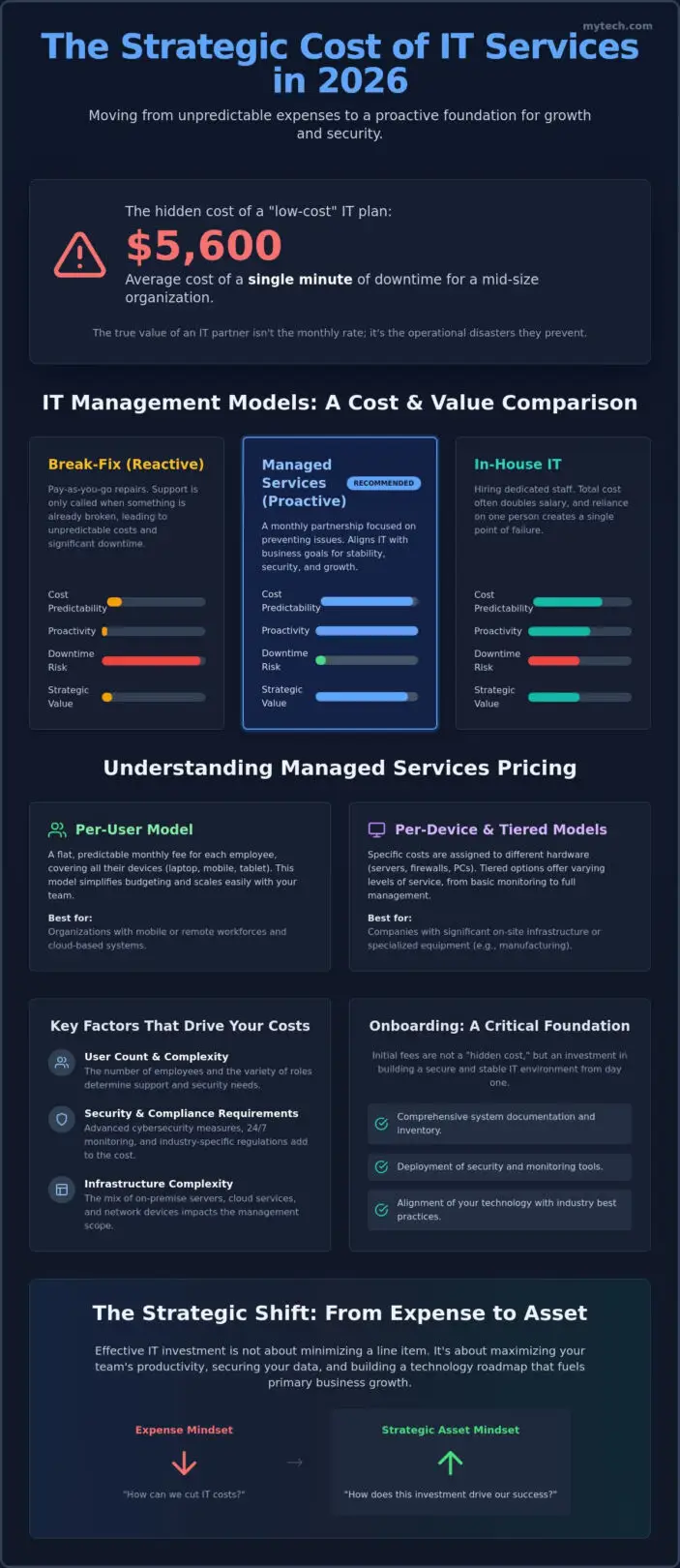
A low-cost IT contract often becomes the most expensive mistake a business can make. When a single minute of downtime costs a mid-size organization an average of $5,600, the real value of managed it services pricing isn’t found in the lowest monthly rate. It’s found in the risks a partner prevents and the operational freedom they enable.
We recognize the anxiety that comes with navigating modern cybersecurity risks while trying to decipher complex, inconsistent quotes. It’s frustrating to deal with hidden fees and vague service descriptions when all you want is a predictable budget and a stable foundation for your team. You deserve a technology roadmap that supports your primary objectives, not one that leaves you guessing about your next invoice or your level of protection.
This guide provides the transparency you need by breaking down the strategic cost models and industry standards for 2026. We’ll outline how to compare providers effectively and explain the strategic value behind every dollar spent on your infrastructure. Our goal is to move your organization toward a future of zero downtime and high-level security through informed, proactive decision-making that treats technology as a catalyst for success.
Key Takeaways
- Understand the shift from reactive repairs to proactive monthly partnerships that prioritize long-term stability.
- Learn how to evaluate managed it services pricing by comparing predictable monthly models against the hidden financial impact of system downtime.
- Identify the specific factors, such as infrastructure complexity and user count, that influence your total technology investment.
- Discover why initial onboarding fees are a critical investment in documenting your environment and securing your foundation.
- Shift your perspective from viewing IT as an operational expense to a strategic asset that fuels your primary business growth.
Understanding Managed IT Services Pricing Models in 2026
Managed IT services represent a fundamental shift in how organizations view their digital infrastructure. Instead of treating technology as a utility that only requires attention when it fails, modern leaders view it as a proactive partnership. This evolution is detailed in this Managed Services Overview, which highlights the transition from reactive break-fix repairs to a structured, recurring support model. By moving away from unpredictable hourly billing, businesses gain the financial clarity necessary for long-term planning and operational stability.
Effective managed it services pricing is built on the foundation of Service Level Agreements (SLAs). These documents define the response times and performance standards you can expect from your partner. However, the most sophisticated pricing models today focus on technology alignment. This process involves more than just fixing tickets; it ensures your hardware and software configurations match industry best practices and your specific growth goals. A provider who emphasizes alignment will regularly audit your environment against established technical standards. This proactive discipline identifies potential failures before they disrupt your operations, which is why pricing often reflects the frequency and depth of these strategic reviews.
The Per-User Pricing Model
The per-user model has become the industry standard for organizations with mobile or remote workforces. This approach simplifies budgeting by providing a flat fee for every employee, regardless of how many devices they use. It typically covers comprehensive support for laptops, tablets, and smartphones, along with Microsoft 365 optimization and advanced security layers. This model also removes the friction of constant invoices for every support call. Because the fee is fixed per person, your provider is financially motivated to make your environment as stable as possible. Their profitability depends on your lack of technical issues, which perfectly aligns their goals with your own. While market rates vary depending on the complexity of your security requirements, this model provides the most predictable path for scaling operations.
The Per-Device and Tiered Models
For organizations with specialized environments, such as manufacturing floors with shared workstations or companies maintaining significant on-site server infrastructure, per-device pricing remains a viable alternative. This model assigns specific costs to different hardware types, such as servers, firewalls, and individual PCs. Some providers also offer tiered levels, ranging from monitoring-only plans for internal IT teams to fully managed solutions for those seeking total outsourcing. Tiered models often provide a lower entry point for smaller teams that only require basic maintenance and security patching. Understanding the nuances of managed it services pricing allows you to choose a structure that matches your current inventory while leaving room for future cloud migrations or infrastructure upgrades.
The True Cost of IT: Managed Services vs. Break-Fix vs. In-House
Many leaders view IT as a binary choice: hire someone in-house or call a technician when things break. However, a strategic analysis of managed it services pricing reveals that the sticker price is only one part of the equation. For a mid-size organization, the average cost of downtime is approximately $5,600 per minute. When your systems fail, the true expense isn’t the repair bill; it’s the total halt of your workforce’s productivity and the potential erosion of client trust. Choosing a model based solely on the lowest monthly cost often ignores these significant financial risks.
For larger mid-market firms, a “Co-Managed” approach has emerged as a powerful hybrid solution. In this model, we partner with your existing internal IT person to provide the specialized tools and 24/7 monitoring they might lack. This allows your internal staff to focus on high-value, business-specific projects while we handle the heavy lifting of cybersecurity and infrastructure maintenance. It’s a collaborative strategy that maximizes your existing payroll while adding an elite layer of protection and expertise.
The Hidden Costs of In-House IT
Hiring a single internal technician might seem like a way to maintain control, but the total cost of employment often doubles the base salary. You must account for benefits, payroll taxes, office space, and the ongoing expense of mandatory technical certifications. Beyond the budget, relying on one person creates a dangerous “single point of failure.” If your only IT resource is on vacation or falls ill during a cyberattack, your organization is left defenseless. Choosing managed it services for small businesses provides access to a disciplined team of specialists for a predictable investment, often costing less than a single senior-level hire. We invite you to explore how a strategic IT partnership can eliminate these staffing headaches while strengthening your operational foundation.
Break-Fix: The “Cheap” Model That Costs More
The break-fix model is inherently reactive and creates a fundamental conflict of interest. Because these providers only earn revenue when your technology fails, they are financially incentivized by your instability. There’s no motivation for them to identify the root cause of a recurring issue or to implement proactive security measures that prevent future billable hours. Managed it services pricing flips this incentive. Since your provider earns a flat monthly fee, their profitability depends on your systems running perfectly. This alignment of goals ensures that we are constantly working to harden your environment and prevent disruptions before they occur, moving your business toward a state of permanent reliability.
Key Factors That Drive Managed IT Service Costs
Managed it services pricing scales with the specific demands of your environment and the level of risk your organization is prepared to manage. While user count is the primary metric for most agreements, it also dictates your economies of scale. Larger organizations with 100 or more employees often benefit from a more efficient distribution of fixed management costs. Conversely, smaller teams may see a slightly higher per-user rate because the baseline level of infrastructure monitoring and security oversight remains constant regardless of staff size.
The complexity of your technical infrastructure is another major driver of your monthly investment. A cloud-only environment centered on Microsoft 365 is typically less labor-intensive to manage than a hybrid or fully on-premise setup. Local servers require physical maintenance, power management, and hardware lifecycle planning, all of which increase the service depth required from your partner. Additionally, your choice of support hours directly impacts the cost. A 24/7/365 monitoring schedule requires a larger rotation of dedicated professionals than a standard business-hours plan, though it provides the continuous protection necessary for modern digital operations.
Compliance and Industry-Specific Requirements
Organizations in highly regulated sectors like healthcare or finance face additional layers of technical scrutiny. Meeting HIPAA or FINRA requirements isn’t just about security; it involves specialized auditing and reporting tools that document every access point and data transfer. These compliance-heavy environments require a partner with deep local expertise in regulatory landscapes, such as it support denver or Texas markets. The extra cost associated with these services reflects the rigorous documentation and risk mitigation strategies required to protect your business from legal and financial penalties.
Strategic Consulting and vCIO Services
The most significant differentiator in managed it services pricing is the inclusion of a Virtual Chief Information Officer (vCIO). This role moves your relationship beyond simple help desk tickets and into long-term strategic roadmapping. A vCIO analyzes your technology through the lens of your business goals, identifying potential bottlenecks before they disrupt your growth. This consultative approach distinguishes high-value it support and services from basic technical support. By aligning your technology with your primary objectives, strategic consulting prevents “emergency” capital expenditures and ensures your infrastructure remains a catalyst for success rather than an operational burden.
Onboarding Fees and Hidden Costs: What to Expect
Transparency is vital when evaluating managed it services pricing. While the recurring fee covers ongoing care, the initial onboarding fee represents a one-time investment in your organization’s technical health. This isn’t a simple administrative charge; it’s a deep-dive phase where we stabilize your environment and align it with our operational standards. A successful onboarding process eliminates the “technical debt” that often accumulates when systems are managed reactively. If your infrastructure has been neglected or poorly documented, the effort required to bring it up to a secure, performant baseline is higher, but this initial investment pays dividends through reduced downtime in the future.
It’s also essential to recognize the boundaries of a standard managed services agreement. While we assume responsibility for the stability of your current environment, certain activities fall outside the scope of daily maintenance. Hardware procurement, large-scale software development, and major physical office relocations are typically treated as separate project services. Understanding these distinctions early helps you build a more accurate technology budget and prevents unexpected invoices. We believe that a clear, upfront conversation about these variables is the first step in building a partnership based on trust and reliability.
What Your Onboarding Fee Actually Covers
During the onboarding phase, our team performs a comprehensive network discovery and security vulnerability scan. This allows us to identify and remediate risks before they can be exploited. We also focus on standardizing your technical documentation. When our support team has instant access to your network maps and configurations, they can resolve your issues with much greater speed and precision. This period is also when we deploy managed it services security protocols, including multi-factor authentication (MFA) and advanced endpoint protection, to harden your digital perimeter from day one.
Project Work vs. Monthly Support
Your monthly managed it services pricing covers the proactive maintenance, monitoring, and help desk support required to keep your business running. In contrast, project work involves significant changes or upgrades to your infrastructure. Common examples include server migrations, cloud transitions, or implementing entirely new enterprise applications. We recommend that our partners budget for hardware refreshes every three to five years to ensure that aging equipment doesn’t become a bottleneck for productivity. If you’re ready to transition away from unpredictable IT expenses and toward a stable, growth-oriented model, we encourage you to connect with our strategic consulting team to begin your assessment.
Strategic ROI: Why Price is Only Part of the Equation
Viewing technology costs as a line-item expense is a perspective that limits growth. When we analyze managed it services pricing through a strategic lens, it becomes clear that we are investing in operational maturity rather than just buying technical support. This stability allows your leadership team to stop reacting to digital fires and start focusing on the core business objectives that drive revenue. A stable, secure foundation isn’t a luxury; it’s a prerequisite for any organization looking to scale in a competitive environment.
A significant portion of this value lies in business continuity and disaster recovery. Think of this as an insurance policy for your most critical assets. While standard IT support fixes what is broken, a seasoned guide ensures that your data remains available and your operations continue even during a crisis. This forward-thinking approach transforms your IT infrastructure from a potential liability into a reliable catalyst for long-term success.
The Cost of “Doing Nothing”
The financial impact of neglecting your infrastructure far outweighs the monthly cost of a managed agreement. For an SMB, a single ransomware attack can be catastrophic, with the average cost of a data breach reaching $4.45 million according to industry reports. Beyond the immediate financial loss, the reputational damage caused by prolonged system outages can take years to recover from. Clients expect seamless service, and any failure to protect their data or maintain availability can lead to permanent churn. Cyber Resilience is the essential metric of business survival in 2026; it represents your organization’s ability to anticipate, withstand, and recover from adverse digital events.
Choosing a Partner, Not a Vendor
The cheapest quote often carries the highest long-term risk because it frequently hides gaps in security or lacks the strategic consulting necessary for digital transformation. A partner who offers a slightly higher rate usually provides the depth of experience and the proactive discipline required to navigate complex digital landscapes safely. Having a local presence in regions like Minneapolis, Denver, or Dallas ensures that you have access to on-site support when it’s necessary, providing a level of accountability that national-only vendors cannot match.
We are genuinely invested in the long-term health of our partners’ organizations. We move beyond simple tickets to align your technology with your broader organizational context, ensuring your tools support your journey. If you’re ready to gain full transparency into your technology roadmap and secure your business foundation, we invite you to Schedule a strategic IT assessment with Mytech Partners today.
Investing in Long-Term Operational Stability
Investing in your technology is an investment in your organization’s future. By shifting from reactive fixes to a proactive partnership, you eliminate the hidden costs of downtime and build a foundation for sustainable growth. We’ve explored how managed it services pricing reflects the depth of security, compliance, and strategic alignment your business requires to thrive in 2026.
With over 25 years of strategic IT experience and local support teams in six major US hubs, we act as a seasoned guide through complex digital landscapes. Our model includes proactive vCIO roadmapping to ensure your infrastructure always supports your primary objectives. You deserve a partner who prioritizes your long-term health and provides the transparency necessary for confident decision-making.
Take the next step toward a stable and secure technology foundation. Request a Transparent Managed IT Pricing Proposal to see how we can align your digital tools with your business goals. We look forward to helping your organization achieve its full potential with confidence and clarity.
Frequently Asked Questions
How much does managed IT services cost per user in 2026?
Managed it services pricing varies based on the level of support and security your organization requires. Most providers structure their fees around the number of active users, ensuring that your costs scale predictably as your team grows. This model typically includes support for multiple devices per person, Microsoft 365 optimization, and core security layers. The specific rate depends on factors like your industry regulatory requirements and the complexity of your infrastructure.
Are there hidden fees in managed IT service contracts?
Reputable partners prioritize transparency, but some contracts include variable costs for items like hardware procurement or major office relocations. These are often classified as project services rather than recurring maintenance. It’s essential to review your agreement for “out of scope” clauses that might trigger additional invoices. A strategic partner will clearly define these boundaries upfront to ensure your monthly budget remains predictable and manageable for the long term.
Does managed IT pricing include hardware and software licenses?
Most managed IT agreements cover the labor and expertise required to manage your systems, but hardware and software licenses are usually separate expenses. While your provider might facilitate the procurement of laptops, servers, or Microsoft 365 subscriptions, these are typically billed as pass-through costs or individual line items. This structure allows you to maintain ownership of your assets while benefiting from professional management and optimization of those critical tools.
Why do IT companies charge an onboarding fee?
Onboarding fees cover the intensive labor required to stabilize, document, and secure your environment at the start of a partnership. This phase involves a full network discovery, security audits, and the deployment of management tools. By investing in this initial alignment, we resolve existing technical debt and establish a reliable baseline. This preparation ensures that our support team can respond quickly and accurately to your future organizational needs.
Is it cheaper to have an in-house IT person or use managed services?
Managed services often provide a higher return on investment than a single in-house hire because they offer a broader skill set and proactive monitoring for a similar or lower cost. An internal employee requires a salary, benefits, and ongoing training, which can exceed the predictable monthly fee of an MSP. Additionally, a managed team eliminates the “single point of failure” risk that occurs when your only IT resource is unavailable.
How do cybersecurity requirements affect managed IT pricing?
Higher security and compliance demands increase the depth of monitoring and the sophistication of the tools required to protect your organization. If your business must comply with HIPAA, FINRA, or other regulatory standards, your pricing will reflect the additional auditing, reporting, and specialized controls needed to meet those mandates. These investments are critical for cyber resilience and protecting your reputation against the rising financial and operational costs of data breaches.
What is typically excluded from a managed IT services monthly fee?
Monthly fees generally exclude one-time project work such as server migrations, cloud transitions, or significant infrastructure overhauls. Physical hardware costs, third-party software subscriptions, and on-site support for residential locations are also common exclusions. It’s important to discuss these potential costs during the discovery phase so you can build a comprehensive technology roadmap that accounts for both recurring maintenance and future capital expenditures as your business matures.
Can I get a fixed-fee quote for managed IT services?
Yes, most modern managed it services pricing models are built on a fixed-fee structure to provide organizations with maximum budgetary certainty. This approach typically uses a per-user or per-device metric that remains constant each month, provided your headcount doesn’t change. Fixed-fee models align our incentives with yours. Because we earn the same amount regardless of how many tickets you open, we are motivated to keep your systems running perfectly.