



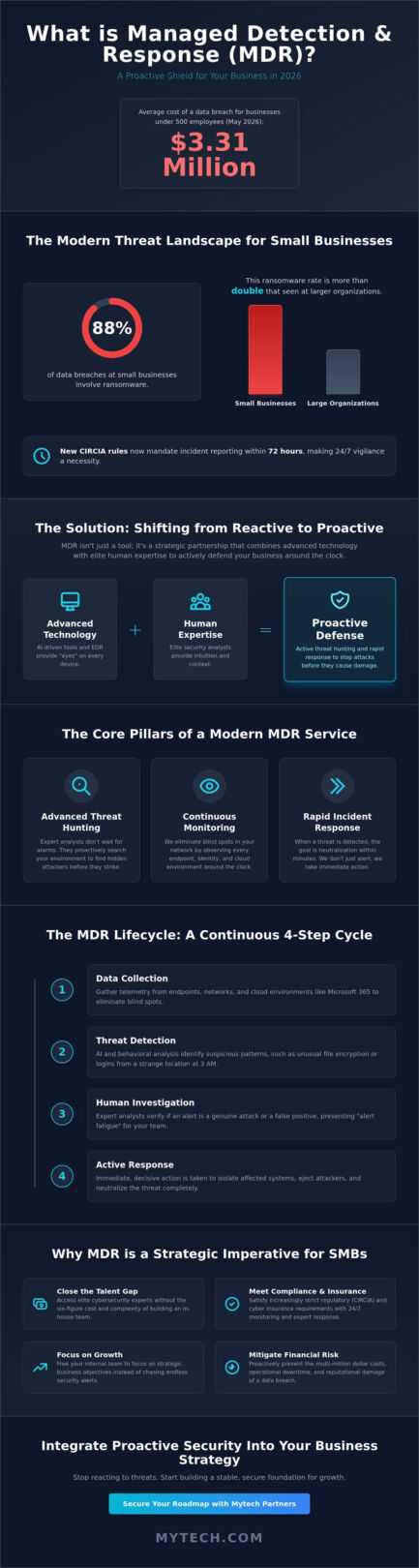
88% of data breaches at small businesses now involve ransomware, which is more than double the rate seen at larger organizations. With the average cost of a breach for businesses under 500 employees reaching $3.31 million in May 2026, the stakes for your infrastructure have never been higher. You likely feel the pressure of these evolving threats and the constant need to monitor your systems. To protect your growth, you must understand what is managed detection and response (MDR) and how it shifts your posture from reactive to proactive.
We’ve seen how internal teams often lack the capacity to maintain 24/7 vigilance, especially with the final CIRCIA rules now requiring incident reports within 72 hours. This guide clarifies the value of MDR by showing how it combines advanced technology with human expertise to provide a stable, secure foundation. You’ll discover a strategic roadmap for risk mitigation that empowers your business to thrive without the fear of digital disruption. We will break down 2026 pricing models and service levels so you can choose a security strategy with total confidence.
Key Takeaways
- Understand what is managed detection and response (MDR) and how it bridges the gap between automated tools and expert human intuition to stop sophisticated attacks before they disrupt your operations.
- Discover how a dedicated Security Operations Center (SOC) provides continuous 24/7 threat hunting, giving you the freedom to focus on growth while experts protect your infrastructure.
- Learn to navigate the complex cybersecurity landscape by distinguishing MDR from traditional models through its emphasis on active defense rather than simple alert monitoring.
- Explore why MDR is the most strategic way for SMBs to close the talent gap and meet increasingly strict insurance and regulatory requirements without the cost of an in-house team.
- Gain a clear roadmap for integrating proactive security into your broader business strategy to ensure a stable environment that serves as a catalyst for success.
Defining Managed Detection and Response (MDR) in 2026
As of May 2026, the digital environment has become too complex for automated tools to manage alone. Understanding Managed detection and response (MDR) is the first step toward securing your business continuity. MDR is an outsourced cybersecurity service that provides 24/7 threat monitoring and response; it’s a strategic partnership that combines elite security analysts with advanced AI-driven tools to protect your infrastructure. While software can flag a potential issue, it lacks the human intuition required to stop sophisticated, multi-stage attacks. This service bridges that gap, ensuring that technology serves as a catalyst for your success rather than a source of anxiety.
Traditional antivirus is no longer sufficient because modern cyber threats are designed to bypass static defenses. Attackers now use “living off the land” techniques, using your own legitimate system tools against you. Without human experts to interpret these subtle signals, a breach can go undetected for weeks. By asking what is managed detection and response (MDR), you’re looking for a solution that doesn’t just watch your network but actively defends it.
The Evolution from Passive to Proactive Defense
The threat landscape has shifted dramatically from simple viruses to targeted ransomware. Today, 88% of data breaches at small businesses involve ransomware, which requires a much more aggressive stance than traditional security models. Passive defense only notifies you after a breach has occurred, leaving your team to scramble during a crisis. In contrast, a proactive MDR strategy focuses on active response. With the CIRCIA final rule now mandating that significant incidents be reported to CISA within 72 hours, waiting until Monday morning to address a Friday night alert is no longer an option. 24/7 coverage is a business necessity that ensures your operations remain stable regardless of the time or day.
The Core Pillars of a Modern MDR Service
A robust MDR framework rests on three essential capabilities that empower your organization to thrive securely. These pillars move your security from a cost center to a strategic asset:
- Advanced threat hunting: Expert analysts don’t wait for an alarm. They proactively search your environment to find hidden attackers before they strike.
- Continuous monitoring: We eliminate blind spots in your network by observing every endpoint and identity around the clock.
- Rapid incident response: When a threat is detected, the goal is neutralization within minutes. We don’t just alert you; we take action to contain the risk immediately.
By implementing these pillars, you gain the confidence that comes from a stable infrastructure. You can stop wondering what is managed detection and response (MDR) and start experiencing the freedom of a fully protected digital landscape.
How MDR Works: The Synergy of Technology and Human Expertise
MDR operates through a continuous cycle of data collection, analysis, and action. It isn’t just a product you install; it’s a dynamic service that combines high-speed technology with the intuition of experienced professionals. By integrating Endpoint Detection and Response (EDR) tools, MDR gains “eyes” on every device in your network. These tools feed a constant stream of telemetry into a central system where AI and machine learning accelerate the detection of unusual behavior. This setup allows your business to stay ahead of threats that would otherwise slip past traditional filters. As Gartner defines managed detection and response, the human element is what separates this service from basic automated alerting.
When exploring what is managed detection and response (MDR), it’s helpful to see it as a 4-step lifecycle that protects your bottom line:
- Step 1: Data Collection. We gather telemetry from endpoints, networks, and cloud environments like Microsoft 365 to eliminate blind spots.
- Step 2: Threat Detection. Behavioral analysis identifies suspicious patterns, such as a sudden surge in encrypted file activity or a login from an unusual country at 3 AM.
- Step 3: Investigation. Human analysts verify if the threat is a genuine attack or a legitimate administrative task, preventing “alert fatigue” for your team.
- Step 4: Active Response. We take immediate steps to isolate the affected device and remediate the system, neutralizing the threat within minutes.
The Role of the Security Operations Center (SOC)
The Security Operations Center, or SOC, acts as the “brain” of the entire operation. It’s a specialized facility staffed by analysts who monitor security feeds 24/7. These experts have seen it all across multiple industries, which allows them to recognize the early signs of a ransomware campaign before it spreads. This is vital because 61% of SMBs experienced a breach in the past year, often occurring outside of standard business hours when internal teams are offline.
A SOC functions as a seamless extension of your own team. They handle the “tech anxiety” of constant monitoring so your staff can focus on high-value projects that drive revenue. This collaborative approach ensures that your security roadmap remains aligned with your corporate objectives. If you need help determining which tools are right for your environment, our strategic IT consulting provides the clarity you need to move forward with confidence. By understanding what is managed detection and response (MDR) in a practical sense, you can see how it creates a stable infrastructure that serves as a catalyst for success.
MDR vs. MSSP vs. EDR: Understanding the Landscape
The cybersecurity industry loves its acronyms. For a business leader, this “alphabet soup” can feel like a barrier to clear decision making. To build a resilient roadmap, you need to understand how these layers differ and where they overlap. While it’s easy to get lost in the technical jargon, the choice boils down to how much of the “heavy lifting” you want your team to handle during a crisis. Matching the right solution to your specific risk profile is the only way to ensure your technology remains a catalyst for success rather than a source of stress.
Managed Security Service Providers (MSSPs) traditionally focus on monitoring logs and maintaining compliance. They’re excellent at telling you that something might be wrong. However, they often stop at the notification stage. This leaves your internal team to investigate and remediate the threat. In contrast, when you ask what is managed detection and response (MDR), the answer lies in active defense. MDR doesn’t just send an alert; it provides the actual remediation. This shift from high-volume noise to high-fidelity, actionable intelligence is what allows a business to thrive without being buried in false alarms. By May 2026, full-service MDR that includes containment and remediation guidance typically costs between $25 and $50 per endpoint per month, providing a level of active defense that traditional MSSPs simply don’t match.
EDR vs. MDR: Tools vs. Managed Services
Endpoint Detection and Response (EDR) is the software that resides on your devices. It’s a powerful tool, but like any precision instrument, it requires a skilled operator. Many organizations face a “DIY trap” where they buy the software but lack the internal expertise to monitor it 24/7. Hiring a single security analyst in 2026 can be cost-prohibitive, let alone staffing a full rotation for around-the-clock coverage. This is where the value of a partnership becomes clear.
MDR is the service that makes the software effective. It leverages EDR as the primary data source to provide a complete it support solution. This combination ensures that the technology isn’t just a line item on your budget, but a catalyst for stability. By choosing MDR, you’re investing in the experts who know how to interpret the data and take decisive action. Understanding what is managed detection and response (MDR) helps you move past the software tools and toward a comprehensive security strategy that empowers your team and secures your long-term success.
Why SMBs Need MDR: Mitigating Risk and Empowering Growth
Many business owners mistakenly believe their organizations are “under the radar” for global cybercriminals. This misconception creates a dangerous vulnerability. In reality, attackers increasingly target small and medium-sized businesses because they often lack the sophisticated defenses found in larger enterprises. If you’re evaluating what is managed detection and response (MDR), you’re likely realizing that basic security is no longer a sufficient shield. For a business to scale safely in 2026, security must move from a reactive “break-fix” mindset to a proactive, strategic foundation. A stable infrastructure doesn’t just prevent failure; it serves as a catalyst for your long-term success.
The cost of a data breach for businesses with fewer than 500 employees has reached an average of $3.31 million as of May 2026. This figure represents more than just a financial loss; it reflects the total disruption of business continuity and the erosion of client trust. By integrating MDR, you’re not just buying a service. You’re investing in a roadmap that mitigates these risks while empowering your team to focus on high-level growth initiatives rather than constant fire drills.
Closing the Security Expertise Gap
Finding and retaining high-level cybersecurity talent is one of the greatest challenges facing SMBs today. The market for security analysts is incredibly competitive, making it cost-prohibitive for most organizations to staff a 24/7 internal rotation. MDR solves this problem by providing immediate access to a full team of experts for a fraction of the cost of a single full-time hire. This partnership alleviates the “tech anxiety” often felt by leadership. You can operate with confidence, knowing that disciplined professionals are watching your digital perimeter around the clock, even when your office is closed.
Compliance and Insurance Readiness
Cyber insurance carriers have implemented much stricter requirements for coverage in 2026. To qualify for a policy or maintain affordable premiums, businesses must now prove they have advanced endpoint protection and documented incident response plans in place. MDR provides the continuous monitoring and detailed audit trails necessary to satisfy modern compliance standards like HIPAA, SEC regulations, and the final CIRCIA reporting rules. MDR provides the comprehensive documentation and real-time activity logs required to pass rigorous security audits and demonstrate regulatory due diligence.
If you’re ready to move beyond reactive security and build a more resilient organization, our managed security services provide the strategic guidance you need to thrive. By understanding what is managed detection and response (MDR) as a tool for growth, you can transform your security posture into a competitive advantage.
Navigating Your Security Roadmap with Mytech Partners
Building a secure environment isn’t a one-time project; it’s a continuous journey that requires a disciplined guide. At Mytech, we act as your Trusted Navigator, helping you move beyond the initial question of what is managed detection and response (MDR) to see how it fits into your broader corporate context. We don’t just manage your technology. We empower your growth by ensuring your infrastructure remains stable and resilient against the $109 billion in cyber threats projected to target SMBs globally by 2026. Our approach tethers every security measure to a specific business outcome, such as increased productivity or reduced risk, ensuring your IT investment acts as a catalyst for success.
Our “presume breach” strategy means we’ve already prepared for the complexities you might face. We don’t just react to alerts; we plan for every eventuality. This discipline is what allows our clients to feel a sense of calm authority over their own operations. When you understand what is managed detection and response (MDR) through the lens of a Mytech partnership, you see it as more than just software. It’s a commitment to your organization’s long-term health and scalability. We lead you through the complexities of the modern digital landscape with a steady, deliberate rhythm that avoids the frantic pace of high-pressure sales tactics.
A Strategic Approach to Layered Security
MDR is a critical component of it services and support for growing firms. We combine proactive maintenance with advanced security layers to eliminate the blind spots that often lead to “tech anxiety.” By including security as a foundational element in your technology roadmap, we help you avoid the granular frustrations of IT failures. This strategic alignment allows your team to thrive in a secure digital landscape, knowing that your long-term health is our primary focus. Our role is to ensure that your infrastructure is not just managed, but optimized for scalability and risk mitigation.
Ready to Secure Your Future?
Starting the conversation about your security posture shouldn’t feel like a high-pressure situation. We believe in an educational and consultative cadence that begins with a comprehensive assessment of your current vulnerabilities. Our team identifies the gaps in your existing defenses and provides a clear path toward risk mitigation. This roadmap is designed to align with your specific business goals, providing the freedom and confidence that come from a stable environment.
Contact Mytech today to discover how our it support and managed services protect your bottom line. We invite you to join us in a collaborative journey where we lead the way through the modern digital landscape. Let’s work together to transform your technology from a tool to be managed into a strategic asset that secures your future and empowers your organization to thrive.
Secure Your Path to Sustainable Growth
Security is no longer just a technical requirement; it’s a foundational pillar of your business growth. You now understand what is managed detection and response (MDR) as a proactive shield that combines advanced AI with 24/7 human intuition. This strategy ensures your organization meets the strict CIRCIA reporting standards and cyber insurance mandates of 2026. By shifting from passive alerts to active remediation, you eliminate the anxiety that often holds leadership back from making bold strategic moves.
With over 20 years of experience as a Trusted Navigator for SMBs, Mytech Partners brings a business-first approach to your IT roadmap. We provide national reach with a personalized, consultative touch that transforms your infrastructure into a catalyst for success. Empower your business with strategic MDR; Connect with Mytech Partners today. We’re ready to lead you through the complexities of the modern digital landscape so you can focus on what you do best.
Frequently Asked Questions
Is MDR the same as managed antivirus?
No, MDR is significantly more comprehensive than managed antivirus. While antivirus software blocks known malware, it can’t adapt to the “living off the land” tactics used in 88% of small business ransomware attacks. MDR provides a team of experts who use behavioral analysis to hunt for hidden threats that software alone often misses.
How much does MDR typically cost for a mid-sized business?
Pricing for MDR in 2026 depends on the level of service and the size of your environment. For a 500-endpoint environment, full-service MDR with containment and remediation typically costs between $25 and $50 per endpoint per month. Comprehensive annual plans that cover cloud, identity, and network monitoring can range from $96,000 to over $420,000.
Do I need MDR if I already have a managed service provider (MSP)?
Yes, because most standard MSPs focus on infrastructure availability rather than proactive threat hunting. Understanding what is managed detection and response (MDR) helps you see it as a specialized security layer that works alongside your MSP. It ensures your business has 24/7 protection that standard IT support hours don’t cover.
Can MDR help my business recover from a ransomware attack?
MDR is designed to minimize the impact of ransomware by containing the threat within minutes of detection. While it focuses on prevention and containment, it also provides remediation guidance to help restore your systems. This proactive approach is vital since the average cost of an SMB data breach has reached $3.31 million as of May 2026.
How quickly does an MDR team respond to a detected threat?
An effective MDR team aims to respond to critical threats within minutes. This speed is essential for compliance with the CIRCIA final rule, which mandates reporting significant incidents within 72 hours of discovery. Rapid response prevents a single compromised device from turning into a full-scale network outage that disrupts your continuity.
What is the difference between MDR and XDR?
XDR (Extended Detection and Response) is a technology platform, while MDR is a managed service. XDR provides the tools to collect data across email, cloud, and network layers. MDR is the strategic partnership where human analysts use those tools to manage your security posture and respond to incidents. You can’t have effective MDR without the right technology, but technology alone doesn’t provide 24/7 response.
Does MDR replace my internal IT team?
No, MDR acts as a force multiplier for your internal IT team rather than a replacement. It handles the exhausting 24/7 monitoring and “tech anxiety” of security alerts. This allows your internal staff to focus on strategic projects and high-value tasks that drive your company’s bottom line and long-term scalability.
Is MDR required for cyber insurance in 2026?
As of May 2026, many insurance carriers mandate advanced endpoint protection and 24/7 monitoring for coverage. While not a universal legal requirement, having an MDR service in place is often the only way to qualify for a policy or avoid exorbitant premiums. When you understand what is managed detection and response (MDR), you see it provides the documented response plans that insurers now demand.