



Did you know that organizations using professional managed providers typically reduce their total technology costs by 20% to 30% while increasing employee productivity by up to 25%? For many business owners, finding the right it services and support feels like a source of constant anxiety rather than a strategic advantage. You likely recognize the hidden drain of the break-fix model or the fear of a data breach, which now averages $3.31 million for companies with fewer than 500 employees. It’s common to feel like you’re just waiting for the next system failure to disrupt your momentum.
We believe your technology should work silently and effectively to support your vision. This guide explains how modern IT strategies shift your infrastructure from a costly burden into a strategic engine that drives growth. You’ll discover how to achieve predictable costs and total confidence in your data security. We’ll preview the essential components of a 2026 technology roadmap, including the impact of ITIL 5 standards launched in February 2026 and the new digital resilience requirements that keep your business ahead of the curve.
Key Takeaways
- Learn the critical distinction between high-level technical expertise and day-to-day user support to ensure your organization has total operational coverage.
- Identify the hidden financial drains of the reactive break-fix model and why a proactive approach is essential for modern business continuity.
- Discover how to evaluate it services and support providers based on their ability to act as a strategic partner rather than just a technical vendor.
- Build a clear path to growth by aligning your technology roadmap with your broader corporate objectives for maximum scalability and security.
Defining IT Services and Support in 2026
By May 2026, the distinction between simple troubleshooting and strategic enablement has never been clearer. IT services represent the broad application of technical and business expertise to help your organization reach its goals. In contrast, IT support is the specific, tactical subset that keeps your users productive and your systems online. Together, modern it services and support act as a catalyst for growth rather than a recurring line-item expense. We view this partnership as the foundation for a stable, secure, and scalable enterprise. This shift in perspective allows business owners to stop worrying about what might break and start focusing on how technology can expand their market reach.
The goal of a modern service provider is to move beyond the “cost center” label. Instead of viewing technology as a burden to be managed, successful organizations use it as a strategic engine. This requires a transition from reactive fixing to proactive enabling. When your technology aligns with your business outcomes, you gain the freedom to innovate without the constant fear of system failure or data loss. It’s about creating a environment where every tool and software choice directly contributes to your bottom line.
The Evolution of Technical Support
The traditional help desk has transformed significantly. We’ve moved beyond the era of simply maintaining on-premise hardware to managing complex, cloud-first environments that require specialized oversight. Modern Technical Support now relies on 24/7/365 monitoring and automated remediation to stop problems before they impact your team. In 2026, AI and machine learning are standard tools for predictive maintenance. These technologies analyze log data and performance metrics in real-time to identify potential failures. This proactive stance means your business avoids the costly disruptions associated with the old “break-fix” mentality, ensuring that uptime is a constant rather than a variable.
Why Business Leaders Must Care About IT Strategy
Technology strategy is no longer optional for the C-suite. With the 2026 revision of the NIST Cybersecurity Framework (CSF 2.0) emphasizing governance and supply chain risk, leaders must prioritize IT as a core business function. A well-defined tech roadmap ensures your organization remains compliant with evolving regulations like DORA while boosting employee retention. When systems are stable and secure, your team feels empowered to do their best work without the frustration of constant downtime. This strategic alignment turns your infrastructure into a competitive advantage. By treating IT as a partner in risk mitigation and productivity, you create a resilient environment where your business can thrive regardless of external digital threats.
The Core Pillars of Comprehensive IT Services
Organizations often struggle with “tool sprawl,” where they have plenty of software but no cohesion. We approach it services and support by organizing technology into three essential pillars that work in tandem. This structure simplifies complex environments and ensures that every investment serves a strategic purpose. By acting as a it solutions provider, we help you choose the right service mix that aligns with your specific corporate roadmap. This “Trusted Navigator” approach replaces tech anxiety with the confidence that your infrastructure is built for long-term scalability.
Managed Security and Risk Management
Managed security is the first pillar of stability. Cybersecurity is the fastest-growing segment of the industry, with an 18% annual growth rate through 2026. This growth is driven by the increasing complexity of threats and the 2026 enforcement of the Digital Operational Resilience Act (DORA), which mandates real-time risk monitoring. We move beyond basic, reactive virus scanning to proactive threat hunting. This level of diligence is vital for maintaining HIPAA or legal compliance, where data integrity is the top priority. A layered security strategy ensures that even if one defense is breached, multiple other safeguards protect your sensitive information.
Cloud Infrastructure and Microsoft 365 Optimization
The second pillar focuses on maximizing your existing digital investments. Cloud waste is a significant issue for modern businesses, with reports indicating that an average of 27% of cloud spending is wasted. We prioritize Microsoft 365 optimization to ensure you’re utilizing every feature you pay for while maintaining a secure, scalable environment. This approach supports remote and hybrid teams by providing seamless access to data without compromising performance. For a look at how large-scale organizations manage these complex user needs and infrastructure, the framework at Oregon Tech IT Services provides a useful reference for structured support and account management.
Business Continuity and Disaster Recovery
Finally, business continuity ensures that your organization can survive a crisis. A backup is just a copy of data; true continuity is a promise of operational survival. When the average cost of a data breach for companies under 500 employees reached $3.31 million in 2026, you can’t afford to leave your recovery to chance. We help you calculate the real cost of downtime to create a recovery roadmap that actually works. We don’t just set up backups; we test and validate recovery protocols to ensure they function when needed most. This proactive stance gives you the freedom to grow without the fear of a single failure halting your progress.
If you’re ready to move away from fragmented tools and unpredictable downtime, partner with us to build a secure foundation.
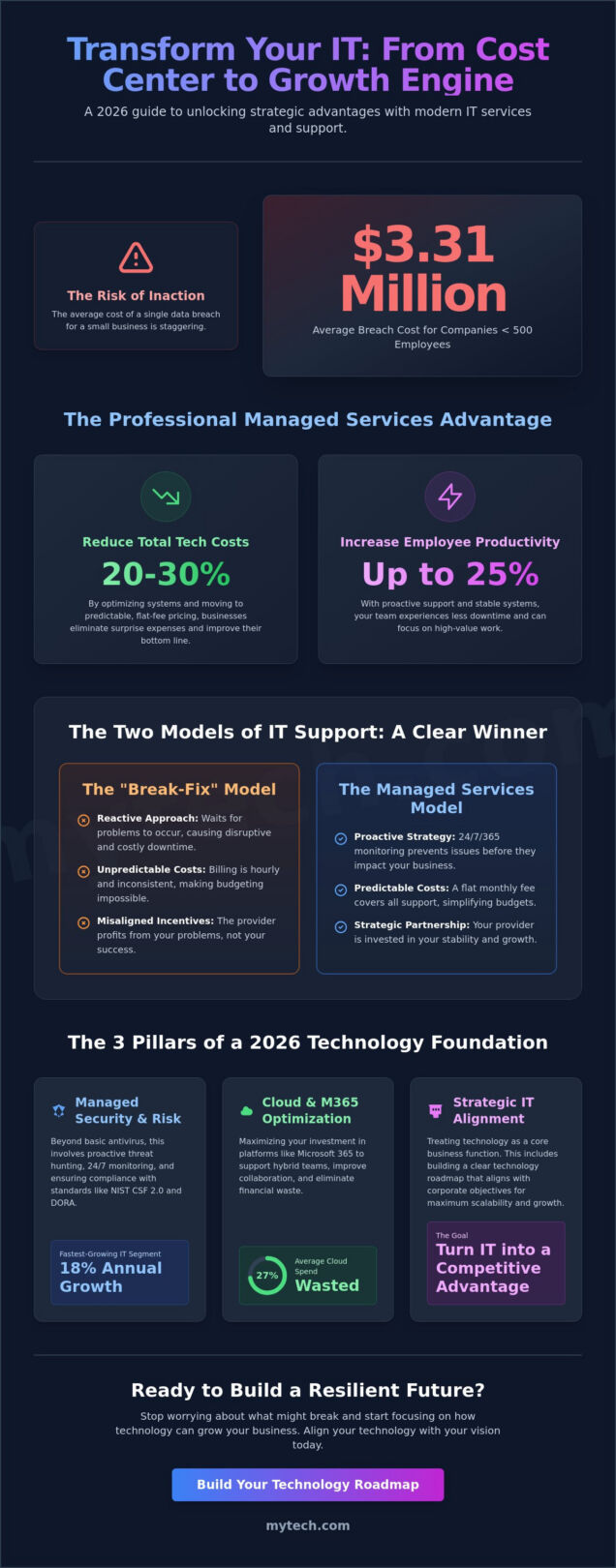
Break-Fix vs. Managed IT Support: Which Model Wins?
Choosing between reactive maintenance and proactive partnership is the most significant decision you’ll make for your operational health. The traditional break-fix approach to it services and support relies on a fundamental conflict of interest. In this model, your technology provider only generates revenue when your systems fail. This creates a cycle where you’re forced to wait for a disaster before receiving help, leaving your business vulnerable to extended downtime and unpredictable financial hits. We believe a modern business deserves a partner whose goals align perfectly with their own success.
Managed IT is a strategic partnership where the service provider’s success is directly tied to the client’s stability, ensuring that both parties win when technology works perfectly. This model shifts the focus from fixing broken parts to maintaining a high-performance environment. When your provider is incentivized to prevent problems rather than bill for them, you gain a level of reliability that the old reactive model simply cannot match.
The True Cost of Reactive IT
The “tech anxiety” caused by the break-fix model is a silent productivity killer. When you’re waiting for a technician to respond to a critical failure, your team’s momentum grinds to a halt. In 2026, hourly rates for break-fix support range between $125 and $350 per hour. These costs don’t include the massive revenue loss associated with system outages. Budget volatility makes financial planning nearly impossible, as a single major server failure or security incident can result in an invoice totaling thousands of dollars without warning. This uncertainty prevents you from investing in the tools that actually drive growth.
The Value of a Managed Partnership
A proactive managed model provides the calm authority your business needs to thrive. Organizations that transition to managed services typically reduce their overall technology costs by 20% to 30% while seeing a 15% to 25% boost in employee productivity. Instead of unpredictable hourly bills, you benefit from consistent monthly fees that range from $110 to $400 per user, depending on your security requirements. This predictability simplifies your financial roadmap and ensures you always have access to a full team of specialists. You’re no longer dependent on the limited knowledge of a single “IT guy” but instead supported by a disciplined infrastructure designed to scale with your ambitions. This proactive maintenance identifies and resolves vulnerabilities before they can disrupt your operations, providing the freedom to focus on your core business objectives.
How to Evaluate an IT Support Company
Selecting a provider for it services and support is one of the most critical leadership decisions you’ll make this year. You aren’t just hiring a technician to fix laptops; you’re choosing a strategic partner who will safeguard your data and enable your growth. A true partner acts as a “Trusted Navigator,” guiding you through complex regulatory changes like the SEC’s four business day incident reporting mandate. You should prioritize firms that offer a sophisticated framework for it support services, focusing on long-term outcomes rather than short-term fixes. Look for an organization that combines a national depth of resources with the personal accountability of a local team.
Industry-specific experience is non-negotiable in 2026. A provider serving the healthcare or financial sectors must demonstrate a deep understanding of the Digital Operational Resilience Act (DORA) and NIST CSF 2.0 standards. They should be able to explain how their internal protocols align with the Cyber Incident Reporting for Critical Infrastructure Act (CIRCIA), which requires reporting significant incidents within 72 hours. If a provider cannot speak fluently about these compliance requirements, they cannot effectively mitigate your risk.
Critical Questions for Potential Partners
When vetting a partner, move beyond basic cost discussions. Ask about their average resolution time, not just how fast they answer the phone. Inquire if their staff is trained on the ITIL 5 standards launched in February 2026. A high-quality provider will offer vCIO (Virtual Chief Information Officer) services to lead your strategic planning. They should provide a clear roadmap for your technology that aligns with your three-year business goals. Verify their security certifications and ask for proof of their own internal disaster recovery testing. You need to know that the team protecting your business practices what they preach.
Red Flags to Avoid in IT Support
Be wary of providers who offer a “one-size-fits-all” approach to cybersecurity. Every business has a unique risk profile, and your security stack should reflect that. Lack of transparency in pricing is another major warning sign. In 2026, standard managed packages typically fall between $110 and $175 per user, while advanced security packages can reach $400. If a quote seems unusually low, they may be hiding project fees or omitting essential services like 24/7 monitoring. Finally, avoid companies that only talk about hardware and software. If they don’t ask about your business outcomes or employee productivity, they’re a vendor, not a partner.
Ready to experience the confidence that comes with a proactive technology partner? Schedule a strategic technology consultation today to see how we can empower your organization.
Strategic IT Alignment: The Path to Business Growth
The transition from basic technical help to strategic empowerment is the final step in your organizational maturity. While previous sections defined the tactical components of it services and support, the true value lies in total business alignment. We act as your Trusted Navigator, ensuring that every hardware investment or security protocol serves a specific corporate objective. This alignment is maintained through a disciplined Technology Roadmap, a strategic document that anticipates your needs for the next 36 to 60 months. By looking beyond the current quarter, you replace the tech anxiety of the past with a clear, proactive path toward long-term success. It’s a shift from managing tools to mastering your digital environment.
A professional approach to technology removes the burden of maintenance from your leadership team. When you stop worrying about the “how” of your infrastructure, you gain the mental bandwidth to focus on the “what” of your business growth. This strategic shift ensures that your technology is no longer a cost center to be minimized, but a growth engine to be leveraged. We provide the steady, deliberate guidance needed to turn complex technical challenges into measurable business results.
Empowering Your Team to Thrive
Technology should be a silent partner in your success. When your infrastructure is stable and secure, your employees are free to focus on their core roles without the friction of system lag or software errors. Professional it services and support create an environment where scaling doesn’t result in organizational chaos. As you expand your footprint or integrate new AI-driven workflows, your systems should adapt seamlessly to support that growth. This professional foundation provides the calm authority necessary for high-level decision-making. You stop being a manager of technical failures and become the leader of a resilient, digital-first enterprise that attracts and retains top talent.
Ready to Achieve Greater Productivity?
The journey toward strategic alignment begins with a consultative discovery process, not a high-pressure sales tactic. We believe the most effective first step is a comprehensive IT assessment to understand how your current infrastructure compares to 2026 industry standards. This evaluation uncovers hidden risks in your supply chain and identifies areas where your technology might be hindering rather than helping your productivity. By establishing this baseline, we can build a customized strategy that secures your data and empowers your workforce. This proactive approach is the ultimate antidote to the stress of modern business technology.
Discover how Mytech Partners aligns technology with your business goals.
Build Your Strategic Technology Roadmap Today
The right approach to it services and support transforms your technology from a constant source of anxiety into a reliable catalyst for growth. You’ve already explored how moving beyond the reactive break-fix model reduces costs and empowers your team to focus on their core roles. By prioritizing strategic alignment and layered security, you protect your bottom line while preparing for the regulatory landscape of 2026 and beyond. This proactive stance ensures that technology supports your vision rather than hindering it.
Mytech Partners has served as a Trusted Navigator for organizations since 2000. We bring decades of experience to complex industries, including specialized compliance expertise for healthcare, legal, and manufacturing sectors. We don’t just manage your hardware; we build the secure foundation your business needs to thrive in a digital-first market. Our disciplined process ensures your infrastructure remains resilient against evolving threats and ready for future scale.
Partner with Mytech Partners to transform your IT into a strategic asset.
Your journey toward a more stable and secure future starts with a single strategic decision. We’re ready to lead the way and help your organization reach its full potential.
Frequently Asked Questions
What is the difference between IT services and IT support?
IT services represent the broad strategic application of technical expertise to enable your business goals. IT support is the specific subset of those services focused on resolving user issues and maintaining system uptime. While support keeps your daily operations running; comprehensive it services and support ensure your entire technology stack aligns with your long-term growth roadmap.
How much does IT support for a small business typically cost?
In 2026, managed IT support for small businesses typically ranges from $95 to $295 per user per month. Basic monitoring and support packages often start between $75 and $125 per user. These rates vary based on the complexity of your network and the specific security protocols required to protect your data from evolving threats.
Does my small business really need managed IT services?
Yes; because small companies are frequent targets for cyberattacks that can cause irreparable financial damage. With the average cost of a data breach for organizations under 500 employees reaching $3.31 million in 2026, a proactive approach is vital. Managed services provide the “Zero Trust” architecture and 24/7 monitoring necessary to prevent these catastrophic events before they occur.
What are the most common IT services for mid-sized companies?
Mid-sized organizations typically prioritize managed security, cloud infrastructure optimization, and business continuity planning. These companies often allocate 4% to 5% of their annual revenue to technology to maintain a competitive edge. They focus heavily on platform consolidation to reduce tool sprawl and use AI-driven workflows to increase employee productivity by up to 25%.
Can an IT support company help with cyber insurance compliance?
A professional provider ensures your infrastructure meets the rigid MFA and governance standards required by modern insurers. Following the 2026 revision of the NIST Cybersecurity Framework, insurers demand proof of risk-informed decision-making. We help you document these controls and maintain the 72-hour incident reporting window mandated by the Cyber Incident Reporting for Critical Infrastructure Act.
What happens during a strategic IT assessment?
We conduct a comprehensive analysis of your existing hardware; software; and security protocols to identify hidden vulnerabilities. This process evaluates how well your current it services and support align with your three-year business objectives. You receive a prioritized roadmap that suggests specific improvements to reduce waste and build a more resilient digital foundation for your team.
How do I know if my current IT provider is underperforming?
Recurring downtime and a lack of proactive communication are clear signs that your provider is failing. If they only respond to broken equipment and never discuss strategic topics like DORA compliance or cloud cost optimization; they’re acting as a vendor rather than a partner. A high-quality partner should consistently suggest ways to improve your efficiency and security.
Is it better to have an in-house IT person or an outsourced team?
An outsourced team offers a depth of specialized knowledge and 24/7/365 monitoring that a single in-house employee cannot provide. While an internal staff member offers physical proximity; an outsourced partner provides a scalable “Trusted Navigator” approach. This ensures you have access to the latest security certifications and automated remediation tools without the overhead of a large internal department.