


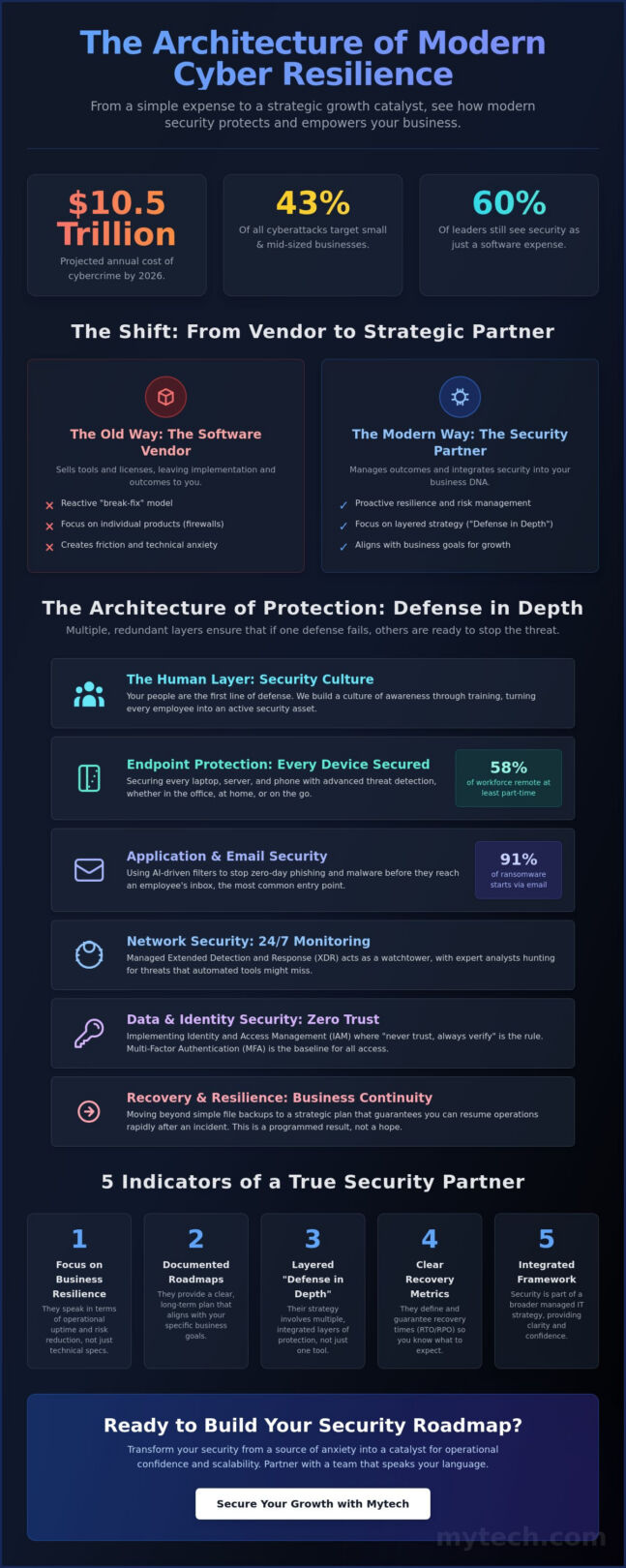
By 2026, global cybercrime costs are projected to hit $10.5 trillion annually according to Cybersecurity Ventures, yet 60% of business leaders still view their defense as a simple software expense. You likely recognize that a standard firewall is no longer enough to stop modern ransomware. However, finding a strategic it security company that speaks your language is often difficult when dense technical jargon obscures the real ROI on your spend. It’s frustrating to feel like you’re constantly reacting to threats instead of building a stable foundation for growth.
We want to change that perspective. This guide demonstrates how a strategic partner moves beyond basic digital locks to provide the comprehensive resilience and long-term roadmap your organization needs to thrive. You’ll discover the practical framework of layered security and gain a clear set of criteria for choosing a partner that aligns with your specific business goals. We’ll show you how to transform your security posture from a source of anxiety into a catalyst for operational confidence and scalability.
Key Takeaways
- Understand the evolution of the modern it security company from a simple software vendor into a strategic partner focused on your long-term resilience.
- Discover how a “Defense in Depth” philosophy creates multiple layers of protection to minimize the operational impact of potential digital threats.
- Learn how to move beyond “tech anxiety” by investing in proactive security that serves as a catalyst for business growth and stability.
- Identify the five critical indicators for evaluating a security partner, including the importance of documented roadmaps and recovery metrics.
- Explore how integrating cybersecurity with a broader managed IT framework provides the clarity and confidence your leadership team needs to thrive.
Defining the Modern IT Security Company in 2026
An it security company in 2026 is no longer a vendor you call only when a laptop fails or a password is lost. It’s a strategic partner that integrates proactive protection and risk management into your business DNA. While you can browse a list of computer security companies to see the sheer scale of the industry, a modern partner does more than sell a software license. They manage your long-term resilience. We’ve moved past the era of “break-fix” models. Leaders now expect a “Trusted Navigator” who anticipates threats before they disrupt the bottom line.
The distinction between a product vendor and a service provider is critical for your roadmap. Vendors sell tools; service providers manage outcomes. In a world where 43 percent of all cyberattacks now target small and mid-sized organizations, you can’t afford a reactive stance. These businesses are often viewed as “soft targets” by global threat actors because they lack enterprise-grade defenses. A modern it security company levels the playing field, ensuring your infrastructure is as robust as a Fortune 500 firm.
The Core Functions of a Security Partner
- Continuous Network Monitoring: We utilize Managed Extended Detection and Response (XDR) to provide a 24/7 watchtower over your digital assets. This isn’t just an alarm system; it’s a proactive hunting team that identifies anomalies before they escalate.
- Incident Response and Recovery: We develop rigid protocols that ensure your team knows exactly how to react if a breach occurs. Rapid recovery isn’t a hope; it’s a programmed result.
- Strategic Alignment: Security shouldn’t hinder your workflow. We ensure every protocol supports business productivity, removing the friction that often comes with technical compliance.
Beyond the Firewall: What Security Means Today
The traditional perimeter is gone. With 94 percent of enterprises now utilizing cloud services, your data lives everywhere. This shift makes traditional firewalls insufficient on their own. Modern security requires a human-centric approach. We focus on building a culture of awareness where every employee serves as an active layer of defense. Technology provides the shield, but your people provide the vigilance.
The Architecture of Protection: Understanding Layered Security
A modern it security company operates on the principle of “Defense in Depth.” This strategy assumes that no single security measure is 100% effective. Instead, we build redundant layers of protection to ensure that if a perimeter defense fails, secondary and tertiary controls stop the threat. This approach effectively minimizes the blast radius of a potential breach. It prevents a single compromised laptop from turning into a company-wide catastrophe. Success requires a seamless intersection of hardware, software, and human intelligence. While automated tools handle the vast majority of threats, the most dangerous 1% requires expert analysts to identify sophisticated patterns that software might miss.
Transitioning from basic managed it services security to a fully realized security posture is about moving from reactive fixes to proactive resilience. When you are evaluating cybersecurity platforms and partners, focus on how they integrate these disparate elements into a unified roadmap. This strategic alignment ensures technology serves your growth rather than creating new vulnerabilities.
The Critical Layers Every Business Needs
Endpoint protection is your first line of defense. With 58% of the American workforce working remotely at least part-time in 2024, the traditional office “moat” has disappeared. We secure every device, whether it’s in a coffee shop or a home office, using advanced detection tools. Email remains the primary entry point for 91% of ransomware attacks. We deploy AI-driven filters that catch “zero-day” phishing attempts before they reach an employee’s inbox. Finally, Identity and Access Management (IAM) ensures that only the right people have access to sensitive data. We implement Zero Trust architectures where Multi-Factor Authentication (MFA) is the baseline for every login, not a luxury.
Data Integrity and Disaster Recovery
Backups are a technical requirement; business continuity is a strategic outcome. A simple backup might save your files, but it doesn’t guarantee you can resume operations within a few hours. We use high-level encryption to render stolen data useless to attackers, ensuring client confidentiality remains intact even during a crisis. Ransomware Resilience is a combination of immutable backups and rapid failover capabilities. This ensures your data cannot be deleted or altered by an attacker, and your systems can “failover” to a clean environment in minutes. If you want to see how these layers fit your specific business goals, we can help you assess your current infrastructure for potential gaps.
Strategic Partnership vs. Technical Support: The ROI of Resilience
Business leaders often mistake technical support for a comprehensive security strategy. In 2026, the distinction determines whether your organization thrives or merely survives. A reactive “break-fix” model leaves you vulnerable to modern threats that move faster than any help desk ticket. Investing in a professional network security company shifts the focus from recovery to resilience. According to the 2023 IBM Cost of a Data Breach Report, the average cost of a breach reached $4.45 million, a figure that continues to climb as AI-driven attacks become more sophisticated. Strategic prevention costs a fraction of that total while protecting your brand equity.
A true it security company acts as a strategic partner that alleviates “tech anxiety.” This feeling of being one click away from a catastrophe paralyzes decision-making. We replace that uncertainty with a stable infrastructure. When your team knows the digital environment is secure, productivity increases. A 2024 study by Gallup found that employees are 21% more productive when they work with reliable tools that don’t require constant troubleshooting. We eliminate the “set it and forget it” myth. In 2026, software alone is a static defense against a dynamic enemy. You need human intelligence to monitor, adapt, and respond to threats in real time.
Reducing Risk to Fuel Business Growth
Security is now a primary driver for client acquisition. In current B2B markets, 73% of enterprise buyers require proof of robust cybersecurity before signing a contract. We help you navigate complex frameworks like HIPAA, SOC2, or CMMC, transforming compliance from a hurdle into a competitive advantage. During a security event, our team provides the calm authority needed to stabilize operations. We don’t just fix the problem; we lead your organization back to a state of confidence and growth.
Predictable Budgeting for Cybersecurity
Erratic emergency expenses destroy annual budgets. We move your organization to a stable monthly recurring model that makes financial planning simple. Our Virtual CISO (vCISO) services provide mid-sized businesses with executive-level security leadership without the $200,000 annual salary of a full-time hire. This strategic consulting prevents “over-tooling.” We identify and remove redundant software, ensuring every dollar spent on your it security company partnership directly supports your bottom line. We focus on lean, effective stacks that empower your team to work without limits.
How to Evaluate an IT Security Company: 5 Key Indicators
Selecting an it security company requires looking beyond technical checklists; you need a partner that integrates with your long-term vision. A strategic partner doesn’t just react to threats. They build a foundation that allows your business to scale without fear of digital disruption. Use these five indicators to separate high-level consultants from mere software vendors.
- Documented Security Roadmap: A true partner provides a multi-year strategy aligned with your business goals. If a provider can’t show you where your security posture will be in 18 months, they aren’t thinking strategically.
- MTTR Benchmarks: Evaluate their Mean Time to Recover (MTTR). According to 2024 industry benchmarks, top-tier providers aim for an MTTR of under four hours for critical incidents. Demand to see their historical performance data.
- Threat Intelligence Depth: They must leverage both local and national intelligence. Knowing that a specific ransomware variant is targeting regional manufacturing firms in 2025 allows for proactive defense rather than reactive cleanup.
- Business-First Communication: Cultural fit is essential. They should discuss “operational uptime” and “risk mitigation” rather than just “IOPS” or “packet filtering.”
- Continuous Improvement Cycles: Transparency in reporting is non-negotiable. Regular reviews should highlight progress against your roadmap and identify the next steps for optimization.
The Strategic Assessment Process
A Gap Analysis is your first step toward clarity. During this audit, a quality it security company focuses on your business objectives first. They’ll ask how a six-hour outage affects your 2026 revenue targets instead of just counting your laptops. Watch for red flags when interviewing cyber security companies near me. If a firm leads with a product pitch before understanding your specific workflow, they’re selling tools instead of security.
Certifications and Standards to Look For
Alignment with the NIST Cybersecurity Framework is the gold standard for methodology. It provides a structured language for managing and reducing risk across your entire organization. You should also demand SOC 2 Type II compliance from the service provider. This independent audit proves they follow the same rigorous security controls they recommend to you. Certified expertise is the baseline, but strategic application is the differentiator for firms that actually drive growth.
Ready to replace tech anxiety with a clear path forward? Schedule your strategic security audit today to see how we empower your business growth.
Building Your Security Roadmap with Mytech Partners
Selecting the right it security company is a pivotal decision that dictates your organization’s trajectory for the next several years. Mytech Partners serves as your Trusted Navigator, providing a steady hand as you cross the shifting terrain of the 2026 digital landscape. We believe that true protection comes from the seamless integration of our cybersecurity services within a comprehensive Managed IT framework. This holistic approach ensures that security isn’t a bottleneck, but a foundation for high performance across your entire enterprise.
Our team prioritizes Microsoft 365 optimization and cloud security to prevent vulnerabilities before they ever manifest. While many organizations only utilize a fraction of their software capabilities, we actively configure your environment to maximize your existing investment while closing critical security gaps. This proactivity allows your leadership team to focus on innovation rather than firefighting technical glitches. The Mytech promise is simple: we empower your business to thrive through technological stability and forward-thinking strategy.
The Mytech Methodology: Aligning Tech with Goals
We recognize that tech anxiety often stems from a lack of clarity and a fear of the unknown. Mytech replaces this uncertainty with calm, authoritative guidance and a disciplined methodology. We use a problem-solution-result flow to address your specific hurdles. In the healthcare sector, we’ve helped clinics secure sensitive patient data while improving staff workflow efficiency by 25%. For our legal and manufacturing clients, we translate complex compliance requirements into actionable steps that drive measurable value. Our goal is to make every technical decision feel purposeful, manageable, and aligned with your primary business objectives.
Next Steps Toward a Secure Future
A secure future isn’t built on reactive patches or last-minute hardware swaps. It requires a comprehensive technology roadmap that looks three to five years ahead. This roadmap serves as your strategic guide, ensuring that every dollar spent on your it security company partnership contributes directly to your bottom line. We invite you to engage with our team for a no-pressure strategic conversation to assess your current posture and identify growth opportunities. At the end of the day, technology is not just a tool to be managed; it’s the primary catalyst for your ongoing success.
Secure Your Competitive Edge for the Years Ahead
Navigating the digital landscape of 2026 requires more than reactive fixes. It demands a layered architecture that integrates protection into the very fabric of your business operations. By shifting focus from basic technical support to a strategic partnership, you transform security into a driver of measurable ROI. Choosing the right it security company means finding a partner that aligns NIST and SOC2 frameworks with your specific growth objectives.
Mytech Partners brings 25+ years of experience in strategic IT consulting to help you move beyond tech anxiety. Our “Trusted Navigator” approach ensures your infrastructure remains stable and scalable while you focus on leadership. We don’t just react to threats; we build proactive roadmaps that empower your entire organization to thrive. You deserve a foundation that supports your vision without compromise.
Empower your business growth with a strategic security roadmap from Mytech Partners.
Take the lead in your industry with the confidence that your team is ready for every new opportunity.
Frequently Asked Questions
What is the difference between an IT company and a cybersecurity company?
An IT company manages your infrastructure uptime and hardware performance, while an it security company focuses on protecting that infrastructure from malicious threats. Standard IT providers handle helpdesk tickets and software installations. In contrast, security specialists prioritize risk management and data integrity. The NIST Cybersecurity Framework identifies five core functions, Identify, Protect, Detect, Respond, and Recover, which form the foundation of a security partner’s strategic approach.
How much should a small business spend on an IT security company?
Small businesses should allocate a specific portion of their technology budget to defense. Gartner’s 2023 research shows that organizations typically spend between 5.6% and 20% of their total IT budget on security measures. We help you determine where your investment will have the most impact. This strategic allocation ensures your growth isn’t derailed by preventable digital disruptions or unexpected recovery costs.
Does my business really need a security partner if we use cloud software like Microsoft 365?
You still need a security partner because cloud providers operate under a Shared Responsibility Model. Microsoft 365 manages the physical data centers, but your business is responsible for securing user identities and data access. Microsoft’s official documentation explicitly states that customers are responsible for protecting the security of their data and identities. We close these gaps to prevent unauthorized access and ensure your cloud environment stays protected.
What happens if my business is breached while working with a security company?
Your Incident Response Plan activates the moment a threat is detected. This protocol minimizes downtime and contains the spread of the attack. The IBM Cost of a Data Breach Report 2023 found that businesses with a tested incident response team save 2.32 million dollars compared to those without one. We lead this recovery process so your team can focus on returning to normal operations with full confidence.
Can an IT security company help with industry compliance like HIPAA or GDPR?
An it security company aligns your technical infrastructure with legal mandates like HIPAA or GDPR. We translate complex legal requirements into actionable technical controls. For example, Article 32 of the GDPR requires specific encryption and system resilience measures. We implement these protocols and provide the documentation needed to prove compliance during an audit, protecting your organization from heavy regulatory fines and reputational damage.
How often should an IT security company perform a risk assessment?
You should conduct a comprehensive risk assessment at least once every 12 months. This frequency ensures your defenses evolve alongside new threats and business changes. The PCI DSS 4.0 standard specifically requires an annual assessment to maintain payment card security. We perform these evaluations to identify vulnerabilities before they can be exploited, keeping your strategic roadmap current and your business operations running smoothly.
What is a vCISO, and does my company need one?
A vCISO is a Virtual Chief Information Security Officer who provides executive-level security leadership without the cost of a full-time executive. Most small to mid-sized firms don’t need a 220,000 dollar annual hire. Cybersecurity Ventures reported 3.5 million unfilled security roles in 2024, making this fractional model a smart way to access expert guidance. It gives you a seat at the table for high-level risk decisions.
How long does it take to implement a comprehensive security roadmap?
Implementing a foundational security roadmap typically takes 90 to 180 days. This period covers initial audits, tool deployment, and staff training. However, reaching a high level of maturity is a longer journey. The SANS Institute indicates that a fully optimized security posture requires 18 to 24 months of continuous refinement. We guide you through each phase, ensuring your business remains resilient as you scale and reach your goals.