



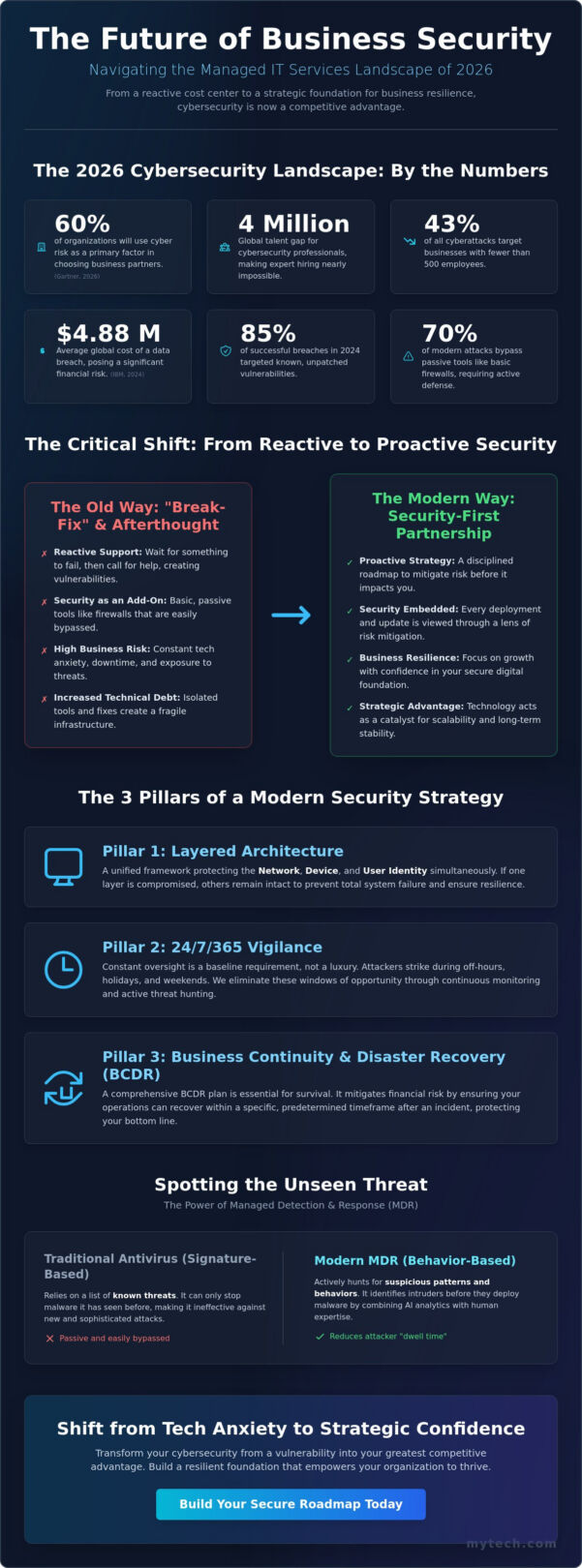
By 2026, Gartner predicts that 60% of organizations will use cybersecurity risk as a primary factor when choosing business partners. This shift means your managed it services security is no longer a back-office expense; it’s a vital pillar of your company’s competitive advantage. You likely feel the weight of cyber insurance premiums that rose 20% in recent cycles, coupled with a global talent gap of 4 million security professionals that makes hiring feel nearly impossible. It’s difficult to focus on growth when the fear of ransomware looms over your daily operations.
We believe technology should be a catalyst for your success, not a source of constant stress. You deserve a partner that replaces tech anxiety with a roadmap for long-term stability. This guide promises to show you how to transform your cybersecurity from a reactive cost center into a strategic foundation for business resilience. We’ll outline the exact steps to build a secure infrastructure and achieve regulatory compliance, giving you the freedom to lead your organization with total confidence.
Key Takeaways
- Learn how to transition from a reactive “break-fix” model to a proactive, security-first partnership that safeguards your business growth from the start.
- Discover how modern managed it services security utilizes layered architecture and Managed Detection and Response (MDR) to protect your network, devices, and users simultaneously.
- Understand the evolving 2026 threat landscape and why securing your supply chain is critical to preventing hackers from using your firm as a gateway to larger targets.
- Identify hidden vulnerabilities in your cloud and hybrid environments by conducting a strategic technology assessment to close configuration gaps before they are exploited.
- Shift from tech anxiety to strategic confidence by adopting a disciplined management roadmap that empowers your organization to thrive in a complex digital landscape.
What is Managed IT Services Security in 2026?
By 2026, the boundary between general IT maintenance and cybersecurity has completely dissolved. Modern managed it services security represents a unified strategy where every hardware deployment and software update is executed through a lens of risk mitigation. This integration ensures that proactive IT management doesn’t just keep your systems running; it keeps them resilient against an increasingly sophisticated threat environment. Business leaders no longer view technology as a series of isolated tools, but as a singular, secure foundation for growth.
The shift from reactive “break-fix” support to a security-first strategic partnership is the defining change of this era. In the past, companies called for help only when something failed. Today, that delay is a vulnerability. We act as a Trusted Navigator to alleviate the tech anxiety that often keeps executives awake at night. By replacing the fear of the unknown with a disciplined roadmap, we empower you to focus on your bottom line while we manage the complexities of your digital infrastructure.
The Evolution of the Managed Service Provider (MSP)
Traditional IT support has matured into comprehensive risk management. In 2026, a provider’s value isn’t measured by how fast they fix a printer, but by how effectively they align technology with your business objectives. Research from 2024 indicated that 85% of successful breaches targeted unpatched vulnerabilities. To address this, modern providers have adopted the principles found in What are Managed Security Services to create a more disciplined approach to infrastructure health. This evolution ensures your technology roadmap is a catalyst for scalability rather than a source of technical debt.
Security-First vs. Security-Afterthought
Many standard IT contracts contain hidden risks because they treat security as an optional add-on. A “security-afterthought” approach relies on passive tools like basic firewalls, which fail to stop 70% of modern, identity-based attacks. In contrast, a security-first culture prioritizes active threat hunting and real-time monitoring. This proactive stance has a direct impact on your company’s reputation and employee productivity. When your team isn’t battling downtime or suspicious system behavior, they remain engaged and efficient. Choosing a partner who embeds managed it services security into every workflow protects your most valuable assets: your data and your time.
The Pillars of a Modern Managed Security Strategy
Resilience in 2026 requires a departure from reactive “break-fix” mentalities. A robust managed it services security framework relies on a layered architecture that protects the network, the device, and the user identity simultaneously. This strategy ensures that if one layer is compromised, others remain intact to prevent a total system failure. Gartner defines an MSSP as an entity providing outsourced monitoring and management of security systems, but modern business needs have evolved beyond simple management. Organizations now require a partner that integrates security into every facet of the infrastructure roadmap.
To achieve this, businesses must look beyond simple management toward smarter IT solutions; for instance, Virtual Sprout provides guidance on modernizing infrastructure to ensure storage and hardware are fully aligned with a security-first strategy.
Mid-market organizations are increasingly targeted; 43% of all cyberattacks are now aimed at businesses with fewer than 500 employees. This reality makes 24/7/365 vigilance a baseline requirement rather than a luxury. Attackers often strike during holidays or weekends when internal teams are offline. By maintaining constant oversight, we eliminate these windows of opportunity. Additionally, a comprehensive Business Continuity and Disaster Recovery (BCDR) plan is essential for survival. The 2024 IBM Cost of a Data Breach Report found the average global cost of a breach rose to $4.88 million. BCDR planning mitigates this financial risk by ensuring your operations can recover in a specific, predetermined timeframe. You can explore our strategic approach to see how these layers work in tandem to protect your bottom line.
Managed Detection and Response (MDR) Explained
Traditional antivirus relies on known signatures to stop threats. This is no longer sufficient. MDR shifts the focus to real-time behavioral analysis, identifying patterns that suggest an intruder is present even if they haven’t deployed malware yet. This approach is critical for reducing “dwell time,” the period an attacker stays hidden in your network. By combining AI-driven analytics with human expertise, we validate and neutralize threats before they escalate into full-scale breaches. This proactive stance ensures managed it services security stays ahead of evolving tactics.
The Human Element: Security Awareness Training
Technology alone cannot stop every threat because 82% of breaches involve a human element, such as social engineering or phishing. We implement ongoing security awareness training as a core component of our managed services. This isn’t a one-time seminar. It’s a continuous educational process. We measure the impact by tracking the decline in successful simulated phishing attempts over 12-month periods, effectively turning your workforce from a vulnerability into a proactive defense layer.
Overcoming the “Too Small to be a Target” Misconception
Many business owners believe their size provides a “security through obscurity” shield. This logic fails in the 2026 threat landscape. Automated botnets and AI-driven scanners don’t search for company names; they hunt for unpatched vulnerabilities and open ports. Small and mid-sized firms often serve as the soft underbelly of the global supply chain. Threat actors use these smaller partners as conduits to reach high-value enterprise targets. This “island hopping” strategy now accounts for approximately 48% of modern cyberattacks.
Implementing robust managed it services security transforms your business from a vulnerable entry point into a fortified partner. You gain access to the same sophisticated defense mechanisms used by Fortune 500 companies, effectively leveling the digital playing field. Expert analysis from Forrester Security Services Insights highlights that proactive defense is now a basic requirement for any firm participating in the digital economy. We help you transition from a reactive posture to a strategic one, ensuring your infrastructure is a catalyst for growth rather than a liability.
The real cost of a breach extends far beyond the immediate ransom payment. You must account for:
- Operational Paralysis: The average downtime following a ransomware attack is 22 days.
- Reputational Erosion: 60% of small businesses close within six months of a major data breach due to lost client trust.
- Legal Liabilities: Regulatory fines and class-action lawsuits can exceed the original recovery costs.
The Financial Reality of Cyber Risk
Downtime is the silent killer of mid-market profitability. When your team can’t access critical data, revenue stops while fixed costs continue to mount. Investing in specialized cybersecurity services directly impacts your bottom line by reducing these variables. Most insurers now require proof of multi-factor authentication and 24/7 monitoring before they’ll issue or renew a policy. For a mid-market firm, the Total Cost of Risk is the comprehensive sum of insurance premiums, retained losses, and the administrative expenses required to manage and mitigate digital threats.
Compliance as a Competitive Advantage
Security isn’t just a defensive shield; it’s a growth engine. Regulated industries like healthcare, defense, and finance require strict adherence to frameworks like HIPAA, GDPR, or CMMC 2.0. When you maintain documented security protocols, you provide immediate peace of mind to stakeholders and investors. This transparency allows you to win larger contracts that your less-prepared competitors can’t touch. We guide you through the complexities of maintaining “audit-readiness” so you can focus on scaling your business with confidence. This strategic approach turns mandatory compliance into a powerful tool for market differentiation. Partnering with a dedicated it security company that understands these regulatory frameworks ensures your compliance posture becomes a genuine competitive differentiator rather than a checkbox exercise.
How to Evaluate Your Managed IT Security Posture
Assessing your managed it services security requires moving beyond basic checklists to uncover structural weaknesses that invite risk. We start by identifying “Tech Debt,” which according to 2024 McKinsey research, consumes nearly 40% of IT budgets and creates significant security holes. These legacy systems and unpatched applications create silent vulnerabilities that modern hackers exploit. A strategic evaluation also identifies configuration gaps in hybrid work environments. This is a critical step since 74% of organizations have adopted permanent flexible work models as of 2025, often leaving home-office connections under-secured.
Reviewing your current network security company helps determine if your partner keeps pace with the 2026 threat environment. A mature partnership focuses on proactive resilience rather than reactive fixes. We use these findings to formalize a multi-year tech roadmap. This plan prioritizes security investments based on their impact on your business continuity and risk mitigation, ensuring your budget aligns with your growth objectives.
The Strategic IT Assessment Process
A professional security and infrastructure audit provides a clear view of your digital health. You’ll receive a detailed inventory of assets and a risk-ranked list of vulnerabilities. A healthy IT environment maintains 99.9% uptime and ensures that 100% of critical security patches are applied within 48 hours of release. Conversely, a failing environment relies on manual updates and lacks centralized visibility. These objective findings allow you to justify security spending to the board by showing exactly how investments reduce the $4.88 million average cost of a data breach reported by IBM in 2024. Understanding what separates a reactive vendor from a strategic it security company is essential when presenting these findings to leadership and making the case for a more comprehensive defense posture.
Planning for Future-State Threats
Your 2026 roadmap must address emerging risks like AI-driven phishing and the need for quantum-resistant encryption. We help you scale security as you adopt new cloud technologies, ensuring your defenses grow alongside your revenue. Collaborating with an experienced managed service provider near me ensures you stay ahead of these trends without the stress of managing them alone. This collaborative approach empowers your team to focus on innovation while we secure the underlying infrastructure.
Is your current infrastructure ready for the challenges of 2026? Schedule a strategic technology assessment with MyTech to secure your business growth.
The Mytech Approach: Strategic Partnership for Business Growth
Technology shouldn’t be a source of constant stress for your leadership team. We replace tech anxiety with disciplined management to build strategic confidence across your entire organization. Our “Trusted Navigator” model serves as your guide through the complexities of the 2026 digital landscape. We’ve seen the pitfalls that derail growing companies, and we know exactly how to lead you past them. By prioritizing proactive maintenance, we create the operational freedom your team needs to thrive. We don’t just monitor servers; we integrate Microsoft 365 optimization with advanced managed it services security protocols. This ensures your everyday tools are both high-performing and shielded from evolving threats.
From Help Desk to Strategic Consulting
Most IT providers measure success by how quickly they close tickets. We measure success by your business outcomes. Our approach moves your organization beyond the reactive help desk cycle. You gain a dedicated virtual Chief Information Officer (vCIO) who works to align your technology roadmap with your long-term corporate goals. This partnership empowers clients to achieve a 25% increase in operational value by eliminating redundant systems and streamlining workflows. We focus on the big picture so your technology becomes a catalyst for your bottom line rather than a recurring expense. Our vCIOs provide the clarity needed to make informed investment decisions that support your specific vision for growth.
Starting Your Journey Toward IT Resilience
The path to a resilient business starts with a stable and secure infrastructure. We help you take the first steps in building a scalable it support and services foundation that grows with you. This stability provides the peace of mind that comes from knowing your data is protected and your systems are reliable. Implementing comprehensive managed it services security can reduce the risk of a major breach by 40% compared to unmanaged environments. You can finally stop worrying about the “what-ifs” of IT failures and start focusing on your market expansion. It’s time to trade technical uncertainty for a clear, documented path forward. Schedule your strategic consultation today to begin building your roadmap toward a secure and resilient future.
Securing Your Competitive Advantage for 2026
The digital landscape of 2026 demands a shift from reactive troubleshooting to a proactive posture. Modern resilience requires acknowledging that 43 percent of cyberattacks now target small businesses, which makes the “too small to be a target” mindset a significant liability. By prioritizing a strategy that aligns technical defenses with business outcomes, you transform your infrastructure from a cost center into a catalyst for scalability. It’s time to stop managing IT failures and start driving results.
Mytech Partners has served as a Trusted Navigator since our founding in 2000, bringing decades of experience to complex IT environments. We focus on eliminating tech anxiety by providing a clear roadmap that ensures your operations remain stable. Implementing a robust managed it services security framework isn’t just about blocking threats; it’s about giving your leadership team the confidence to pursue aggressive growth. We’ve spent over 24 years refining an approach that moves beyond technical fixes to deliver measurable business results.
Empower your business growth with a strategic security roadmap from Mytech Partners.
Your journey toward a secure, optimized future starts with a single strategic step.
Frequently Asked Questions
What is the difference between managed IT services and managed security services?
Managed IT services focus on the operational health and performance of your technology, while managed security services prioritize threat detection and risk mitigation. Think of IT as the engine that keeps your business moving and security as the protective shield around it. In 2026, we integrate these functions to close the 21% gap in response times often found when organizations manage these two critical areas in separate silos.
Does my small business really need managed security in 2026?
Yes, small businesses are currently the primary targets for automated attacks because they often lack enterprise-grade defenses. The 2025 Verizon Data Breach Investigations Report found that 43% of all cyberattacks targeted small organizations. Implementing managed it services security allows you to leverage AI-driven threat hunting without the expense of a full-time internal team. This proactive stance transforms security from a source of anxiety into a strategic advantage.
How does managed IT security help with cyber insurance requirements?
Managed security providers implement the specific technical controls that insurers now demand for policy eligibility and lower premiums. By 2026, carriers like Marsh and AXA typically require Multi-Factor Authentication, encrypted backups, and 24/7 endpoint monitoring as baseline standards. We provide the documented proof of these controls, helping our partners secure coverage and potentially reducing premium costs by 15% based on industry benchmarks for risk reduction.
What are the most common security threats for businesses this year?
The most prevalent threats in 2026 include AI-enhanced phishing and sophisticated supply chain compromises. Research from the Cybersecurity and Infrastructure Security Agency (CISA) shows that 85% of breaches now involve some form of social engineering. We counter these threats by deploying behavioral analytics that identify unusual patterns before they escalate into incidents. This strategic focus ensures your team stays productive while your data remains isolated from evolving digital risks.
Can managed IT services help my business stay compliant with regulations?
Managed IT services ensure your infrastructure remains aligned with evolving regulatory frameworks like GDPR, HIPAA, or CMMC 2.0. We map your technical controls directly to specific regulatory requirements, providing the continuous monitoring and reporting necessary for professional audits. This systematic approach eliminates the guesswork from compliance. It empowers your business to expand into regulated markets with the confidence that your data handling meets 100% of the necessary legal benchmarks.
How much should a mid-sized business invest in managed IT security?
Mid-sized businesses generally allocate between 10% and 15% of their total IT budget toward specialized security measures. This investment supports a comprehensive roadmap that includes incident response planning and regular vulnerability assessments. By prioritizing this spend, organizations avoid the average $4.88 million cost of a data breach reported by IBM in 2025. We help you balance this investment to maximize your security posture and your overall operational efficiency.
What happens if we experience a security breach while under managed services?
If a breach occurs, we immediately trigger a pre-defined Incident Response Plan to contain the threat and minimize operational downtime. Our team manages the entire lifecycle of the event, from initial detection to forensic analysis and system restoration. This rapid intervention is critical, as containing a breach within 200 days can save a company over $1 million in total damages according to the Ponemon Institute. We lead the recovery process so you can focus on your business.
How do I know if my current IT provider is actually securing my data?
You can verify your provider’s effectiveness by requesting a SOC 2 Type II report or reviewing their Mean Time to Detect (MTTD) metrics. A transparent partner provides regular reports showing blocked threats and patch compliance percentages. If your current provider can’t produce a clear security roadmap or hasn’t conducted a formal risk assessment in the last 12 months, your data might be at risk. We believe in total visibility to ensure your peace of mind.