



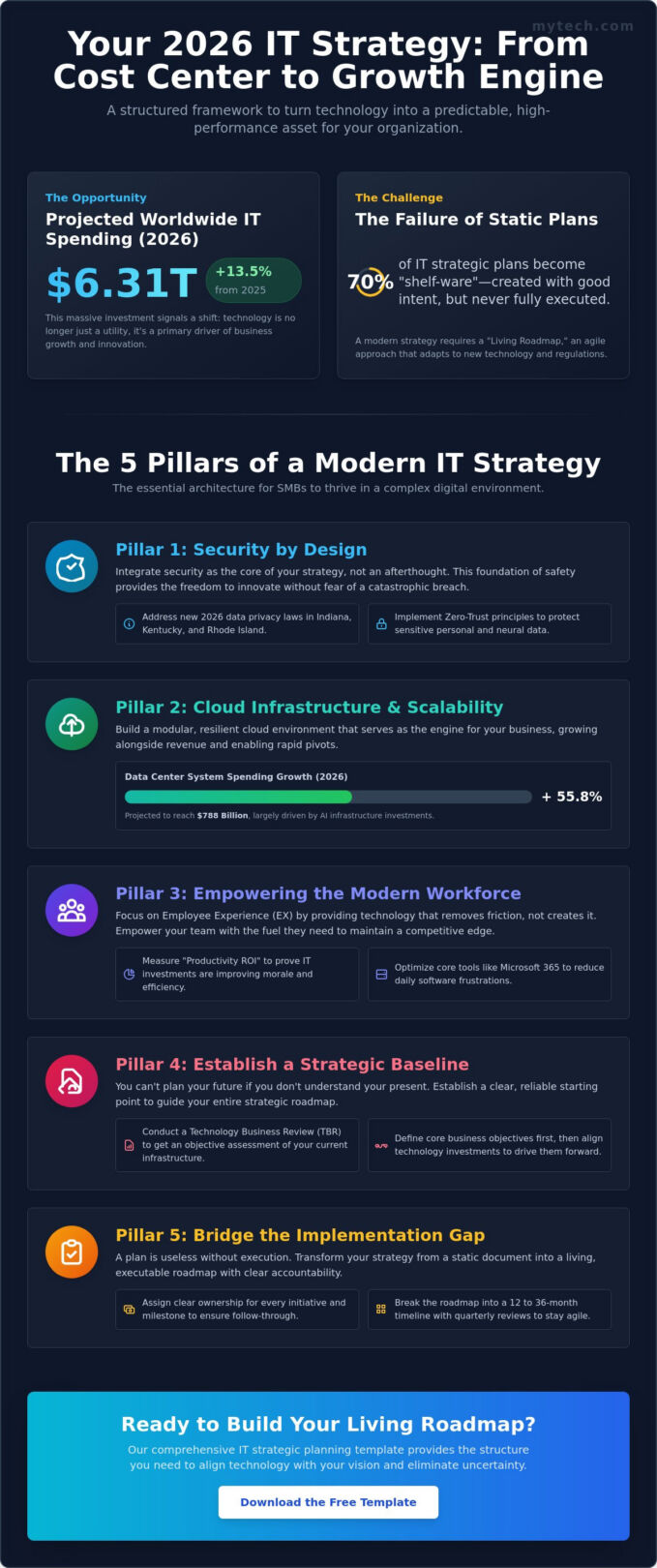
Worldwide IT spending is projected to hit $6.31 trillion in 2026, a 13.5% increase from 2025 according to Gartner’s April 2026 forecast. For many business owners, this massive figure represents a growing sense of anxiety rather than a clear opportunity. You likely feel that your technology budget is a sunk cost that lacks a direct connection to your actual growth goals. We understand the frustration of seeing IT as a black hole of jargon and unpredictable expenses instead of a strategic asset.
Our comprehensive IT strategic planning template changes that narrative by aligning your technical infrastructure with your business vision. You’ll learn how to navigate the complex 2026 regulatory landscape, including new data privacy laws in Indiana, Kentucky, and Rhode Island, while ensuring your workforce remains empowered and secure. This article provides a clear preview of your next 12 to 36 months; offering a structured framework to turn your technology into a predictable, high-performance engine for your organization.
Key Takeaways
- Align technology investments with measurable business growth to transform IT from a cost center into a strategic asset.
- Utilize a comprehensive IT strategic planning template to create a clear 12 to 36-month roadmap that eliminates technical uncertainty.
- Integrate cybersecurity and cloud infrastructure as the foundational pillars that secure your workforce and power business scalability.
- Establish a reliable baseline through a Technology Business Review (TBR) and define core objectives that drive your organization forward.
- Bridge the implementation gap by assigning clear ownership and moving from a static document to a living, executable strategy.
Why Static IT Strategic Planning Templates Fail in 2026
IT strategic planning isn’t just a list of upcoming hardware purchases. It’s the deliberate alignment of your technology investments with your desired business outcomes. Many SMB owners experience “tech anxiety” when faced with a blank page; they fear making expensive mistakes or choosing the wrong path. While downloading a generic IT strategic planning template is a good first step, most of these documents suffer a quiet death. Industry data suggests that 70% of IT plans become “shelf-ware,” documents that are written with great intent but never actually executed.
In 2026, the speed of technological change makes static documents dangerous. A plan created in January 2026 might be irrelevant by July 2026 due to new AI infrastructure investments or shifting data privacy laws in states like Utah, where new consumer correction rights take effect on July 1. You need a “Living Roadmap.” This approach treats the strategic planning process as an ongoing cycle of assessment and adjustment rather than an annual chore.
The Difference Between IT Operations and IT Strategy
Operations focus on keeping the lights on. This includes your daily helpdesk tickets, server patches, and basic maintenance. While essential, operations alone won’t grow your business. Strategy builds your future. A robust IT strategic planning template must move beyond simple hardware replacement cycles. It shifts your mindset from viewing IT as a “cost center” to seeing it as a “value driver.” Instead of asking how much a laptop costs, you ask how a specific cloud migration will improve employee productivity by 15% or reduce downtime by 20 hours per year.
The Role of the Trusted Navigator in Planning
You don’t have to navigate this complex landscape alone. A “Trusted Navigator,” such as a vCIO or a strategic IT consultant, provides the objective perspective needed for effective planning. They bridge the linguistic gap between your C-suite goals and technical execution. For example, while you focus on scaling your workforce, your navigator ensures your infrastructure is ready for that growth before it happens. This partnership transforms your IT department from a reactive fire-fighting team into a proactive force that anticipates challenges before they impact your bottom line.
The 5 Pillars of a Modern IT Strategy Framework
A successful 2026 roadmap requires more than just a list of tasks. It needs a structured framework that balances innovation with stability. While you can find a basic IT strategic planning template from sources like CIO Index, a modern approach must address five specific pillars. These pillars ensure that your technology doesn’t just function but actually propels your business forward. We view these elements as the essential architecture for any SMB aiming to thrive in an increasingly complex digital environment.
Pillar 1: Security by Design
In 2026, security is the core of your strategy, not an afterthought. With new privacy laws taking effect in Indiana, Kentucky, and Rhode Island on January 1, 2026, compliance is now a moving target. We integrate zero-trust principles into every layer of your infrastructure to protect sensitive personal information, including neural data and data from minors now covered under updated CCPA regulations. For a deeper look at managing these risks, explore our strategic guide to cybersecurity services in San Antonio. This foundation of safety provides the freedom to innovate without the constant fear of a catastrophic breach.
Pillar 2 focuses on Cloud Infrastructure and Scalability. Spending on data center systems is projected to grow by 55.8% in 2026, reaching nearly $788 billion. This growth is largely driven by investments in AI infrastructure. Your IT strategic planning template should reflect a shift toward modular, resilient cloud environments that grow alongside your revenue. This “engine” allows your business to pivot quickly when market conditions change.
Pillar 3: Empowering the Modern Workforce
Technology should remove friction, not create it. We prioritize the Employee Experience (EX) by optimizing tools like Microsoft 365 to reduce daily frustrations. When your team spends less time fighting with software and more time on high-value tasks, morale improves. Measuring “Productivity ROI” allows us to prove that IT investments are empowering your people rather than just draining your budget. This pillar ensures your workforce has the “fuel” needed to maintain a competitive edge.
Pillar 4 serves as the compass for your organization through Data Insights and Business Intelligence. In an era where data is your most valuable asset, your strategy must include clear protocols for data governance. This is especially critical given the August 1, 2026, operational date for the California Delete Act. We help you turn raw data into actionable insights that drive better leadership decisions.
Pillar 5 establishes the guardrails of Budgetary Predictability. IT services are expected to reach a total of $1.87 trillion in 2026, making it the largest segment of technology spending. Without a strategic framework, these costs spiral out of control. We focus on creating a roadmap that provides a clear view of your financial commitments for the next three years. If you feel your current spending lacks this level of foresight, our Strategic IT Consulting team can help you build a more disciplined and predictable roadmap.
Choosing Your Format: One-Page Strategy vs. Comprehensive Roadmap
Choosing the right format for your IT strategic planning template depends on your specific audience. A CEO needs a high-level view of how technology drives revenue. Conversely, an IT director requires a granular list of project milestones and budget allocations. We recommend a “Strategy Stack” approach. This hybrid model combines a concise vision with a detailed technical roadmap. It ensures your leadership remains aligned on the “why” while your execution team stays focused on the “how.” This clarity alleviates the tech anxiety that often stems from a lack of transparency between departments.
Your choice often hinges on three specific factors: organizational size, industry regulation, and your projected growth rate. For a rapidly scaling company, a rigid five-year plan is often less effective than a flexible 18-month roadmap that allows for quick pivots. If you operate in a highly regulated sector, like healthcare or finance, the level of detail in your documentation must be significantly higher to satisfy audit requirements. We see many firms struggle because they try to use a simple checklist for complex compliance needs. A disciplined approach ensures that no critical security patch or regulatory deadline falls through the cracks.
When to Use a One-Page Template
A one-page strategy is your “North Star.” It’s the ideal tool for communicating a broad vision to non-technical stakeholders. Use this format to set quarterly goals and simplify complex transitions. For instance, if you’re planning a move to cloud services and migrations, a one-page summary explains the business benefits like scalability and cost-efficiency. It avoids getting bogged down in server configurations. This level of communication builds trust and ensures everyone understands how technology empowers the workforce.
When a Comprehensive Roadmap is Essential
Detailed roadmaps are necessary when managing significant capital expenditures (CapEx) and long-term infrastructure changes. With global IT spending expected to reach $6.31 trillion in 2026, every dollar in your budget must be tied to a specific business outcome. You need this format for multi-year projects such as server decommissioning, legacy system replacements, or large-scale security overhauls. It’s also vital for meeting strict compliance deadlines. For example, the California Delete Act becomes operational on August 1, 2026. A comprehensive roadmap ensures you have the necessary data systems and request-handling protocols in place well before that deadline arrives. This level of detail provides the predictable budgeting that a high-level summary simply cannot offer. It turns your IT strategic planning template into a living document that your internal team can actually execute.
Step-by-Step: How to Fill Out Your IT Strategic Planning Template
Filling out your IT strategic planning template is the critical moment where your business vision meets technical reality. This process demands a disciplined look at your current state before you commit to future investments. We break this down into five actionable steps designed to eliminate guesswork and build a roadmap that your entire leadership team can support. By following this sequence, you ensure that every dollar spent is a deliberate step toward your 36-month goals.
Step 1: The Discovery Phase
You must establish a clear baseline. This involves auditing your existing infrastructure, security posture, and software licensing. We find that interviewing department heads often reveals “tech friction” that doesn’t show up in automated reports. These conversations help identify where outdated processes are slowing down your team. You should also gather data on your current it support and managed services performance to identify recurring bottlenecks that could impede your growth. This phase turns vague tech anxiety into a list of manageable challenges.
Step 2 requires you to define 3 to 5 core business objectives for the next 12 months. Don’t let IT lead the conversation here. Instead, let your revenue and operational goals dictate the technology needs. Once these are set, Step 4 involves a thorough Gap Analysis. You need to identify what tools, skills, or infrastructure components are missing. For example, you might discover that your current backup solution doesn’t meet the recovery time objectives (RTO) required for your new 24/7 manufacturing schedule.
Step 3: The Mapping Exercise
Translate every “Technical How” into a “Business Why.” Your IT strategic planning template should avoid technical jargon that alienates non-technical stakeholders. Instead of listing “Server Upgrade,” write “Enhance uptime to 99.9% to support 24/7 manufacturing.” This clarity helps the board see IT as a catalyst for success rather than a sunk cost. You might frame a security initiative as “Reducing financial risk by implementing Zero Trust protocols to protect sensitive consumer data in accordance with 2026 state privacy updates.” This approach ensures that every project has a clear, defensible purpose.
Finally, Step 5 is about finalizing your 12-month tactical calendar and budget. This step ensures that projects are spaced out to avoid overwhelming your staff or your cash flow. It provides the “guardrails” mentioned earlier, giving you the confidence that your technology is both securing and empowering your workforce. If you’re ready to move from a blank page to a finished roadmap, our Strategic IT Consulting team can guide you through each of these steps to ensure total alignment.
From Template to Execution: Bridging the Implementation Gap
A plan is only as valuable as the action it inspires. The greatest danger to any organization is the “Perfect Plan” that never actually starts. We often see business owners spend weeks refining an IT strategic planning template, only for the document to gather dust while technical debt continues to mount. Execution requires a shift from theory to discipline. You must assign clear ownership for every roadmap item to ensure accountability. Without a specific name attached to a goal, that goal remains a wish rather than a priority.
Successful execution thrives on a consistent cadence. We recommend Monthly Tactical Reviews to track project progress and Quarterly Strategic Reviews to evaluate high-level alignment. This “Agile Planning” approach is vital in a year where data center spending is projected to grow by 55.8% due to AI infrastructure investments. If market conditions or technology costs shift, your roadmap must be flexible enough to adapt without losing sight of your 36-month vision. This disciplined rhythm transforms your strategy from a static document into a living engine for growth.
The Role of Project Management
Every item in your roadmap must eventually become a scoped project with a defined timeline and budget. This transition is where many SMBs struggle due to “Change Fatigue.” Implementing too many initiatives at once overwhelms your workforce and leads to poor adoption rates. We focus on prioritizing high-impact projects that deliver immediate value. If your internal team lacks the bandwidth to manage these complex transitions, partnering with a managed service provider near you can provide the necessary capacity and expertise. This ensures your strategic goals don’t stall due to a lack of resources.
Measuring Success: The IT Scorecard
You cannot manage what you do not measure. A modern IT scorecard moves beyond basic uptime statistics to focus on “Value Delivery” metrics. We track project completion rates against the original roadmap to ensure we remain on schedule and within budget. Communicating these wins back to the board is essential for justifying ongoing investment. When leadership sees that a specific Microsoft 365 optimization has reduced document retrieval time by 15% or that a security overhaul has mitigated risks associated with the August 1, 2026, California Delete Act, technology is no longer seen as a cost. It’s recognized as the catalyst that empowers your workforce to thrive.
Secure Your Growth with a Strategic Roadmap
Your technology should be a catalyst for your success, not a source of constant tech anxiety. By moving from a static document to a living roadmap, you ensure your organization remains resilient against the shifting technical landscape of 2026. We’ve explored how a structured IT strategic planning template helps you prioritize the core pillars of modern infrastructure while maintaining budgetary predictability for the next 12 to 36 months.
Since our founding in 2000, Mytech Partners has provided over 25 years of strategic experience to help SMBs navigate these complexities. Our specialized vCIO services are designed to align your technical roadmap with your core business objectives, ensuring your workforce is both secure and empowered. We take a proactive approach that eliminates the friction of traditional IT management and focuses on long-term health. This consultative partnership provides the calm authority you need to lead your company forward with confidence.
Take the first step toward a more stable and prosperous digital future. We’re ready to lead you through every stage of your growth journey.
Frequently Asked Questions
What should be included in an IT strategic plan for a small business?
Your plan must include a current infrastructure assessment, a 12 to 36-month list of business objectives, and a prioritized project roadmap. An effective IT strategic planning template also incorporates a clear cybersecurity risk assessment and a predictable budget. These elements ensure your technology investments directly support your growth rather than serving as a recurring sunk cost.
How often should an IT strategic plan be updated?
You should review and update your plan every quarter to stay ahead of rapid technological shifts. While a 12-month calendar provides a baseline, the April 2026 Gartner forecast of a 13.5% spending increase proves the landscape moves too quickly for annual reviews. Regular updates allow you to pivot when new regulations or AI infrastructure opportunities emerge.
What is the difference between an IT strategy and an IT roadmap?
An IT strategy defines your long-term vision and aligns technical goals with your business “why.” An IT roadmap is the tactical execution plan that outlines the “how” and “when” for specific projects. Both components are necessary within a comprehensive IT strategic planning template to bridge the gap between executive buy-in and technical implementation.
Who should be involved in the IT strategic planning process?
Successful planning requires a collaborative team including the C-suite, department heads, and your technical leadership or vCIO. We find that interviewing department heads is critical because they identify the daily “tech friction” that automated reports often miss. This inclusive approach ensures the final roadmap empowers the entire workforce and supports diverse operational needs.
How much should a mid-sized business spend on IT strategy?
Investment levels should scale with your growth objectives and risk profile. With IT services projected to reach $1.87 trillion globally in 2026, it’s clear that strategic spending is a primary driver of corporate success. Your budget should focus on proactive initiatives like cloud scalability and risk mitigation rather than just keeping the lights on with basic maintenance.
Can I use a free IT strategy template for compliance audits?
A free template is a helpful starting point but usually lacks the depth required for rigorous audits. New laws in Indiana and Kentucky that took effect on January 1, 2026, require specific data governance protocols that generic documents don’t cover. Compliance demands a customized framework that addresses your specific industry regulations and the unique data you process.
How do I align IT strategy with my overall business goals?
Start by defining 3 to 5 core business objectives for the coming year and then map every technical project to one of those goals. If a proposed IT initiative doesn’t directly improve productivity, reduce risk, or support scalability, it doesn’t belong on your primary roadmap. This discipline ensures technology acts as a catalyst for your organization’s success.
What role does a vCIO play in IT strategic planning?
A vCIO serves as your “Trusted Navigator” by translating complex technical concepts into actionable business strategies. They provide the objective expertise needed to create a predictable roadmap and manage implementation. This role is essential for avoiding the 70% failure rate of static plans, ensuring your technology evolves alongside your revenue and workforce needs.