



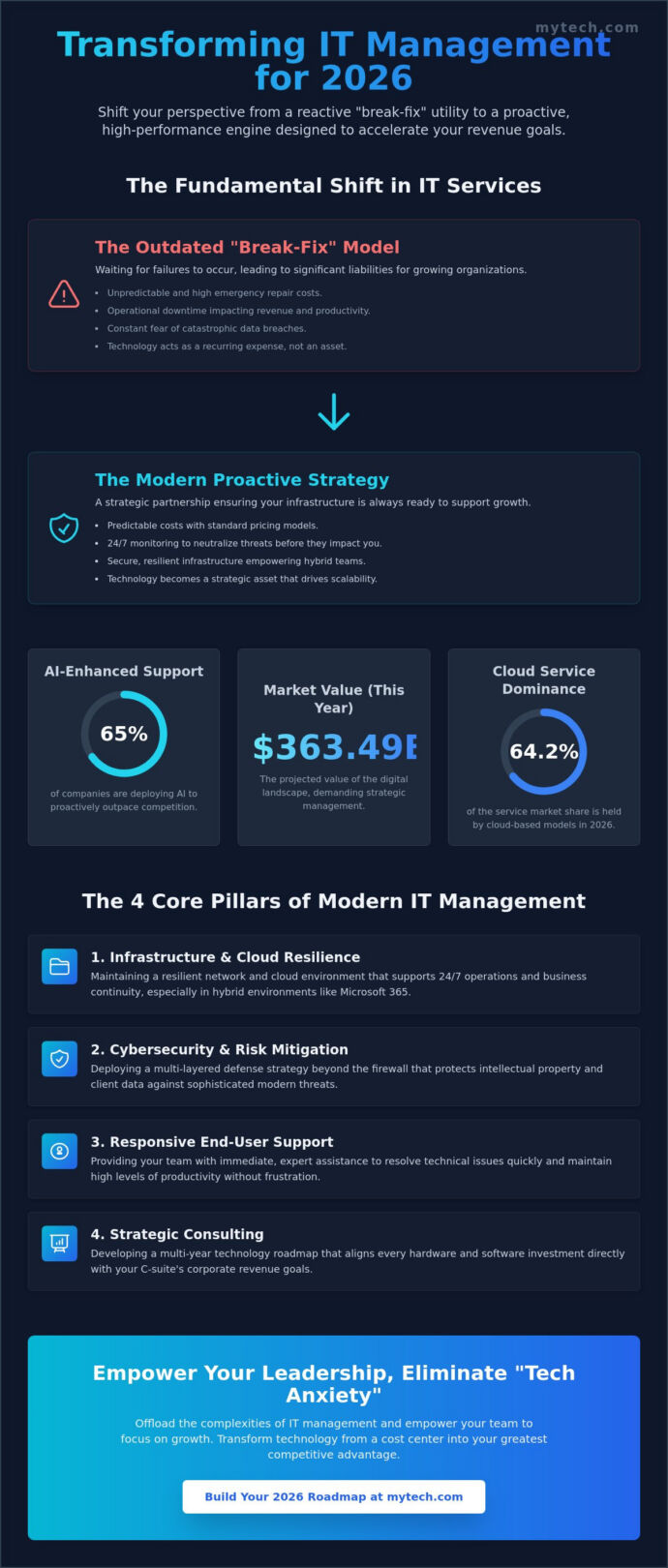
What if your technology was no longer a recurring expense to be managed, but a high-performance engine designed specifically to accelerate your 2026 revenue goals? Most executives still view it management services as a “break-fix” utility, yet 65% of companies are now deploying AI-enhanced support to proactively outpace their competition. It’s understandable if you’re frustrated by unpredictable monthly costs or the constant fear of a data breach that could compromise your entire operation. You want a secure, resilient infrastructure that empowers your hybrid team without the “tech anxiety” of surprise repair bills.
At Mytech Partners, we position ourselves as the guide you need to lead your organization through the complexities of the modern digital landscape. You’ll discover how to transform your digital environment from a source of stress into a strategic asset that drives scalability. We’ll explore the shift toward governance-focused frameworks like NIST CSF 2.0 and explain how standard pricing models provide the financial predictability you need. You’re about to see exactly how a clear technical roadmap allows your business to thrive in a digital landscape that’s projected to reach a $363.49 billion market value this year.
Key Takeaways
- Shift your perspective from reactive repairs to proactive it management services that safeguard your entire digital ecosystem.
- Strengthen your business foundation by implementing a layered defense strategy that prioritizes both infrastructure resilience and modern risk mitigation.
- Learn why technology tools alone aren’t enough and how strategic guidance transforms software into a powerful engine for scalability.
- Discover how to measure a partner’s value by assessing their proactivity ratio and their commitment to your long-term corporate goals.
- Empower your leadership team to focus on growth by offloading “tech anxiety” to a trusted navigator who understands the 2026 landscape.
What are IT Management Services in 2026?
Modern business doesn’t just run on technology; it’s built inside it. In 2026, it management services represent the comprehensive, proactive oversight of your company’s entire digital ecosystem. This isn’t about waiting for a server to crash or a laptop to blue-screen. It’s a strategic partnership that ensures your infrastructure is always ready to support growth. While competitors might define this as a simple help desk, true management involves a high-level orchestration of security, cloud assets, and hardware.
The outdated “break-fix” model has become a significant liability for growing organizations. When you wait for a failure to occur before seeking help, you’re already losing money through downtime and emergency repair fees. To grasp the full scope of this shift, one must look at What is IT Management as a discipline that fuses business strategy with technical execution. We’ve seen IT evolve from basic maintenance into an engine for digital transformation leadership. As your Trusted Navigator, Mytech Partners simplifies the complex technical landscape so you can focus on your core mission with total confidence.
The Shift from Reactive to Proactive Support
Successful IT management is often invisible. When your systems are monitored 24/7, threats are neutralized before they reach your inbox and updates happen while you sleep. This “quiet” infrastructure is the ultimate goal for any executive. Proactive management is the systematic elimination of technical debt. By resolving small vulnerabilities today, we prevent the catastrophic outages that impact the bottom line. With 65% of companies now deploying AI-enhanced it management services to improve efficiency, staying ahead of the curve is no longer optional; it’s a requirement for survival.
Why Business Outcomes Dictate IT Strategy
We measure success by your bottom line, not just “uptime” percentages. If your team can’t collaborate effectively in a hybrid environment, your technology is failing you. Modern strategy moves beyond technical specs to focus on metrics like employee productivity and risk mitigation. This alignment ensures that as you scale, your technology scales with you. Every dollar spent on your technical roadmap should directly support your corporate revenue goals. By tethering your IT spend to specific business outcomes, you transform a traditional cost center into a catalyst for long-term resilience and competitive advantage.
The 4 Core Pillars of Modern IT Management
To move beyond simple troubleshooting, your organization needs a framework that treats technology as a growth engine rather than a maintenance burden. We define it management services through four strategic pillars: infrastructure resilience, layered cybersecurity, responsive end-user support, and long-term strategic consulting. This structure ensures that your foundation is stable while your strategy remains flexible enough to pivot with the market. When these pillars work in harmony, they eliminate the “tech anxiety” that often stalls digital transformation initiatives.
- Infrastructure Management: Maintaining a resilient network and cloud environment that supports 24/7 operations.
- Cybersecurity & Risk Mitigation: Deploying a multi-layered defense that protects your intellectual property and client data.
- End-User Support: Providing your team with immediate, expert assistance to maintain high levels of productivity.
- Strategic Consulting: Developing a multi-year technology roadmap that aligns every hardware and software investment with your C-suite goals.
Infrastructure & Cloud Resilience
In 2026, cloud-based models account for 64.20% of the service market share. This dominance highlights the necessity of optimizing hybrid environments, particularly through platforms like Microsoft 365. Resilience isn’t just about having a backup; it’s about ensuring business continuity through automated disaster recovery. Partnering with a specialized it solutions provider allows you to modernize legacy systems without disrupting daily workflows. This transition empowers your workforce to collaborate securely from any location, turning your infrastructure into a competitive advantage.
Layered Cybersecurity: Beyond the Firewall
Traditional security measures are no longer sufficient against the sophisticated ransomware threats of 2026. A layered defense strategy focuses on identity management and continuous employee education as the new front lines of protection. We align our security protocols with the NIST Cybersecurity Framework (CSF) 2.0, which emphasizes governance and supply chain risk management. This proactive stance does more than just stop breaches. It often leads to reduced cyber insurance premiums and ensures you remain compliant with evolving state-level data privacy laws in regions like New Jersey and Iowa. 24/7 monitoring replaces the outdated model of annual audits, providing the constant vigilance required to protect your bottom line. If you’re ready to see how a secure foundation can accelerate your growth, you can explore our strategic approach to managed security.
IT Management Software vs. Managed Service Providers
Choosing between a “tool-only” approach and a “service-partner” model is one of the most critical decisions a business leader makes in 2026. Software platforms like LogMeIn Resolve or NinjaOne provide the technical execution needed to monitor devices, yet they require seasoned internal expertise to operate effectively. In contrast, a service-partner provides the expertise, the strategy, and the tools as a unified package. While software-as-a-service (SaaS) platforms like Rippling have gained popularity for automating basic tasks, they don’t replace the need for an IT manager. Automation can handle a password reset, but it cannot architect a secure, multi-state network expansion.
In larger organizations, these two models often coexist through a Co-Managed IT arrangement. This hybrid approach allows internal teams to use professional-grade software for daily tasks while offloading high-level security and infrastructure projects to a specialized provider. This synergy ensures that your internal staff isn’t bogged down by routine maintenance, freeing them to focus on proprietary business projects. By 2026, 65% of companies have integrated AI-enhanced it management services to bridge the gap between human oversight and automated efficiency.
When to Invest in Tools vs. Partnerships
Determining the right path requires an honest assessment of your internal team’s technical maturity. The “hidden costs” of self-managed software often surprise business owners. Beyond the license fee, you must account for the hundreds of hours spent on implementation, staff training, and constant patch management. If your internal team is stretched thin, the ROI of a fixed-fee managed provider becomes clear. While hourly break-fix rates in 2026 range from $75 to $150, a managed model provides predictable monthly spending. This stability eliminates the financial spikes associated with “surprise” breakdown expenses and provides a more resilient foundation for growth.
The Human Element: Why Strategy Can’t Be Automated
Software is designed to identify problems, but only a human partner provides a business-aligned solution. This is where the role of the Virtual Chief Information Officer (vCIO) becomes indispensable. A vCIO looks beyond the dashboard to ensure your technology roadmap supports your three-year revenue goals. They guide you through complex transitions, such as moving to a hybrid cloud model or meeting the strict requirements of CMMC 2.1 for government contracts. For a deeper look at how different support structures impact your daily operations, you can explore our it support services comparison. Ultimately, a tool is a static resource; a partner is a “Trusted Navigator” who evolves alongside your organization.
How to Evaluate an IT Management Partner
Selecting a partner for your it management services is a high-stakes decision that dictates your company’s trajectory for years. You aren’t just hiring a help desk; you’re choosing a Trusted Navigator for your digital journey. The most effective partners prioritize “Strategic Alignment” by asking about your three-year revenue goals before they ever mention server specifications. If a provider focuses solely on hardware, they’re a vendor. If they focus on how technology accelerates your bottom line, they’re a partner. You need a team that speaks the language of business, translating complex technical risks into clear growth opportunities.
Experience matters, but the “Proactivity Ratio” is the true metric of success. This represents the percentage of work spent preventing issues versus fixing them after a failure. In 2026, 65% of companies utilize AI-enhanced managed services to identify vulnerabilities before they impact productivity. Ask potential partners how they leverage these tools to maintain a “quiet” environment. Their internal security posture is equally critical. A partner who adheres to the NIST Cybersecurity Framework (CSF) 2.0 and manages their own supply chain risks demonstrates the discipline required to protect your organization from modern ransomware threats.
Critical Questions for Your Potential MSP
Demand transparency during the discovery phase. Ask how they help you build a three-year technology roadmap and what their process is for quarterly business reviews (QBRs). These meetings should focus on strategic adjustments, not just a recap of past tickets. Inquire about their onboarding phase as well. A disciplined transition process should minimize disruption while documenting your entire ecosystem to ensure immediate support. If you’re ready to see how a tailored roadmap can empower your team, schedule a strategic technology consultation with our experts today.
Understanding Service Level Agreements (SLAs)
Don’t be misled by “guaranteed uptime” marketing. In a complex digital landscape, true 100% uptime is a myth. Instead, focus on “Time to Resolution” rather than just “Response Time.” A quick response is meaningless if the problem persists for days. Look for partners who provide real-time dashboards and transparent reporting. This level of visibility ensures you always know the health of your infrastructure. By prioritizing resolution speed and governance-focused compliance, such as CMMC 2.1 or ISO 27001 standards, you gain the freedom to focus on your core mission while your partner secures the foundation.
The Mytech Partners Approach: Empowering Business Growth
At Mytech Partners, we operate as your Trusted Navigator in a digital landscape that is becoming increasingly complex. With the global managed services market currently valued at $363.49 billion, businesses require more than just a vendor; they need a partner with the calm authority to lead them through rapid technical shifts. We have developed a disciplined “Problem-Solution-Result” framework that moves away from the granular frustrations of IT failures. Instead, we focus on the freedom and confidence that come from a stable, secure infrastructure. Our it management services are designed to ensure that every technical decision we make together serves as a direct catalyst for your long-term success.
We understand that “tech anxiety” often stems from a lack of transparency and unpredictable costs. Our approach replaces that uncertainty with a strategic technical roadmap. This isn’t a static document; it is a living strategy that evolves as your business grows. Building on the pillars of infrastructure and security discussed earlier, we prioritize the health of your entire digital ecosystem. We focus on scalability and risk mitigation rather than quick, temporary fixes that lead to technical debt. This forward-thinking optimism ensures that your technology is always an asset, never a hurdle.
Our Strategic Roadmap Process
Our methodology is divided into three distinct phases to ensure total alignment with your corporate goals. In Phase 1, we conduct a deep-dive assessment to identify hidden vulnerabilities and immediate opportunities for optimization. Phase 2 involves the strategic alignment of your technology spend with specific business growth milestones. We ensure your budget supports your revenue targets rather than just maintaining the status quo. Finally, in Phase 3, we implement continuous optimization and proactive security layering. This phase keeps your organization resilient against emerging threats while ensuring your infrastructure remains agile enough to pivot when market conditions change.
Ready to Thrive? Next Steps for Your IT Strategy
The journey toward a more resilient business starts with a professional IT assessment. This process identifies the gaps in your current defense and highlights where your technology may be bottlenecking your productivity. We invite you to start the conversation with Mytech Partners to experience a partnership grounded in reliability and expertise. Our goal is to empower your leadership team to focus on innovation while we secure the foundation. Technology should accelerate your goals, not hinder them. To begin building a foundation that supports your vision for 2026 and beyond, schedule your strategic IT consultation with Mytech Partners today.
Secure Your Technical Foundation for Future Growth
The transition from reactive troubleshooting to strategic it management services is the defining factor for business resilience in 2026. You’ve seen how a layered security posture and a focused technical roadmap eliminate the “tech anxiety” that stalls innovation. By moving beyond simple tools to a partnership grounded in business outcomes, you gain the freedom to focus on your core mission. Mytech has served as a Trusted Navigator since 2000, bringing over 25 years of experience to every client journey. Our specialized expertise in Microsoft 365 and advanced cybersecurity ensures your infrastructure isn’t just stable, but a catalyst for scalability.
Don’t let technical debt or unpredictable costs hinder your progress. It’s time to align your technology spend with your revenue goals and thrive in a digital-first landscape. Empower your business growth with Mytech’s strategic IT management services. We’re ready to lead you through the complexities of the modern digital landscape with calm authority and disciplined execution. Your journey toward a more secure and resilient future starts with a single strategic conversation.
Frequently Asked Questions
What are the most common services included in IT management?
Modern IT management typically includes 24/7 network monitoring, multi-layered cybersecurity, cloud optimization, and strategic vCIO consulting. These it management services ensure your foundation remains resilient while providing a clear roadmap for future technical investments. By integrating responsive help desk support with high-level governance, we eliminate technical debt and empower your team to focus on revenue-generating activities.
How much do IT management services typically cost for a mid-sized business?
Mid-sized businesses in 2026 usually pay between $125 and $175 per user per month for standard managed IT packages. For organizations requiring advanced compliance or premium security monitoring, costs can reach $250 or more per user. These fixed rates replace the unpredictable $75 to $150 hourly fees associated with the outdated break-fix model, providing the financial predictability needed for accurate annual budgeting.
Can IT management services help with regulatory compliance (like HIPAA or CMMC)?
Professional management is essential for meeting the strict requirements of CMMC 2.1 and the 2026 HIPAA modernization rules. We implement the governance controls and data interoperability standards required to avoid the increased penalties associated with new state-level privacy laws in regions like New Jersey and Iowa. Our approach aligns your infrastructure with the NIST CSF 2.0 framework to ensure you remain compliant across all jurisdictions.
What is the difference between an IT manager and a managed service provider (MSP)?
An IT manager is a single internal employee focused on daily operations, while an MSP is a team of specialists providing broad strategic oversight. While an internal manager might handle local troubleshooting, an MSP provides the specialized expertise in cloud migration and cybersecurity that a single person can’t maintain. Many firms use a co-managed model where both work together to achieve greater scalability.
How do IT management services improve cybersecurity for remote teams?
Cybersecurity for remote teams focuses on identity management and cloud-native security standards found in the latest ISO 27001 revisions. We deploy Endpoint Detection and Response (EDR) and encrypted access to protect data outside the traditional office walls. This proactive monitoring ensures that your hybrid workforce remains productive without exposing your network to the rising threat of sophisticated ransomware attacks.
Will I lose control of my technology if I outsource IT management?
You retain total control over your business strategy and technical direction while we handle the complex execution. We act as your Trusted Navigator, providing the data and insights you need to make informed decisions without getting bogged down in granular technical failures. You own your data and your roadmap; we simply ensure the infrastructure is there to support your long-term vision.
How long does it take to see a return on investment from strategic IT management?
Most organizations see an immediate return through predictable monthly spending and the elimination of costly downtime. Strategic ROI typically matures within 6 to 12 months as the technical roadmap begins to align your technology spend with specific revenue milestones. By removing “surprise” repair bills, you free up capital that can be reinvested into your company’s core growth initiatives.
What happens if our business grows rapidly—can IT management services scale with us?
Managed it management services are built to scale instantly by leveraging cloud-based models, which now account for over 64% of the market. Whether you’re adding five employees or fifty, a professional partner adjusts your infrastructure and support levels without the need for massive capital expenditures. This agility ensures that your technology remains a catalyst for success during periods of rapid expansion. To learn more about how comprehensive it services and support can reduce your total technology costs while increasing employee productivity, explore our strategic guide for businesses in 2026.