



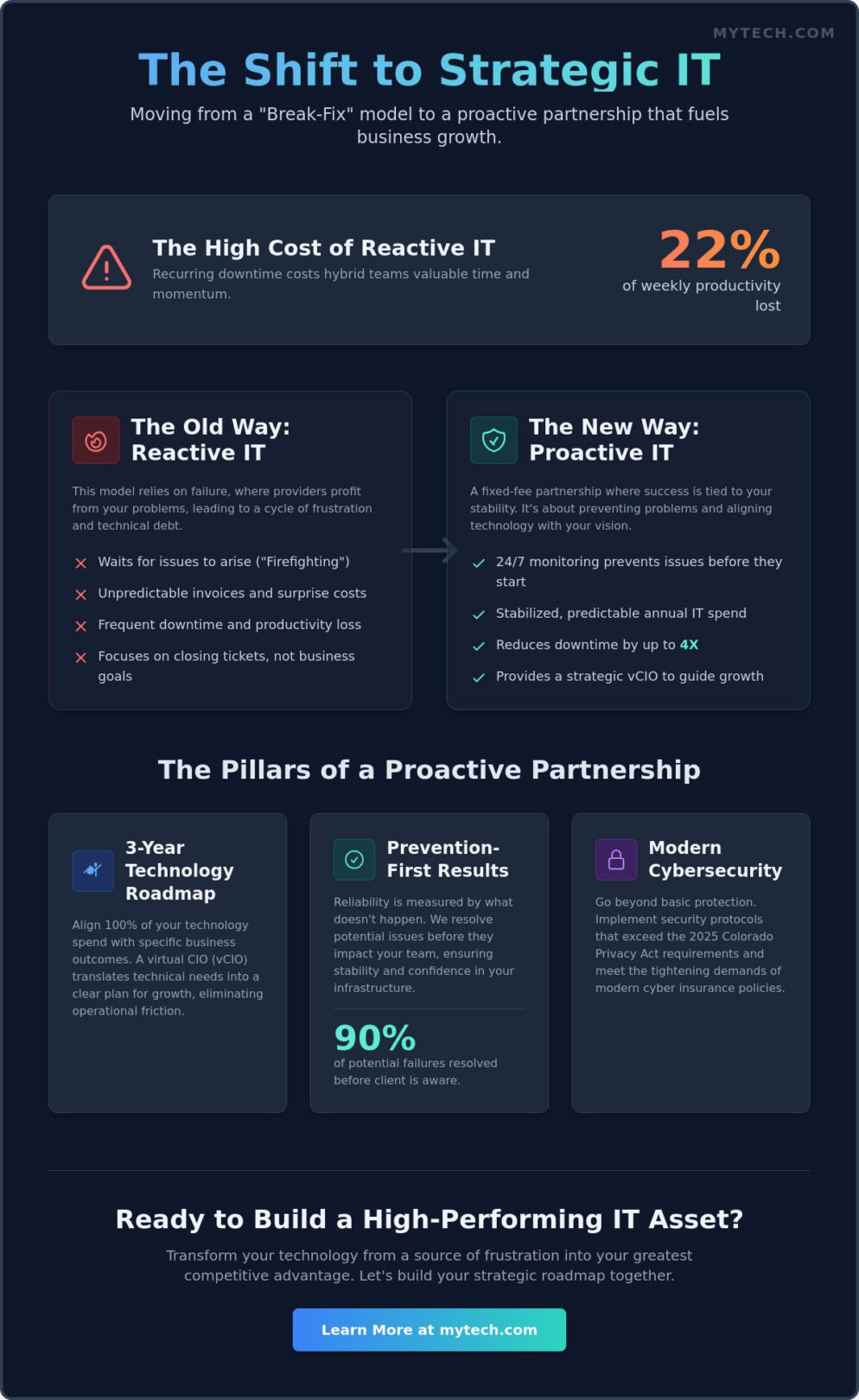
What if the technology that currently keeps you awake at night became the very engine that powers your expansion through 2026? You likely feel that your current IT provider is more of a firefighter than a strategist, arriving only when smoke appears while your hybrid teams lose up to 22% of their weekly productivity to recurring downtime. It’s exhausting to face unpredictable invoices and a constant sense of technical debt. We agree that technology should empower your vision rather than hinder it. Finding the right managed it support denver offers is no longer about fixing broken laptops; it’s about securing your competitive advantage in a crowded market.
This guide shows you how to move beyond reactive repairs to establish a strategic partnership that drives measurable growth. You’ll learn how to build a robust three-year technology roadmap, stabilize your annual IT spend, and implement cybersecurity that exceeds the 2025 Colorado Privacy Act requirements. We will walk through the exact steps to transform your infrastructure into a predictable, high-performing asset that supports your long-term success.
Key Takeaways
- Shift from reactive “break-fix” repairs to a proactive partnership that prioritizes business clarity over technical complexity.
- Utilize a five-step framework to select a provider that aligns with your long-term goals rather than simply closing support tickets.
- Determine whether a managed, co-managed, or in-house model provides the most scalable foundation for managed it support denver organizations.
- Learn how to build a multi-year technology roadmap that eliminates operational friction and fuels consistent business growth.
- Explore a proven onboarding process designed to transition your team into a secure and predictable digital environment.
Understanding Managed IT Support in Denver: A Strategic Shift
Technology should empower your organization, not create a cycle of frustration. For many local businesses, managed it support denver has evolved from a simple help desk into a strategic partnership. This shift moves away from the traditional model where you only call a technician when something breaks. Instead, it embraces the role of a Trusted Navigator. We focus on providing business clarity by removing the technical noise that slows down your team. By 2026, the primary goal for every Denver leader is to replace tech anxiety with infrastructure confidence.
The concept of Managed services centers on a fixed-fee partnership that prioritizes your success. In this model, we aren’t incentivized by your problems; we’re incentivized by your stability. Denver’s unique economic environment, which includes a heavy presence of hybrid teams and distributed job sites, requires a level of connectivity that reactive IT cannot sustain. When your infrastructure is stable, your team can focus on growth rather than troubleshooting.
The Reactive vs. Proactive IT Model
The traditional “break-fix” model is inherently flawed because it relies on failure to generate revenue for the provider. In contrast, modern MSPs use a prevention-first approach. By implementing 24/7 proactive monitoring, we identify and resolve vulnerabilities before they impact your operations. Industry data indicates that this proactive stance reduces recurring issues and unplanned downtime by up to 4X compared to reactive methods. “In a proactive model, the success of the IT provider is directly tied to the uptime of the client.”
Why Denver Businesses are Moving to Managed Services
The regulatory environment in Colorado is becoming increasingly complex. Between 2024 and 2026, requirements for cyber insurance have tightened. These policies often demand specific security protocols that smaller internal teams struggle to maintain without external help. Local firms also face the challenge of managing seamless technology across diverse environments. Whether your team is in a LoDo office, working from a home in Highlands Ranch, or accessing data from a remote construction site, the experience must be identical. For a deeper look at these trends, see our Strategic IT Support: A Comprehensive Guide for Growing Businesses in 2026. This strategic alignment ensures that managed it support denver becomes a catalyst for your long-term success.
How to Evaluate Managed IT Support Providers: A 5-Step Framework
Selecting a partner for managed it support denver requires looking beyond the ticket queue. By 2026, technology is no longer a background utility; it is the primary engine of corporate growth. Business owners often feel tech anxiety when their infrastructure feels like a black box. A strategic framework shifts the focus from fixing what is broken to building what is possible. This five step process ensures your technology roadmap aligns with your 2026 revenue targets.
Step 1: Aligning IT with Business Outcomes
Top tier providers avoid talking about “speeds and feeds” in isolation. Instead, they ask how a specific cloud migration will shorten your sales cycle or how a hardware refresh will improve employee retention. You need a Virtual Chief Information Officer (vCIO) who translates technical jargon into a business roadmap. A vCIO ensures that 100% of your technology spend supports a specific operational goal. If a provider cannot explain how their service helps you scale, they are a vendor, not a partner.
Step 2: Testing for Proactivity and Reliability
Reliability is measured by what does not happen. Ask prospective partners for their “prevention-first” data. A mature provider should demonstrate how they resolved 90% of potential system failures before the client even noticed an issue. Demand specific metrics: ask for their average response time and their first-contact resolution rate. In a high stakes market like Denver, a 15 minute response time for critical issues is the standard for 2026. True reliability means they close the loop on every open item without your team needing to send a follow up email.
Industry expertise is the third pillar of a successful partnership. A provider who understands the specific compliance hurdles of healthcare (HIPAA), legal (ABA standards), or manufacturing (CMMC) will save you from costly regulatory errors. They should arrive with pre-built templates for your industry’s unique workflows.
Security protocols must be non-negotiable. Verify that the provider maintains SOC2 compliance and follows the FTC cybersecurity guide for protecting sensitive data. This level of rigor protects your reputation and ensures your insurance premiums remain manageable. We recommend reviewing a provider’s incident response plan to see exactly how they handle a simulated breach.
The final step is analyzing their communication style. A strategic partner uses a “Trusted Navigator” approach, providing calm authority during transitions. They don’t just send invoices; they hold quarterly business reviews to report on progress. If you want to see how this level of clarity can empower your organization, start by auditing your current communication gaps. A disciplined provider will always leave you feeling more confident than when the conversation started.
Comparing IT Support Models: Managed, Co-Managed, and In-House
Choosing how to manage your technology determines your organization’s agility. Denver businesses often struggle to decide between hiring internally or outsourcing. These models aren’t rigid categories; they function as a spectrum of support. A common question we hear is why a company needs managed it support denver if they already have an IT manager. The answer lies in capacity. One person cannot provide 24/7 monitoring, specialized security expertise, and long-term roadmapping while also handling daily user requests. We act as a force multiplier, not a replacement.
| Feature | In-House IT | Managed IT | Co-Managed IT |
|---|---|---|---|
| Cost Structure | Variable (Salary, Benefits, Taxes) | Predictable Flat Monthly Fee | Hybrid / Fixed Project Fees |
| Scalability | Slow (Hiring takes 4+ months) | Immediate and On-Demand | Fast and Flexible |
| Expertise | Individual Skillset | Multi-Disciplinary Team | Combined Strengths |
When to Choose Managed IT Services
Organizations with 20 to 200 employees typically see the highest ROI from fully managed services. This model replaces unpredictable repair bills with a stable monthly investment. It’s about proactive health. You get 24/7 monitoring and a dedicated support desk without the overhead of a large internal department. This approach provides total visibility into your technology spend. For a deep dive into specific service tiers, review The Strategic Guide to IT Support and Services in 2026.
The Power of Co-Managed IT for Mid-Sized Teams
Co-managed IT is the ultimate collaborative tool for mid-sized teams. It allows your internal IT Director to offload the repetitive “noise” of patching and help desk tickets. We step in to handle the heavy lifting of cloud migrations, Microsoft 365 optimizations, and security audits. This partnership creates a “we” culture where your internal staff focuses on business-specific software while we maintain the foundation. It’s a strategic alliance that empowers your team to lead rather than react. By sharing the load, your organization gains managed it support denver that scales alongside your growth objectives.
How to Build a Strategic Technology Roadmap for Your Denver Business
A technology roadmap serves as your organization’s multi-year vision. It aligns every IT investment with your 2026 corporate growth targets. Without this plan, businesses often fall into the trap of reactive spending. We see this lead to “IT friction,” which is the cumulative drag caused by slow systems and mismatched tools. Statistics show that employees lose up to 21% of their productive time to tech-related hurdles. By partnering with experts in managed it support denver, you can identify these bottlenecks and transition from high “tech debt” to a scalable, modern environment. Tech debt represents the long-term cost of choosing easy, short-term fixes over robust solutions; we help you pay down that debt by replacing fragile systems with resilient infrastructure.
Auditing Your Current Infrastructure
Start with a hard look at your foundation. You need to hunt for hardware over four years old and software that no longer receives security patches. “Shadow IT,” or apps your team uses without official approval, often creates massive security gaps. We evaluate how your tools support Denver’s 65% hybrid workforce. For a step-by-step breakdown, follow The Ultimate IT Support Checklist for Businesses: A Strategic Guide for 2026 to ensure no detail is missed.
Prioritizing Security and AI Readiness
Cybersecurity isn’t a feature; it’s the foundation of your entire roadmap. In 2026, 75% of small businesses will face a sophisticated cyber threat. We focus on Microsoft 365 integration and AI consulting to help Denver teams work smarter. Strategic IT Alignment is the process of ensuring every tech dollar spent directly impacts a business goal. This approach turns IT from an expense into a competitive advantage.
Your 2026 roadmap should include these critical items:
- Zero Trust Security Architecture: Moving beyond simple passwords to identity-based verification.
- Cloud-First Scalability: Migrating remaining on-premise legacy servers to secure cloud environments.
- AI Readiness: Auditing data quality to prepare for Microsoft Copilot and automated workflows.
- Business Continuity: Implementing 15-minute recovery point objectives for all critical data.
Building a roadmap requires a partner who understands the local business landscape. Our team provides the managed it support denver organizations need to move from daily fires to long-term growth. We don’t just fix what’s broken; we build what’s next. When evaluating your options, understanding what separates a reactive vendor from a true local IT support company can make the difference between stagnation and scalable success.
Ready to eliminate IT friction and prepare for 2026? Schedule your strategic roadmap consultation with MyTech today.
Implementing Managed IT with Mytech: Your Trusted Denver Navigator
Technology should empower your business, not act as a constant source of friction. Mytech focuses on removing the technical obstacles that stall growth. By implementing standardized operational frameworks, we often reduce client downtime by 30% or more within the first year. We take the “alphabet soup” of modern IT, including complex requirements like MFA, EDR, and SOC2 compliance, and translate them into a clear, manageable roadmap. This allows your leadership team to stop worrying about server uptimes and start focusing on your 2026 expansion goals.
Our onboarding process is a deliberate transition designed to move you from a reactive state to a predictable, secure environment. We don’t just “take over” your tickets; we perform a deep-dive audit of your entire infrastructure. This ensures every piece of hardware and software aligns with your business objectives. You’ll experience clear communication and reliable follow-through from day one. We believe that a stable IT environment is the baseline, while strategic partnership is the true value we provide.
The Mytech Difference in Denver
We’ve spent 25 years helping organizations across the Front Range thrive by treating technology as a strategic asset. Our deep roots in the Colorado business community give us a unique perspective on the local economic landscape. We understand the specific challenges faced by firms operating in our high-growth corridor, from the tech hubs in Boulder to the professional services firms in downtown Denver.
Consider the experience of a local Denver logistics company that faced recurring network failures during peak shipping seasons. These outages resulted in roughly $12,000 in lost revenue per hour. Mytech stepped in to modernize their infrastructure and implement a 24/7 proactive monitoring system. The result was a 99.9% uptime record over the following 24 months. This stability allowed the company to scale its fleet by 15% without needing to hire additional internal IT staff. When you choose managed it support denver through Mytech, you’re choosing a partner that prioritizes your bottom line.
Next Steps: Your Free IT Assessment
If you’re tired of “quick fixes” that don’t last, it’s time for a different conversation. We invite you to a brief discovery call to discuss your current technology hurdles and future goals. This isn’t a high-pressure sales pitch. It’s a strategic consultation where we listen to your needs and offer honest feedback on your current IT health. We’ll identify hidden risks and show you how a disciplined approach to technology can drive your success. You deserve a navigator who knows the terrain and can lead you toward a more secure, productive future.
Empower Your Denver Business for 2026
Success in the coming years depends on shifting from reactive troubleshooting to a proactive, strategic mindset. You’ve learned how to evaluate providers using a 5-step framework and why a custom technology roadmap is essential for scalability. Choosing the right managed it support denver partner means finding a navigator who prioritizes your long-term stability over temporary patches. It’s about creating a secure environment where your team can thrive without the weight of technical debt. It’s about results.
Mytech has served the Front Range for over 20 years; we provide the discipline and expertise needed to drive meaningful growth. Our approach has delivered a proven 4X reduction in recurring IT issues for our clients. By pairing your leadership with a dedicated vCIO, we ensure your technology evolves alongside your business objectives. This partnership replaces tech anxiety with confidence. We’re ready to lead the way and help you build a more resilient future.
Ready to reduce IT friction? Schedule a conversation with our Denver team.
Frequently Asked Questions
What is the average cost of managed IT support in Denver for a small business?
Small businesses in Denver typically invest between $150 and $250 per user monthly for comprehensive support according to 2024 industry benchmarks. This investment covers proactive monitoring and strategic planning. Choosing a flat-rate model prevents unexpected budget spikes, allowing your leadership to focus on growth rather than fluctuating repair bills. It’s a predictable way to manage your technology budget while ensuring your infrastructure remains robust and reliable.
Does managed IT support include cybersecurity and compliance services?
Managed IT support in Denver integrates advanced cybersecurity and compliance frameworks into every core service offering. We align your infrastructure with standards like NIST or HIPAA to mitigate risk. This proactive stance ensures your data remains protected against 95% of common vulnerabilities. We don’t treat security as an add-on; it’s the foundation of a stable environment that empowers your team to work with total confidence.
How quickly can a Denver MSP respond to an emergency IT issue?
A reputable Denver MSP typically guarantees a response time of 15 to 60 minutes for critical system failures. Our team uses automated monitoring to detect issues before they impact your operations. Fast intervention reduces downtime, which costs small businesses an average of $137 per minute according to 2023 industry data. We prioritize these high-impact events to restore your productivity and maintain the strategic momentum your business needs to thrive.
Can managed IT services help our business migrate to the cloud?
Our managed IT support in Denver provides the technical roadmap and execution for seamless cloud migrations. We assess your current workloads to determine which assets belong in public, private, or hybrid environments. This transition often reduces hardware capital expenditure by 30% over a three-year period. By handling the migration, we ensure your team accesses data securely from anywhere. This fosters a more flexible and scalable business model that adapts to your growth.
What is the difference between managed IT and a traditional help desk?
Managed IT offers a strategic partnership, while a traditional help desk focuses solely on reactive, break-fix repairs. Our approach involves continuous monitoring and long-term planning to prevent issues before they occur. A help desk might fix a printer today, but we build the infrastructure that ensures your entire office thrives. This shift from reactive to proactive can reduce recurring technical tickets by 40% within the first year of implementation.
Will a managed IT provider work with our existing in-house IT person?
We frequently collaborate with existing in-house IT personnel through a co-managed model. This partnership allows your internal staff to focus on high-level business goals while we handle the 24/7 monitoring and routine maintenance. It’s a strategic way to scale your capabilities without the cost of hiring three additional full-time employees. We act as an extension of your team, providing the specialized tools and extra hands needed to succeed together.
How does a managed IT service help with cyber insurance requirements in Colorado?
Managed IT providers ensure your business meets the 12 essential controls required by most Colorado cyber insurance carriers. These include multi-factor authentication, encrypted backups, and endpoint detection. Meeting these rigorous standards can prevent a 50% increase in annual premiums. We document your compliance and security posture, making the application process straightforward. This helps you secure the coverage necessary to protect your organization’s future against evolving digital threats.
What industries in Denver do you typically provide IT support for?
We support 4 primary Denver industries including legal services, healthcare, construction, and professional services. Each sector has unique regulatory requirements, such as CJIS for law enforcement or SOC2 for financial firms. Our expertise across these specific verticals allows us to implement proven solutions that drive efficiency. We understand the specific challenges your local business faces and provide the disciplined guidance required to navigate the modern digital landscape.