



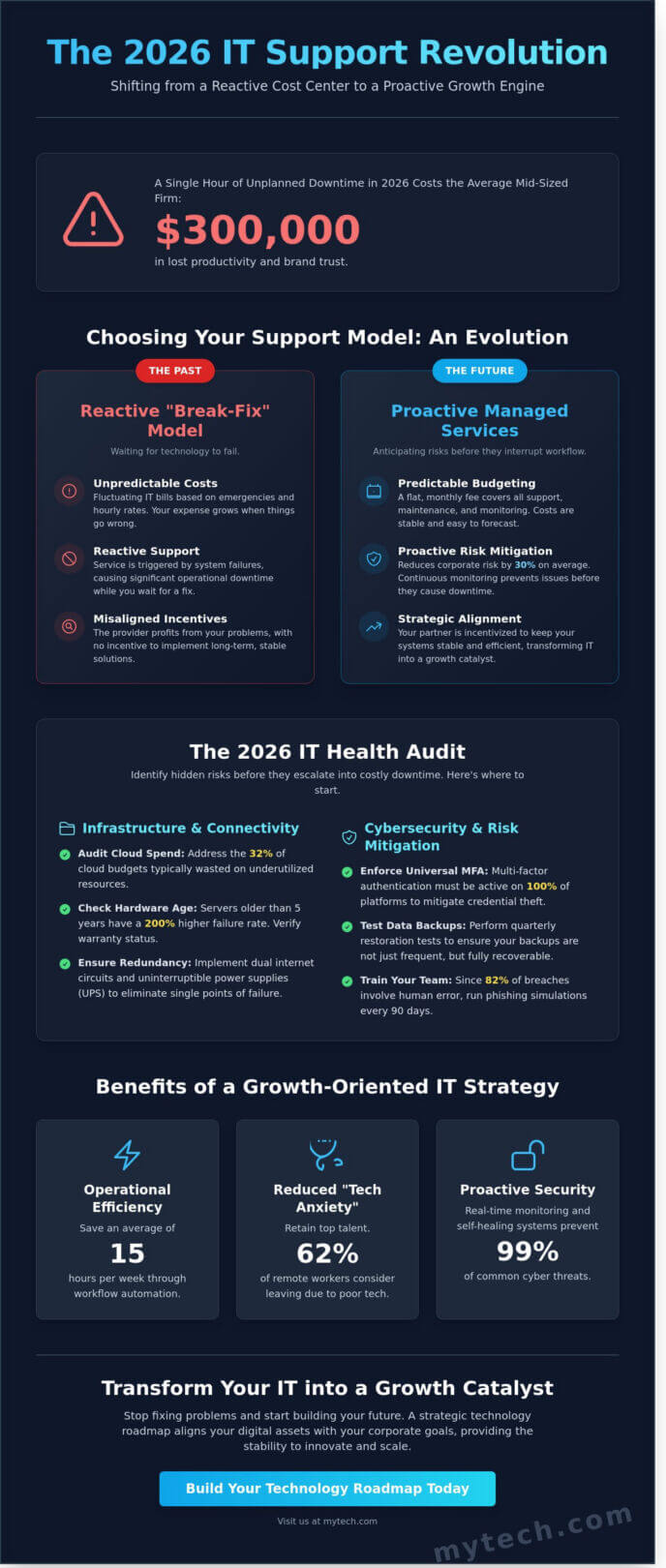
In 2026, a single hour of unplanned downtime costs the average mid-sized firm $300,000 in lost productivity and brand trust. If you’re still viewing technology as a line-item expense rather than a strategic engine, you’re already falling behind. Modern it support for businesses has shifted from a reactive break-fix model to a proactive discipline that secures your future. You deserve a partner that doesn’t just respond to tickets; you need a navigator that anticipates risks before they interrupt your workflow.
You likely feel the weight of fluctuating IT bills and the nagging fear that your cybersecurity isn’t as robust as it should be. It’s exhausting when technology feels like a hurdle instead of an advantage. This guide empowers you to move beyond tech anxiety by providing a framework to evaluate your current health and select a partner aligned with your 2026 revenue targets. We’ll walk through a comprehensive checklist covering cloud scalability, risk mitigation, and predictable budgeting to ensure your infrastructure just works while you focus on growth.
Key Takeaways
- Perform a comprehensive 2026 health audit to identify hidden risks in your infrastructure and empower your team with secure, modern tools.
- Discover why proactive managed services offer superior financial stability compared to the unpredictable costs of traditional it support for businesses.
- Learn to evaluate potential partners using a strategic checklist that prioritizes accountability, industry expertise, and long-term alignment.
- Shift your focus from resolving technical failures to building a technology roadmap that transforms IT into a catalyst for corporate growth.
- Understand the “Trusted Navigator” approach to navigating digital complexity and ensuring your technology posture supports your specific business outcomes.
Beyond the Help Desk: Redefining IT Support for Modern Businesses
The definition of Technical Support has undergone a radical transformation. By 2026, it support for businesses has moved far beyond the basement help desk. It is no longer a reactive “break-fix” model where you wait for a crash to call for help. Instead, modern organizations rely on proactive managed services that anticipate friction before it halts operations. This shift reduces corporate risk by 30% on average compared to traditional models. We act as a Trusted Navigator, guiding your team through a digital environment that changes every 18 months. This strategic alignment ensures that your technology serves your goals rather than dictating your limitations.
The Evolution of Business Technology Support
A decade ago, IT meant managing on-premise servers and physical cables. Today, 94% of enterprises utilize cloud-first hybrid environments. This transition changed the stakes for employee retention. A 2025 study found that 62% of remote workers would consider leaving an employer due to persistent “tech anxiety” caused by laggy VPNs or fragmented tools. We solve this by ensuring your infrastructure remains invisible and seamless. When technology works, people stay. Outdated support models often ignore the human element, but we prioritize the user experience to drive productivity. Our approach eliminates the frustration of “waiting for IT” by implementing self-healing systems that resolve issues in the background.
IT as a Catalyst for Business Growth
Strategic it support for businesses transforms your technology budget from a cost center into a value driver. Instead of seeing a line item for repairs, your P&L reflects investments in scalability. A clear technology roadmap aligns your digital assets with 5-year corporate goals. This structure provides the confidence to innovate. When your core infrastructure is secure, you can explore AI or new market entries without fearing a catastrophic breach. We provide the stability that makes bold moves possible. Consider these benefits of a growth-oriented IT strategy:
- Predictable Scaling: Your systems expand automatically as your headcount grows.
- Risk Mitigation: Real-time monitoring prevents 99% of common entry-level cyber threats.
- Operational Efficiency: Automated workflows save the average mid-sized firm 15 hours of manual labor per week.
We believe that technology should empower your team to thrive. By moving away from the chaos of emergency repairs, you gain the freedom to focus on your core mission. Our role is to provide the steady, expert guidance needed to turn complex technical challenges into competitive advantages. Organizations that invest in professional it services aligned with a strategic framework are far better positioned to scale efficiently and outpace competitors in 2026.
The 2026 IT Health Audit: A Comprehensive Business Checklist
A resilient technology posture starts with a clear view of your current landscape. Executives often overlook “silent killers” like technical debt, which can account for 40% of IT budgets according to a 2023 McKinsey report. This audit provides a framework to identify these risks before they escalate into costly downtime. By categorizing your needs into infrastructure, security, and empowerment, you transform it support for businesses from a reactive expense into a strategic asset that drives growth.
Infrastructure and Connectivity Audit
Cloud optimization is your first priority. Recent industry data shows that 32% of cloud spend is wasted on underutilized or orphaned resources. You should verify the age and warranty status of all critical hardware; servers older than five years experience a 200% increase in failure rates. Reliability depends on redundancy. Ensure your office maintains dual internet circuits from separate providers and uninterruptible power supplies (UPS) to prevent a single point of failure from halting your operations.
Cybersecurity and Risk Mitigation Checklist
Security isn’t a one-time setup. It’s a continuous state of readiness. Multi-factor authentication (MFA) must be active across 100% of your platforms to mitigate credential theft. For additional guidance, the Federal Communications Commission provides a detailed framework for Cybersecurity for Small Businesses that aligns with modern standards. You must confirm that data backups are not only frequent but “recoverable” through quarterly restoration tests. Since 82% of breaches involve human error, schedule phishing simulations every 90 days to keep your team sharp and aware.
User Support and Productivity Metrics
Productivity hinges on how quickly your team can overcome technical hurdles. Measure your “time-to-resolution” for help desk tickets; a healthy environment typically resolves 75% of Tier 1 issues within two hours. Audit your onboarding and offboarding workflows to ensure new hires are productive on day one and departed employees lose access instantly. If your team only uses Microsoft 365 or Google Workspace for email, you’re missing out on significant collaboration benefits. A strategic IT roadmap can help you unlock the full potential of these tools while ensuring your it support for businesses remains proactive rather than just functional.
Managed IT vs. Break-Fix: Choosing the Right Support Model
Choosing how to manage your technology infrastructure isn’t just a technical decision; it’s a financial strategy. Most organizations operate under one of two frameworks: the reactive break-fix model or the proactive Managed Services Provider (MSP) model. While the break-fix approach might seem cost-effective on the surface, the hidden financial drain of unpredictable failures often outweighs the perceived savings. We view technology as a catalyst for growth, and your support model should reflect that ambition.
The Risks of the Reactive Model
The break-fix model relies on a fundamental conflict of interest. Your IT provider only earns revenue when your systems fail, meaning their profit increases as your productivity decreases. This reactive cycle often results in catastrophic downtime. Data from the Ponemon Institute indicates that the average cost of unplanned downtime across various industries reached $9,000 per minute in recent years. When you wait for a server to crash before calling for help, you’re paying for emergency labor rates and lost employee output. This model lacks a roadmap for disaster recovery, leaving 40% of small businesses unable to reopen after a major data loss event according to FEMA statistics.
The Managed Services Advantage
Modern it support for businesses focuses on prevention rather than repair. Managed IT services provide a stable foundation through 24/7 proactive monitoring. We identify a failing hard drive or a security vulnerability before your team even notices a lag. This approach replaces the “jack-of-all-trades” technician with a specialized team of engineers, security analysts, and strategic advisors. Much like how real estate investors trust TBM Property Management to handle property oversight, businesses use managed IT to move from a state of tech anxiety to a state of operational freedom.
Key benefits of the managed model include:
- Financial Predictability: Fixed monthly fees eliminate the volatility of hourly billing, allowing for precise annual budgeting.
- Continuous Optimization: Regular system updates and patches reduce the risk of cyberattacks by 80% compared to unmanaged environments.
- Strategic Alignment: Technology becomes a tool for scalability rather than a recurring headache.
For organizations with existing internal staff, co-managed IT offers a hybrid solution. This partnership allows your in-house team to focus on high-level projects while we handle the repetitive maintenance and specialized security tasks. This collaborative structure ensures that your it support for businesses remains scalable and resilient as you head into 2026. We work as an extension of your team, providing the specialized tools and 24/7 coverage that a single internal hire cannot realistically maintain. Growing firms looking to build this foundation can benefit from reviewing our strategic IT support guide for growing businesses in 2026 to understand how a structured approach can accelerate revenue and eliminate costly disruptions. Organizations in the region can also explore how managed IT support in Denver delivers a structured three-year technology roadmap that stabilizes annual IT spend and drives measurable competitive advantage.
The Strategic Partner Checklist: Evaluating IT Support Providers
Selecting the right partner transforms technology from a recurring expense into a competitive advantage. When you evaluate it support for businesses, you’re looking for more than a help desk; you’re looking for a disciplined navigator. A robust Service Level Agreement (SLA) must define clear accountability, specifying response times and 99.9% uptime guarantees to ensure your operations never stall. This document shouldn’t be a legal shield for the provider, but a commitment to your productivity.
Industry-specific expertise is equally vital. A provider familiar with HIPAA for healthcare or SEC regulations for legal firms understands the specific risks your team faces every day. This specialized knowledge prevents compliance gaps that generalist firms might overlook. Cultural fit also dictates long term success. You need a team that communicates with clarity and calm authority, matching your company’s internal rhythm and values. Firms that engage professional it services built around a strategic growth framework are better equipped to close compliance gaps and align technology investments with measurable business outcomes.
Technical Standards and Security Protocols
Demand evidence of rigorous standards. Ask if the provider follows the NIST Cybersecurity Framework or maintains SOC 2 Type II certification. These frameworks ensure they follow high-level security protocols within their own organization. Investigate their internal disaster recovery plans; a provider must be more resilient than the clients they protect. Finally, verify their track record with Microsoft 365 optimization. Since 70% of businesses moved to cloud-native models by 2024, your partner must know how to secure and scale these specific environments.
Strategic Alignment and Consulting
Modern it support for businesses must include vCIO (virtual Chief Information Officer) services to bridge the gap between technical tasks and corporate goals. Your provider should lead Strategic Business Reviews (SBRs) at least twice a year to analyze performance and plan for future growth. A technology roadmap acts as a collaborative journey between IT and leadership to align digital investments with long term business goals. This proactive planning ensures you’re never surprised by aging hardware or sudden software licensing shifts. For businesses operating in the Colorado market, a provider offering managed IT support in Denver built around cybersecurity and compliance can be especially valuable in meeting the specific regulatory demands of the region.
Transparency and Communication
Transparency is the foundation of trust. Effective reporting doesn’t just list tickets closed; it highlights threats neutralized and downtime prevented. You should see a clear “problem-solution-result” flow in every monthly summary. The help desk experience must be frictionless for your employees, with a goal of connecting them to a technician in under 15 minutes. During your initial consultation, watch for red flags like opaque pricing models, a lack of written documentation, or a focus on selling hardware rather than understanding your business objectives.
Ready to move beyond reactive fixes and start growing? Explore how our strategic it support for businesses empowers your team to thrive.
Building Your Technology Roadmap with Mytech Partners
Technology shouldn’t be a source of constant friction. At Mytech Partners, we step into the role of your Trusted Navigator, guiding your organization through the complexities of the modern digital environment. Our proactive process ensures that it support for businesses transcends basic troubleshooting. We focus on aligning your technology stack with your specific corporate outcomes for 2026 and beyond. This alignment transforms your infrastructure from a silent overhead cost into a visible catalyst for growth.
The Mytech difference lies in our unique operational model. We provide the enterprise-level tools and security protocols typically reserved for global corporations, yet we deliver them with the personalized, high-touch service of a regional partner. You gain access to sophisticated monitoring and automation while maintaining a direct relationship with experts who understand your local market. We move you from technical frustration to strategic confidence by building a roadmap that anticipates hurdles before they disrupt your workflow. Effective it support for businesses requires this blend of high-level capability and local accountability.
Our Approach to Managed IT Services
We believe effective IT management is about empowerment, not just maintenance. Our team works to minimize tech anxiety by providing steady leadership and clear communication. We don’t just keep the lights on; we find ways to make them shine brighter. For instance, a 2024 Microsoft 365 optimization project for a professional services firm resulted in a 24% measurable increase in team productivity. By streamlining their communication channels and automating document workflows, we enabled their staff to reclaim five hours per week previously lost to administrative lag. We focus on these tangible results rather than just monitoring server uptime.
Start Your Journey Today
The first step toward a resilient future is understanding where you stand today. A professional IT assessment provides a vital baseline of your current digital health, highlighting security gaps and performance bottlenecks that could hinder your 2026 objectives. Our strategic consulting then uses this data to build a roadmap that offers a genuine competitive advantage. You deserve a partner who’s as invested in your long-term health as you are. Don’t let outdated systems dictate your ceiling. Schedule your strategic IT assessment with Mytech Partners to begin your transition from reactive maintenance to proactive growth.
Navigate Your Digital Future with Confidence
Technology shouldn’t be a source of constant frustration. It’s a powerful catalyst for success when managed with a clear, long-term vision. By moving from reactive repairs to a proactive strategic model, you ensure your infrastructure supports your specific goals through 2026 and beyond. A thorough health audit identifies critical gaps in your security and productivity tools, allowing your leadership team to focus on innovation rather than daily troubleshooting. Modern it support for businesses must prioritize this strategic alignment to deliver measurable value to the bottom line.
Since 2000, Mytech Partners has leveraged over two decades of experience to help organizations thrive. Our specialized expertise in Microsoft 365 optimization and advanced cybersecurity provides the stable foundation your company deserves. We utilize our proven “Trusted Navigator” methodology to transform complex technical hurdles into clear opportunities for sustainable growth. You don’t have to face the evolving digital landscape alone. Empower your business with a strategic technology roadmap from Mytech Partners and secure your path to a more productive future. Your team’s potential is limitless when your technology finally works for you.
Frequently Asked Questions
What is the difference between IT support and managed IT services?
IT support typically addresses technical issues as they arise, while managed IT services provide a comprehensive, proactive strategy to prevent downtime before it occurs. Standard support focuses on individual tickets; however, a managed approach includes 24/7 monitoring and long-term planning. This shift from reactive to proactive can reduce infrastructure failures by 45% according to industry benchmarks. We focus on building a stable foundation that empowers your team to work without interruption.
How much does IT support for a small business typically cost?
Small businesses usually invest between $100 and $250 per user per month for comprehensive managed services. According to a 2023 report from Kaseya, 34% of small businesses spend at least 10% of their annual revenue on technology needs. These costs reflect the value of securing your data and maintaining 99.9% uptime. Investing in professional it support for businesses ensures your budget remains predictable while mitigating the risk of expensive emergency repairs.
Why should I outsource my IT support instead of hiring an internal employee?
Outsourcing grants you access to a diverse team of specialists for a fraction of the $80,000 to $120,000 average annual salary of a single IT manager in 2024. An internal hire often lacks the breadth of knowledge required to handle complex cloud migrations or advanced cybersecurity threats alone. By partnering with a provider, you gain a strategic ally that offers 24/7 coverage. This eliminates the risk of downtime during vacations or sick leave.
What should be included in a standard IT support contract?
A standard contract must detail specific Service Level Agreements, defined response times, and a clear list of supported hardware and software. It should also outline data backup frequencies and disaster recovery protocols to ensure business continuity. We ensure every agreement includes a 12 month strategic outlook, which helps you align your technology investments with your growth goals. This clarity eliminates hidden fees and builds a partnership based on transparency.
Can an IT support company help with cybersecurity and data compliance?
Professional it support for businesses now includes robust cybersecurity frameworks and compliance management for regulations like HIPAA or GDPR. Since 60% of small businesses close within six months of a major data breach, we prioritize proactive threat hunting and employee training. Our team implements multi-factor authentication and encryption to protect your intellectual property. This strategic approach mitigates risk and ensures your organization meets 100% of its legal data obligations.
How fast should an IT support company respond to a critical issue?
A reputable provider should guarantee a response to critical, business-halting issues within 15 to 30 minutes. Industry standards suggest that 80% of technical tickets should be resolved during the first contact to maintain high productivity levels. We use automated monitoring tools to identify potential failures before they impact your operations. This rapid intervention keeps your team focused on their core tasks rather than waiting for technical assistance.
Does IT support include hardware procurement and software licensing?
Most managed providers handle the full lifecycle of your technology, from sourcing high-performance hardware to managing complex software renewals. We leverage established vendor relationships to secure better pricing and ensure your equipment meets 2026 performance standards. This service removes the administrative burden of tracking expiration dates for dozens of different licenses. Your team stays equipped with the latest tools, fostering an environment where innovation can thrive.
What is a technology roadmap and why does my business need one?
A technology roadmap is a strategic 3 to 5 year plan that aligns your digital infrastructure with your long-term business objectives. It prevents tech debt by scheduling necessary upgrades and budget allocations well in advance. Businesses with a documented roadmap see a 20% increase in operational efficiency because they aren’t constantly reacting to obsolete systems. We act as your trusted navigator, ensuring every tech investment serves as a catalyst for your future success.