



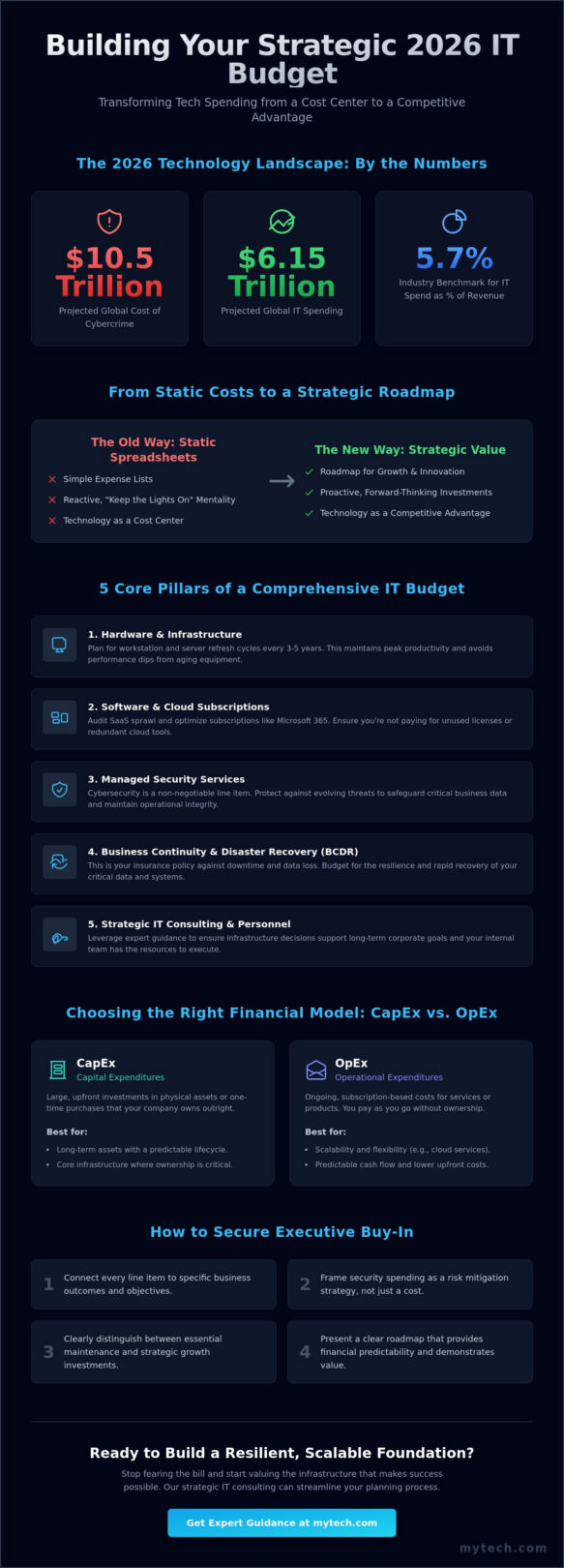
Did you know the global cost of cybercrime is forecasted to reach a staggering $10.5 trillion in 2026? For many leaders, this figure fuels a persistent tech anxiety, especially as global IT spending is projected to hit $6.15 trillion this year. You likely feel the pressure to keep pace with AI deployments and NIST CSF 2.0 standards, yet communicating that technical value to a non-technical board remains a constant hurdle. It’s difficult to justify a comprehensive IT budget proposal template when you fear overspending on underutilized infrastructure.
We understand that you need more than a list of expenses; you need a roadmap that provides financial predictability and earns executive buy-in. This guide will show you how to turn your technology investments into a strategic catalyst for growth rather than just another line-item burden. We’ll walk through a framework that aligns your 2026 spend with industry benchmarks, such as the 5.7% revenue average, while preparing your organization for regulatory milestones like the EU AI Act. By the end of this article, you’ll have the confidence to build a secure, scalable foundation that empowers your business to thrive.
Key Takeaways
- Transform your budget from a simple expense list into a strategic roadmap that aligns technology spending with long-term business objectives.
- Utilize a comprehensive IT budget proposal template to manage hardware refresh cycles and control the sprawl of modern cloud and software subscriptions.
- Evaluate the shifting balance between CapEx and OpEx to determine which financial model provides the best scalability and predictable cash flow for your 2026 operations.
- Master a proven framework for securing executive buy-in by connecting every technical line item to specific business outcomes and risk mitigation strategies.
- Discover how strategic IT consulting can streamline your planning process and ensure your infrastructure is built for stability and growth.
The Strategic Value of a Modern IT Budget Proposal in 2026
A modern IT budget proposal isn’t just a financial ledger; it’s a strategic roadmap for your company’s future. In 2026, technology has moved past being a back-office utility. It’s now the primary engine for growth. By using a well-crafted IT budget proposal template, you shift the conversation from “how much does this cost” to “how much value does this create.” This approach naturally alleviates the tech anxiety that often plagues leadership when they’re faced with rising cybersecurity threats and complex infrastructure needs. We view this process as an opportunity to move from a defensive posture to a proactive, forward-thinking strategy that empowers your team to work with confidence.
Why Static Spreadsheets Are No Longer Enough
Traditional spreadsheets often fail because they treat technology as a static line item. In reality, modern costs are volatile. Cloud infrastructure scales based on demand, and cybersecurity risks evolve daily. We must look beyond simply “keeping the lights on.” A strategic proposal prioritizes innovation and IT cost transparency to ensure every dollar spent contributes to the bottom line. When you understand exactly where your resources go, you gain the freedom to invest in tools that actually drive revenue. This clarity transforms technology from a burden into a competitive advantage. It allows you to move from reactive repairs to intentional investments that scale effortlessly with your business growth.
Aligning Technology with 2026 Business Objectives
Strategic alignment serves as the bridge between your current operational capacity and your future market competitiveness. You need to distinguish between maintenance-stage costs, which preserve existing functions, and growth-stage investments that expand your reach. For example, optimizing your Microsoft 365 environment isn’t just a software update; it’s a strategic move to enhance employee productivity and client satisfaction. Focusing on the result ensures your technology spend is purposeful and measurable.
Key areas for 2026 alignment include:
- Risk Mitigation: Prioritizing Managed Security Services to protect against the rising $10.5 trillion global cybercrime threat.
- Scalability: Investing in Cloud Services that offer the flexibility to scale as market demands shift without massive upfront capital.
- Expert Guidance: Leveraging Strategic IT Consulting to ensure every hardware refresh cycle supports long-term corporate goals.
This structured approach ensures that your IT department operates as a partner in success, rather than a cost center. By focusing on these specific outcomes, you build a resilient organization ready to thrive in a digital-first economy. You stop fearing the bill and start valuing the infrastructure that makes your success possible.
Essential Components of a Comprehensive IT Budget Proposal Template
Building a resilient business starts with a structured breakdown of your technology requirements. An effective IT budget proposal template organizes complex technical needs into clear, manageable categories that resonate with stakeholders. Leaders who utilize strategic approaches to budgeting find that categorizing costs by business impact reduces friction during the approval process. We recommend focusing on five core pillars to ensure your 2026 roadmap is both exhaustive and strategic.
- Hardware and Infrastructure: Account for the refresh cycle of workstations and servers. Aim to replace devices every three to five years to maintain peak productivity and avoid the performance dips of aging equipment.
- Software and Cloud Subscriptions: Audit your SaaS sprawl. This includes Microsoft 365 Optimization to ensure you aren’t paying for unused licenses or redundant tools.
- Managed Security Services: Cybersecurity is no longer an optional add-on. With global cybersecurity spending projected to reach $240 billion in 2026, this must be a standalone, non-negotiable line item.
- Business Continuity & Disaster Recovery (BCDR): Budget for the resilience of your data. This is your insurance policy against downtime and data loss.
- Professional Services and Projects: Scope out one-time implementations, such as cloud migrations or office expansions, that fall outside of daily operations.
Categorizing Recurring Managed IT Service Fees
Predictability is the foundation of financial confidence. By shifting to a per-user or per-device monthly billing model through Managed IT Services, you eliminate the volatility of “break-fix” emergency costs. This proactive approach ensures your infrastructure remains healthy while providing 24/7 help desk support for your team. You gain a steady, manageable expense that scales directly with your headcount, making long-term forecasting much simpler.
Allocating Funds for Cybersecurity and Risk Mitigation
The cost of inaction is too high when the global cost of cybercrime is forecasted to reach $10.5 trillion in 2026. We treat security as an essential brand protection strategy. Your budget should include specific line items for multi-factor authentication (MFA), advanced endpoint protection, and ongoing employee training. For a deeper dive into managing these vulnerabilities, see our Strategic IT Support guide. Investing in these areas now prevents the $4.88 million average cost associated with a data breach. If you need help identifying these gaps, our team can provide Strategic IT Consulting to refine your 2026 financial plans.
CapEx vs. OpEx: Choosing the Right Financial Model for 2026
Deciding how to fund your technology stack is a pivotal moment in the planning process. In the past, businesses relied heavily on Capital Expenditure (CapEx), the traditional “buy and own” model for hardware like servers and workstations. While this approach allows for full ownership and certain tax depreciation benefits, it often leads to “lumpy” spending cycles that strain cash flow. Every few years, your IT budget proposal template might show a massive spike for server refreshes, creating financial unpredictability that can worry stakeholders.
Operating Expenditure (OpEx) offers a different path by focusing on a “pay-as-you-go” subscription model. This approach turns large, upfront investments into predictable monthly fees. Because OpEx costs are generally tax-deductible in the year they occur, they provide immediate cash flow relief. In 2026, the trend heavily favors OpEx because it aligns perfectly with the need for business agility. You stop paying for idle capacity and start paying for exactly what you use, which keeps your balance sheet lean and your infrastructure modern.
The Shift to Cloud-First Budgeting
Cloud migrations and platforms like Microsoft Azure have fundamentally changed the budget landscape. By moving workloads to the cloud, you replace the high cost of physical server maintenance with flexible Cloud Services fees. This transition eliminates the risk of overspending on underutilized hardware. As your headcount grows, your OpEx costs scale incrementally, ensuring that your technology spend always matches your operational reality. It’s a scalable solution that provides the freedom to expand without the fear of hitting a hardware ceiling. This predictability is exactly what boards look for when approving a strategic roadmap.
When CapEx Still Makes Strategic Sense
While the world is moving toward the cloud, CapEx still holds value in specific scenarios. Certain industries with specialized hardware needs or strict data sovereignty requirements may find that owning on-premise infrastructure offers a better long-term ROI. For example, high-performance computing tasks or localized manufacturing controls might require dedicated physical assets. We often help clients implement a hybrid approach. This strategy balances the ownership of core, specialized assets with the agility of cloud-based subscriptions. By carefully selecting which items remain as CapEx, you can maintain a competitive edge while still enjoying the scalability of an OpEx-heavy environment. We use Strategic IT Consulting to help you find that perfect balance for your 2026 goals.
How to Present Your IT Budget to Get Executive Buy-In
The most detailed IT budget proposal template only succeeds if you can translate those numbers into a narrative that resonates with your board. Executives don’t want to see a list of part numbers or software versions; they want to see how your plan drives the organization forward. Presenting your budget is about building trust and demonstrating that you’ve considered the long-term health of the business. We recommend a five-step approach to move from a defensive request for funds to a strategic partnership with leadership.
Start with the business outcome. Connect every dollar of tech spend to revenue generation or risk reduction. Use the “Problem-Solution-Result” framework for specific projects. For example, if you’re proposing an upgrade to your server infrastructure, identify the problem (aging hardware causing downtime), the solution (a hybrid cloud migration), and the result (increased employee productivity and 99.9% uptime). This logical progression makes the investment feel purposeful. Provide a clear “Current State” versus “Future State” comparison to help stakeholders visualize the roadmap. It’s equally vital to define the “Cost of Doing Nothing.” Remind the board that with the global average cost of a data breach hitting $4.88 million, the price of inaction far outweighs the cost of proactive Managed Security Services.
Speaking the Language of the C-Suite
Technical jargon often creates a barrier to approval. Instead of discussing bandwidth or latency, focus on business metrics like “uptime,” “scalability,” and “compliance.” Explain how comprehensive it services and support empower your employees to thrive without the frustration of constant technical hurdles. Your goal is to project a sense of calm authority. When leadership knows the infrastructure is stable and secure, they can focus on innovation rather than fire-fighting. This shift in perspective turns technology from an expense into a catalyst for success.
Visualizing the Tech Roadmap
A visual roadmap builds significantly more trust than raw data alone. We suggest presenting your IT budget proposal template within a 12-to-36 month timeline. This long-term view shows that you aren’t just reacting to current needs but are planning for sustainable growth. Highlight “low-hanging fruit” like Microsoft 365 Optimization to demonstrate immediate ROI and efficiency gains. This strategy proves you’re a disciplined steward of the company’s resources. If you’re ready to align your technology with your 2026 growth goals, our team can help you design a strategic IT roadmap that secures executive approval.
Beyond the Spreadsheet: Partnering for Strategic IT Success
Completing your IT budget proposal template is a significant milestone, but the numbers on the page only tell half the story. To truly transform your technology into a growth engine, you need a partner who looks beyond the immediate costs to see the broader corporate vision. At Mytech Partners, we act as your Trusted Navigator, leading you through the complexities of the digital landscape with disciplined, experienced guidance. We don’t just manage your systems; we ensure every technical investment empowers your team to thrive and remain competitive in an evolving market.
One of the greatest challenges in budgeting is the fear of hidden costs or scope creep during major implementations. We address this by offering fixed-fee project implementation. This approach provides the financial predictability your board demands, ensuring that migrations or infrastructure upgrades stay within the parameters of your approved budget. By removing the risk of unexpected expenses, you gain the freedom to focus on strategic initiatives rather than financial damage control. Our goal is to create an atmosphere of reliability where technology is a stable foundation for your success.
Leveraging a vCIO for Long-Term Planning
Many organizations struggle to find executive-level technical strategy without the high cost of a full-time executive salary. This is where a Virtual CIO (vCIO) becomes invaluable. A vCIO provides the high-level roadmap and oversight needed to align your IT spend with long-term business goals. By utilizing managed it support services, you ensure a cycle of continuous improvement rather than just settling for basic maintenance. This strategic partnership bridges the gap between daily operations and future scalability, turning your IT department into a proactive value-driver.
Your Next Steps: Refining Your 2026 Proposal
Before you step into the board meeting, take a final look at your proposal to ensure it’s ready for executive scrutiny. A polished plan should be clear, outcome-focused, and resilient. Use this checklist to validate your assumptions:
- Does the proposal clearly link tech spend to specific business growth or risk reduction?
- Have you accounted for the 2026 shift toward OpEx and cloud-first scalability?
- Is there a standalone line item for Managed Security Services to address modern threats?
- Does your timeline reflect a 12-to-36 month strategic roadmap?
Don’t leave your 2026 success to chance. A professional assessment can help you validate your budget and identify opportunities for optimization that you might have missed. We invite you to connect with Mytech Partners for a Strategic IT Roadmap consultation to ensure your organization is prepared to lead with confidence.
Take Command of Your Technology Strategy for 2026
Creating a resilient organization starts with moving beyond simple spreadsheets and embracing a proactive, strategic vision. You now understand how to categorize essential infrastructure and leverage the flexibility of OpEx models to keep your cash flow predictable while supporting rapid scaling. By focusing on tangible business outcomes rather than technical specifications, you can finally eliminate the friction often found in the executive approval process. A well-structured IT budget proposal template acts as your first step toward transforming technology from a line-item burden into a powerful, scalable asset for growth.
Since 2000, Mytech Partners has served as a Trusted Navigator for mid-sized businesses nationwide. We provide the specialized expertise in Microsoft 365 Optimization and cybersecurity needed to ensure your infrastructure remains a catalyst for success rather than a source of tech anxiety. You don’t have to navigate these technical complexities alone. Empower your business with a Strategic IT Roadmap from Mytech Partners and gain the confidence to lead your organization into a secure, high-growth future. The future of your business is bright when you lead with the right technological foundation.
Frequently Asked Questions
What should be included in a standard IT budget proposal?
A standard proposal includes hardware lifecycles, cloud subscriptions, managed security layers, and contingency funds for disaster recovery. It’s about grouping these into a functional IT budget proposal template that executives can scan quickly. You also need to account for professional services for one-time migrations to ensure no hidden costs disrupt your operations or strain your cash flow during the year.
How do I justify a 2026 increase in cybersecurity spending?
Justify the increase by pointing to the shifting regulatory landscape, such as the EU AI Act obligations coming into force in August 2026. Frame security as a business enabler that prevents the catastrophic $9.44 million average cost of a U.S. data breach. This moves the conversation from an “added cost” to “essential risk management” that protects the organization’s long-term health and brand reputation.
What is the average IT budget percentage for a mid-sized business?
Most organizations spend an average of 5.7% of their revenue on technology in 2026. While small businesses often average 6.9% to build their foundation, mid-sized companies typically find a balance between that and the 3.7% spent by large enterprises. Your specific industry, such as financial services or healthcare, may require a higher allocation of up to 10% due to stricter compliance and data security needs.
How can a Managed Service Provider help with my budget proposal?
An MSP acts as a strategic partner by identifying infrastructure gaps before they become expensive emergencies. They provide the data needed to populate your IT budget proposal template with accurate, fixed-fee costs for projects and monthly services. This collaboration ensures your roadmap is based on real-world technical requirements rather than guesswork, providing the financial predictability and calm authority that leadership values during the approval process.
What is the difference between CapEx and OpEx in an IT context?
CapEx involves large upfront investments to own physical assets like servers, which then depreciate over time on your balance sheet. OpEx is a subscription-based model where you pay monthly for services like cloud hosting or managed IT support. Most 2026 businesses favor OpEx because it offers superior scalability and immediate tax benefits, allowing you to adjust your spending as your headcount changes.
How often should I review and adjust my IT budget?
You should conduct a formal budget review at least quarterly to maintain financial discipline. Technology moves fast, and cloud-first environments require constant monitoring to prevent “subscription creep” or underutilized resources. Regular reviews allow you to implement FinOps practices, ensuring your spending remains aligned with actual usage and market shifts throughout the fiscal year. This cadence keeps your infrastructure stable and your costs predictable.
What are the biggest mistakes to avoid in an IT budget proposal?
The most common mistake is treating IT as a cost center rather than a strategic value-driver. Avoid the trap of “reactive budgeting,” where you only allocate funds when something breaks. You should also watch out for “shadow IT,” where individual departments purchase software outside of central oversight. This leads to redundant costs and security vulnerabilities that aren’t reflected in your primary proposal, creating hidden risks for the company.