What if the collection of security tools you’ve purchased is actually creating more risk than it solves? It’s a frustrating reality for many business leaders who find themselves facing rising insurance premiums and the constant threat of ransomware despite their best efforts. We understand the pressure of trying to manage a complex technology stack without enough internal expertise to keep up with every new alert. You want the freedom to focus on your business growth, not a list of technical fires to put out. A stable security foundation should provide confidence, not operational stress.
In this guide, we’ll help you differentiate between basic security vendors and true strategic partners who provide managed detection and response services. You’ll learn how to build a proactive security posture that meets the rigorous demands of the NIST 2.0 framework and new reporting rules like CIRCIA. We’ll provide a clear roadmap for aligning your technology with your long-term goals. This approach ensures your security becomes a catalyst for success rather than a burden on your operations.
Key Takeaways
- Distinguish between software vendors who sell tools and strategic partners who deliver measurable security outcomes.
- Explore how managed detection and response services provide the proactive threat hunting necessary to maintain a resilient posture in 2026.
- Identify the functional differences between managed IT services focused on uptime and managed security services focused on risk mitigation.
- Learn the essential assessment questions that reveal if a provider can truly align technology with your long-term business growth.
- Shift your perspective from viewing security as an operational burden to seeing it as a stable foundation for future success.
What is an IT Security Company and How Does it Differ from a Software Vendor?
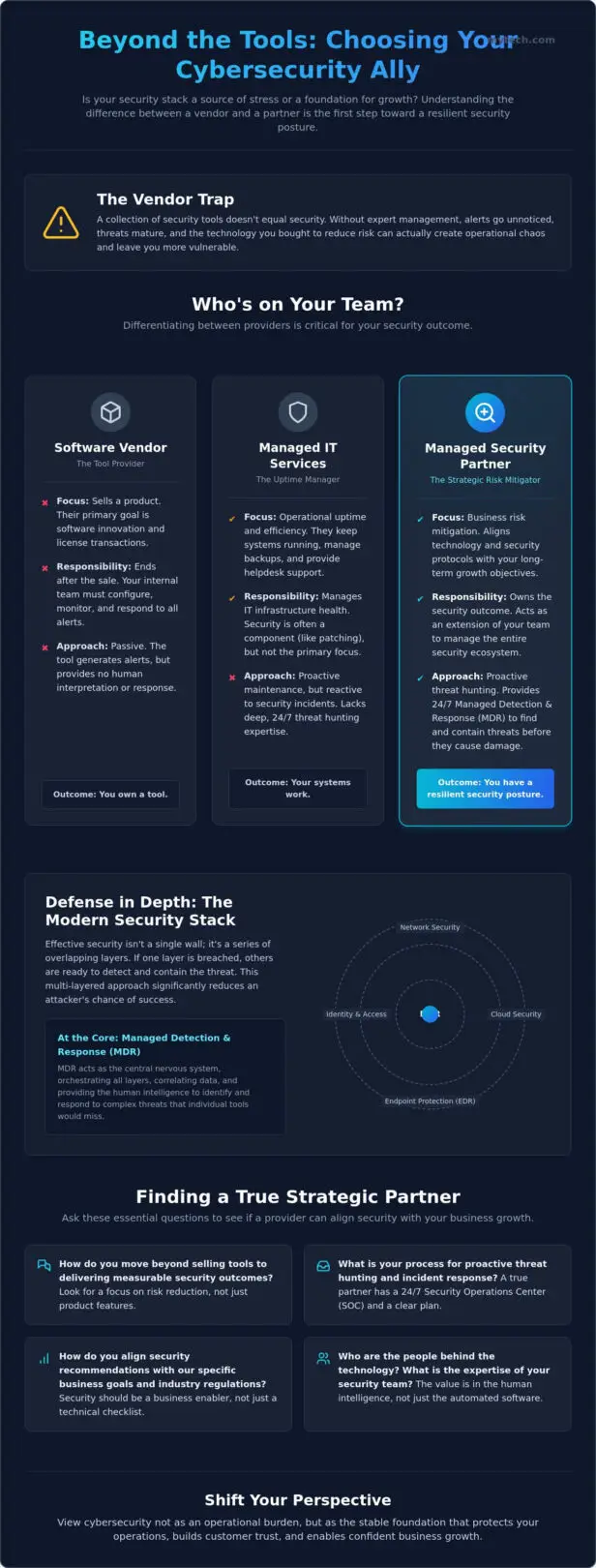
Thinking about cybersecurity often feels like staring at a wall of expensive products. You see logos for firewalls, antivirus, and encryption, each promising to be the ultimate shield. However, there’s a fundamental gap between owning a tool and achieving a secure outcome. A software vendor provides the technology, but an IT security company provides the expertise to make that technology work for your specific business goals. We view an IT security company as a strategic partner that manages risk, rather than just a vendor that processes transactions.
Tools are essential, but they’re insufficient on their own. Even the most advanced software generates alerts that require human intelligence to interpret. Without proactive monitoring, those alerts often sit in a dashboard while a threat matures. This is where Managed Detection and Response (MDR) becomes vital. It bridges the gap between software and safety by adding a layer of expert oversight. For small and mid-sized businesses (SMBs), this role is typically filled by a Managed Security Service Provider (MSSP). We act as an extension of your team, ensuring your security stack isn’t just a collection of disconnected products, but a unified defense.
The Role of a Security Software Vendor
Software vendors exist to create specialized tools. They focus on the technical mechanics of blocking malware or filtering traffic. Their primary goal is to innovate the software itself. While these tools are powerful, the vendor’s responsibility usually ends once the license is sold. They don’t monitor your network at midnight, and they don’t help you recover if a breach occurs. If you buy directly from a vendor, your business must have the internal staff to configure, update, and respond to every notification the tool generates.
The Role of a Managed IT Security Partner
A true partner takes ownership of the entire security ecosystem. We don’t just hand you a login; we take responsibility for the configuration and ongoing updates of your security stack. We ensure your protocols align with industry regulations and your specific growth objectives. This involves providing a strategic guide to IT support and services that integrates security into every operational decision. By utilizing managed detection and response services, we move beyond simple alerts to active threat containment. This creates a stable foundation where technology acts as a catalyst for your success, rather than a source of constant stress.
The Layers of Modern Cybersecurity: Understanding Managed Detection and Response Services
Effective cybersecurity in 2026 requires a shift from the traditional “perimeter” mindset to a philosophy of defense in depth. This approach recognizes that no single tool can stop every threat. Instead, we build multiple, overlapping layers of protection that work in harmony. If one layer is breached, others are ready to detect and contain the movement. At the heart of this strategy are managed detection and response services, which act as the central nervous system for your security stack. They provide the orchestration and intelligence needed to see across your entire digital environment, identifying patterns that individual tools might miss.
Modern attacks are rarely one-dimensional. They are multi-vector, often combining social engineering with the exploitation of unpatched vulnerabilities and lateral movement within a network. Relying on periodic scans or quarterly audits is no longer a viable strategy in this fast-moving landscape. We emphasize continuous, real-time monitoring because threats don’t wait for your next scheduled checkup. By maintaining a constant watch, we can identify anomalies the moment they appear, significantly reducing the “dwell time” of an attacker in your system.
Endpoint and Network Protection via MDR
The foundation of any resilient posture begins at the endpoint. Traditional antivirus is no longer enough to stop sophisticated fileless malware or credential theft. We utilize Endpoint Detection and Response (EDR) as a core component of our managed detection and response services. This technology monitors every laptop, server, and mobile device for suspicious behavior. For our partners in Denver and Minneapolis, where hybrid work is the standard, securing these remote endpoints is critical. We pair this with advanced firewalls and intrusion prevention systems to create a hardened perimeter that protects your data, regardless of where your team is logging in from.
The Human Element: Threat Hunting and vCISO Services
Technology alone cannot solve a human problem. While AI and automation are excellent for processing vast amounts of data, they can still miss the subtle, “low and slow” tactics used by experienced threat actors. This is why we employ human threat hunters who proactively search for hidden indicators of compromise. Beyond the technical hunt, we provide strategic leadership through virtual CISO (vCISO) services. This ensures that your security isn’t just a technical project, but a business-aligned strategy. A dedicated cybersecurity services company helps you build a culture of security where every employee understands their role in protecting the organization. If you want to see how these layers fit into your specific business model, we invite you to connect with our strategic consultants for a tailored evaluation.
Managed IT vs. Managed Security: Which Does Your Business Need?
Efficiency and safety are often mistaken for the same goal in technology management. While they’re closely related, Managed IT and Managed Security serve distinct purposes within your organization. We often see business leaders assume that a standard IT agreement covers every possible cyber threat. This assumption creates a dangerous gap in your defense. Managed IT focuses on the “how” of your business, ensuring your team can work without interruption. Managed Security focuses on the “who” and “what” that might try to stop you, managing the inherent risks of a connected world. You don’t have to choose one over the other; you need both to build a truly resilient organization.
Standard IT support is designed to facilitate productivity. It’s the engine that keeps your daily operations running smoothly. However, the skill set required to maintain a server is different from the skill set required to hunt for a sophisticated threat actor. Managed Security is a specialized discipline that requires dedicated tools and constant vigilance. Integrating managed detection and response services into your strategy ensures that while IT keeps the lights on, security keeps the door locked. This separation of duties allows each team to focus on what they do best, providing you with a stable foundation for growth.
The Scope of Managed IT Services
Managed IT services are the backbone of your digital workspace. This service layer focuses on help desk support, hardware maintenance, and the optimization of platforms like Microsoft 365. The primary objective is uptime. When an employee’s laptop fails or a cloud application won’t sync, Managed IT provides the solution. We work to ensure your systems remain operational and your employees stay productive. For businesses looking for local expertise, we offer a specialized look at managed IT services in Minneapolis to help align these technical needs with regional business goals.
The Specialized Focus of Managed Security
Managed Security moves beyond operational support into the world of risk mitigation and compliance. This service layer involves active threat hunting, regular compliance auditing, and rapid incident response. It’s particularly critical for industries like healthcare, legal, and manufacturing that face complex regulatory requirements. By utilizing managed detection and response services, we provide a proactive defense that identifies and contains threats before they can disrupt your business. You can find more details on how to weave these layers together in our comprehensive guide to managed services. This strategic alignment ensures that security is a catalyst for your success, not a hurdle to overcome.
How to Evaluate and Choose a Local IT Security Partner
Selecting a security partner is one of the most consequential decisions you’ll make for your organization’s long-term health. In a landscape where threats evolve daily, you need more than a technician who responds to tickets. You need a seasoned guide who understands your business objectives. When you begin your evaluation, start by asking how their managed detection and response services integrate with your broader growth strategy. A true partner won’t just talk about software; they’ll discuss how they minimize operational risk to give you the freedom to focus on your core mission.
Verifying a company’s track record in your specific industry is essential. A partner who understands the nuances of manufacturing workflows or legal confidentiality requirements will provide far more value than a generalist. We suggest looking for a firm that prioritizes Strategic IT Consulting. This ensures that every security decision is tethered to a tangible business outcome. By choosing a partner rather than a vendor, you gain a disciplined ally invested in your success.
Key Criteria: Certifications and Compliance Expertise
In 2026, compliance is no longer optional. You must verify that a potential partner has deep expertise in the NIST 2.0 framework, along with specific regulations like HIPAA or SOC2. Ask them directly about their internal security protocols. If they can’t demonstrate how they protect their own systems, they shouldn’t be trusted with yours. Additionally, evaluate their response time guarantees for critical incidents. A resilient posture depends on how quickly a partner can contain a threat after detection. We believe transparency in these metrics is the hallmark of a reliable partnership.
The Value of a Local Presence in 2026
While digital tools allow for remote monitoring, local presence remains a vital asset. Partners with offices in Dallas, San Antonio, or Denver possess a unique understanding of the regional business climate and talent market. This local knowledge informs a more tailored strategy that remote-only providers often miss. Furthermore, having a team nearby allows for on-site support during emergency responses or major hardware refreshes. Finding a managed service provider near you fosters a deeper, more collaborative relationship. If you’re ready to move beyond basic support toward a proactive defense, we invite you to schedule a strategic security assessment with our local experts today.
The Mytech Approach: Aligning Managed Security with Business Growth
At Mytech Partners, we believe technology should be a catalyst for your success, not an operational burden. Security shouldn’t feel like a series of hurdles that slow your team down. Instead, it should provide the stable foundation your business needs to scale with confidence. Our approach centers on the idea that managed detection and response services are most effective when they’re integrated into a broader business strategy. We don’t just deploy tools; we align them with your long-term objectives to ensure your technology stack supports your growth rather than hindering it.
Since our founding in 2000, we’ve focused on helping small and mid-sized businesses in Minnesota, Colorado, and Texas achieve this level of stability. We understand the specific challenges faced by organizations in hubs like Minneapolis, Denver, Dallas, and San Antonio. By combining technical excellence with Strategic IT Consulting, we provide a level of oversight that goes beyond simple troubleshooting. This partnership-focused model ensures that your security posture evolves alongside your business, satisfying insurance requirements and providing the peace of mind needed to focus on your primary goals.
Proactive Management and Continuous Monitoring
Reliability comes from vigilance. Our team provides continuous monitoring to identify and contain threats before they can disrupt your daily operations. This proactive stance is a core part of our managed detection and response services, allowing us to maintain a calm authority even in the face of complex digital risks. We don’t wait for a crisis to speak with you. We conduct regular business reviews to adjust your security protocols as your company grows and as regulatory requirements like the NIST 2.0 framework evolve. This ongoing dialogue ensures we remain genuinely invested in the long-term health of your organization.
Getting Started: Your Security Roadmap
Every successful partnership begins with a clear understanding of the current landscape. Our initial technology assessment isn’t a generic checklist. We dive deep into your specific environment to identify vulnerabilities and prioritize gaps based on their potential business impact. This process results in a tailored security roadmap that includes:
- A comprehensive evaluation of your existing technology stack and security protocols.
- Identification of vulnerabilities and compliance gaps relative to 2026 standards.
- A prioritized action plan that balances risk mitigation with your operational budget.
- A long-term strategy for technology alignment and business growth.
We help you address high-risk areas first, ensuring your resources are allocated where they matter most. If you’re ready to build a more resilient future, we’re here to lead the way. You can schedule a strategic IT assessment with Mytech Partners today to begin aligning your security with your business vision.
Building Your Resilient Future
Securing your organization in 2026 requires more than a collection of software licenses. It demands a shift in perspective where technology serves as a stable foundation for your long-term success. We’ve explored how managed detection and response services provide the proactive oversight necessary to satisfy insurance requirements and mitigate operational risk. By distinguishing between simple tool vendors and true strategic partners, you can move away from the stress of constant technical fires and focus on your core business objectives. A secure foundation gives you the confidence to pursue new opportunities without hesitation.
Our team has been dedicated to this shared journey since 2000. We bring local expertise to our partners in Minneapolis, Denver, Dallas, and San Antonio, ensuring your security posture aligns perfectly with your growth goals. This specialized focus on SMB strategic alignment means you don’t have to face the digital landscape alone. When you have a disciplined guide by your side, operational tools become catalysts for achievement rather than sources of frustration. You deserve a partner who is genuinely invested in your organization’s health.
Ready to take the next step? Partner with a strategic IT security company that drives business growth. We look forward to helping you build a secure, thriving organization.
Frequently Asked Questions
What is the difference between an MSP and an IT security company?
Managed Service Providers (MSPs) focus on infrastructure, uptime, and employee productivity. An IT security company focuses on risk mitigation and active threat defense. We view Managed IT as the engine that keeps you moving and Managed Security as the armor that protects your journey. While an MSP ensures your systems are operational, a security partner ensures those systems aren’t exploited by sophisticated actors.
Why can’t my internal IT person handle all of our security needs?
Modern security is a 24/7 discipline that requires specialized tools and constant vigilance. Most internal IT professionals are generalists who are already busy managing daily hardware and software needs. They rarely have the time or the specialized training required for deep threat hunting. Partnering with us allows your internal team to focus on business growth while we handle the complex security stack.
How much should a small business spend on cybersecurity in 2026?
Spending should align with your specific risk profile and the sensitivity of your data rather than a fixed dollar amount. Resilient organizations treat security as a strategic investment in business continuity. Utilizing managed detection and response services is often more cost-effective than trying to hire a full time internal security team. We help you prioritize your budget to address the highest impact risks first.
Does my business need an IT security company if we use the cloud?
Yes, because cloud providers follow a shared responsibility model. They secure the underlying infrastructure, but you’re responsible for securing the data and access points within that environment. We help you manage these permissions and monitor for suspicious activity. Without expert oversight, cloud configurations can easily lead to data exposure or unauthorized access.
How does an IT security company help with cyber insurance requirements?
We implement and manage the specific technical controls that insurance carriers now demand for coverage. This includes multi-factor authentication, incident response plans, and managed detection and response services. We provide the necessary documentation and proof of posture that insurers require to verify your organization’s resilience. This proactive approach helps you qualify for better coverage and potentially lower your premiums.
What are the first signs that my current IT provider is neglecting security?
A major red flag is a provider who only talks about hardware refreshes and uptime. If they haven’t discussed the NIST 2.0 framework or provided a clear security roadmap, your protection is likely an afterthought. You should receive regular reports that focus on risk levels and threat containment, not just a list of closed support tickets. A secure partner should be a proactive guide, not just a reactive technician.
Can an IT security company help with industry-specific compliance like HIPAA?
We specialize in mapping your technical controls to specific regulatory frameworks like HIPAA, SOC2, or the NIST framework. This ensures that your technology environment meets its legal obligations while still supporting your operational goals. We help you translate complex compliance language into tangible business processes. This alignment protects your organization from both cyber threats and heavy regulatory fines.
How often should my business undergo a professional security assessment?
We recommend a comprehensive assessment at least once per year to account for the evolving threat landscape. It’s also vital to trigger a review whenever you undergo major changes, such as opening new locations or moving to a new cloud platform. Regular assessments ensure your security strategy stays aligned with your current business model. This disciplined rhythm prevents small vulnerabilities from becoming major operational risks.