According to research published in March 2026, organizations overspend on their software by an average of 30% because they lack visibility into decentralized procurement. Many leaders find that software license management for small business is often a source of stress rather than a strategic advantage. This waste usually stems from “ghost” licenses tied to former employees or redundant subscriptions that quietly drain your monthly budget. It’s a common challenge, especially when you face the looming threat of a software audit or the complexity of navigating Microsoft 365 tiers.
We understand that you’d rather focus on scaling your operations than auditing every seat in your stack. This guide provides a clear path to optimizing your software environment. You’ll learn how to eliminate wasted spend, ensure total compliance, and turn your license inventory into a strategic asset. We’ll preview how to navigate the significant July 2026 price increases and show you how to build a predictable technology budget that supports your long-term goals.
Key Takeaways
- Understand how the shift to “Forever-SaaS” models impacts your bottom line and why centralized oversight is now a requirement for sustainable growth.
- Compare per-user, per-device, and consumption-based models to identify which licensing structure provides the best return for your specific team size.
- Implement a practical framework for software license management for small business that uncovers underutilized tools and eliminates redundant monthly subscriptions.
- Evaluate the transition from manual spreadsheets to automated management tools and discover when professional IT consulting becomes the more cost-effective choice.
- Discover how aligning your technology roadmap with quarterly strategic reviews can transform your software inventory from a static expense into a catalyst for operational efficiency.
What is Software License Management and Why Does it Matter for SMBs?
Software license management for small business is the strategic process of tracking, documenting, and controlling how your organization utilizes software applications. It’s no longer just about keeping product keys in a desk drawer or a random spreadsheet. As a specialized branch of Software Asset Management (SAM), this discipline ensures that every dollar you invest in technology directly supports your operational goals. We view it as a foundational practice that transforms an often-ignored expense into a clear business asset.
We’ve moved away from the era of one-time perpetual purchases. Today, we operate in a “Forever-SaaS” environment where recurring subscriptions are the standard. While this offers incredible flexibility for growing teams, it also creates a continuous financial commitment. Without a clear inventory, these subscriptions become invisible leaks in your budget. Gaining visibility into your stack is the first step toward operational stability. It gives you the freedom to deploy new tools with total confidence, knowing your foundation is secure and cost-effective.
The Real Cost of “Software Sprawl” in Growing Teams
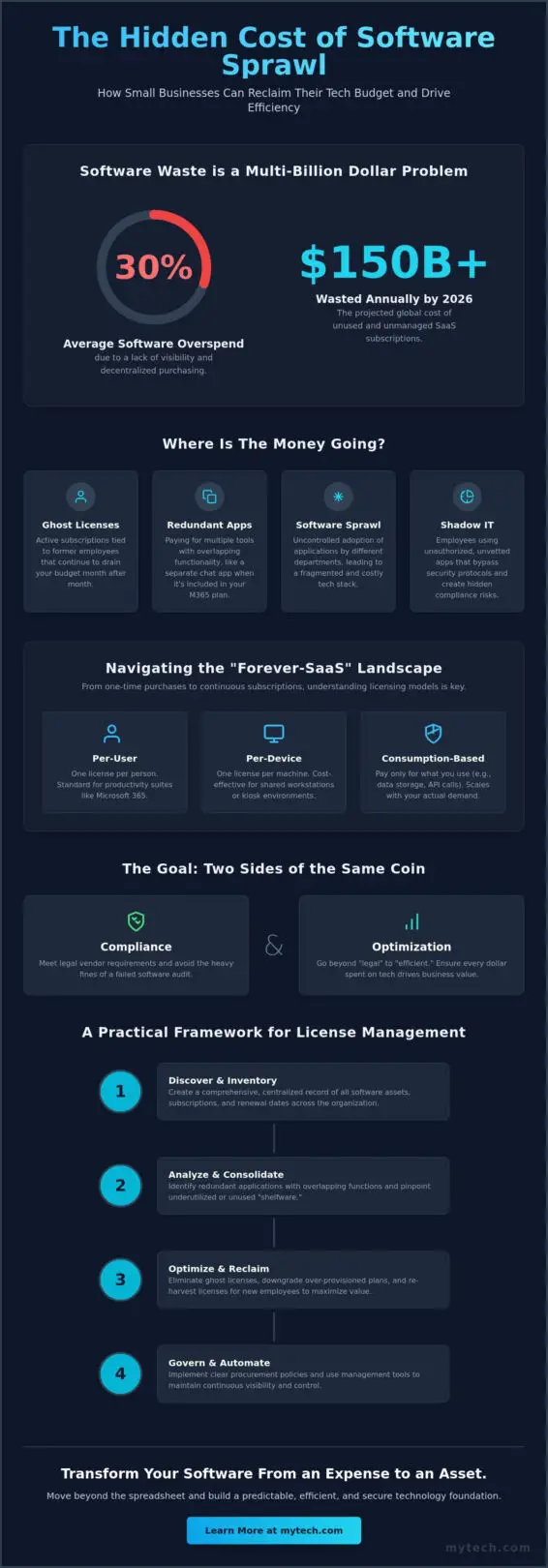
Growing teams often face “software sprawl” when different departments adopt tools independently. This leads to overlapping functionality; for instance, you might pay for a standalone messaging app while your Microsoft 365 subscription already includes a robust communication platform. Consolidating these redundant applications doesn’t just improve your ROI. It streamlines communication across your entire company and reduces technical friction.
A major contributor to this sprawl is the “ghost” license. When an employee leaves, their active accounts often remain in the system, continuing to bill your company month after month. Research from March 2026 indicates that organizations overspend on software by an average of 30% because they lack visibility into these decentralized purchases. By 2026, it’s estimated that businesses will waste over $150 billion annually on unused SaaS subscriptions. Furthermore, unmanaged software creates “Shadow IT,” where employees use unauthorized apps that bypass your security protocols. Proper management ensures every tool is vetted, secure, and necessary.
Compliance vs. Optimization: Two Sides of the Same Coin
Compliance and optimization are two sides of the same coin. Compliance focuses on meeting the legal requirements of your vendor contracts to avoid the financial sting of a failed audit. Major vendors frequently conduct audits to ensure users aren’t under-licensed, which can lead to unexpected and heavy fines. However, optimization goes a step further. It’s the shift from simply “being legal” to “being efficient” with your tech spend.
A well-managed license inventory protects your business reputation and financial health. It ensures you only pay for the licenses you actually use, rather than what you’ve simply accumulated over time. This proactive approach transforms software from a stressful overhead cost into a predictable, manageable catalyst for your long-term success.
Understanding the Modern Software Licensing Landscape
The transition from physical media to digital subscriptions has introduced a variety of complex consumption models. Today, most organizations navigate a mix of per-user, per-device, and consumption-based licensing. Per-user models remain the standard for productivity suites, while consumption-based models allow you to pay only for the resources you actually utilize. Adopting the ISO/IEC 19770-1 IT asset management standard provides a professional framework to manage these variations, ensuring your software license management for small business remains disciplined and transparent.
Tiered SaaS structures, ranging from “Free” to “Enterprise,” often create a dilemma for growing teams. While higher tiers offer advanced security and integration features, they can also lead to significant waste if those features remain undeployed. Bundled software packages frequently promise cost savings by grouping multiple tools together. However, these bundles can hide “shelfware,” which is software you pay for but never actually use. We’ve seen that a strategic approach to these bundles can reveal opportunities to trim overhead without sacrificing functionality.
Microsoft 365 Licensing: A Strategic Case Study
Microsoft 365 serves as the primary ecosystem for most small businesses, yet its licensing tiers are notoriously difficult to navigate. Effective July 2026, Microsoft is implementing price increases of 12-17% for its business tiers. This makes right-sizing your environment more critical than ever. Many organizations pay for Business Premium licenses when their actual usage only requires the features found in Business Standard or Basic. By leveraging professional Microsoft 365 Optimization, you can ensure your subscription levels match your team’s specific needs. This proactive alignment prevents you from absorbing the full impact of vendor price hikes while maintaining the security tools your business requires.
The Hidden Complexity of Hybrid Environments
Many established businesses operate in hybrid environments, managing legacy on-premise licenses alongside modern cloud-native subscriptions. Tracking perpetual licenses that require annual maintenance contracts is a common point of failure. If you lose visibility into these assets, you risk falling out of compliance or losing access to critical updates. A unified view of all software assets is essential for a robust disaster recovery plan. You must know exactly which licenses you own to restore operations quickly after a system failure. Managing these diverse assets with a single, clear strategy provides the stability needed for long-term growth. If you’re unsure where your current inventory stands, our team can provide Strategic IT Consulting to help you map out a more efficient path forward.
Evaluating Management Strategies: Tools vs. Managed Services
Choosing the right approach to software license management for small business often starts with a simple spreadsheet. While manual tracking is a common entry point, it quickly becomes a liability as your team grows. Spreadsheets are prone to human error and lack the real-time connectivity required to track modern SaaS subscriptions. This often leads to a “Management Gap” where you have data but no clear direction on how to use it to reduce costs.
Dedicated software license management (SLM) tools like SolarWinds or Freshservice offer a more robust alternative. These platforms excel at discovering every application installed across your network. They provide the visibility needed to identify unused assets, but they still require human expertise to interpret that data strategically. Without that oversight, a tool is simply another subscription you’re paying for without a guaranteed return on investment.
The Limits of Automated Software License Management Tools
Automation is a powerful discovery mechanism, but it has distinct limitations. A tool can identify a license, but it cannot determine its actual business value. For example, an automated scan might show that an employee has a specific design tool installed, but it won’t tell you if they only open it once a year. This leads to “alert fatigue,” where your IT staff is buried under a mountain of notifications about renewals and version updates without a strategic plan to prioritize them. The hidden cost of these platforms is the time required to train your staff. High-end SLM platforms require significant training to maintain, which often pulls your internal resources away from projects that drive your business forward.
The Benefits of an MSP-Led Licensing Strategy
Positioning a partner at the center of your strategy ensures that your technology remains aligned with your long-term objectives. Professional Managed IT Services provide the strategic oversight layer that tools alone lack. We conduct proactive license auditing to catch wasteful spending before it impacts your bottom line. This approach also allows you to leverage our purchasing power and vendor relationships to secure better margins and more favorable terms. By aligning your license renewals with your overall business growth roadmap, we turn your software inventory into a predictable and manageable asset. This partnership removes the operational stress of compliance and allows you to focus on scaling your organization with confidence.
How to Implement a Software License Management Framework
Implementing a reliable framework for software license management for small business requires a shift from reactive fixes to proactive oversight. We recommend a five-step approach to bring order to your digital environment. First, centralize your documentation. You need a single repository for every vendor contract and license key. Second, conduct a usage audit. Don’t just look at what’s installed; look at who’s actually logging in. Research indicates that by 2026, businesses will waste over $150 billion annually on unused SaaS subscriptions. Third, benchmark your current spend. If your monthly overhead feels high, compare it against the typical $25 to $150 per-user range for off-the-shelf tools. Fourth, standardize your stack to eliminate redundant applications. Finally, establish a continuous monitoring calendar to review every subscription before it auto-renews.
This disciplined process ensures that your technology remains a catalyst for growth rather than a source of financial stress. By following these steps, you build a foundation that supports both your current team and your future scaling efforts. It’s about creating a predictable technology budget that you can trust.
Conducting Your First Software Audit
Your first audit might reveal “Shadow IT,” which are applications purchased on individual employee credit cards without official approval. Finding these isn’t a reason to panic. It’s a chance to consolidate those tools into your managed environment. By identifying these outliers, you create a “Source of Truth” that reflects your actual software footprint. This transparency is the only way to ensure your team has the tools they need without the hidden risks of unmanaged software. We’ve found that clarity here often alleviates the operational stress felt by many business owners.
Establishing a Procurement and Offboarding Policy
A strategic framework must include clear rules for how software enters and leaves your organization. We help clients build workflows that reclaim licenses the moment an employee departs. This prevents “ghost” accounts from draining your budget for months after an offboarding event. You should also set approval gates for new software requests to stop sprawl before it starts. Integrating these policies into your Strategic IT Support plan ensures that every new tool aligns with your long-term roadmap. If you’re ready to stop the waste and secure your environment, connect with us to start your optimization journey.
Strategic Licensing with Mytech: Beyond the Spreadsheet
At Mytech Partners, we believe that your technology stack should serve as a stable foundation for growth rather than a source of operational stress. We take software license management for small business beyond simple inventory tracking by aligning every subscription with your specific organizational goals. This strategic approach ensures you aren’t just “managing” costs; you’re actively investing in tools that drive productivity. Our vCIOs lead this effort by conducting quarterly reviews of your licensing strategy. These sessions provide a dedicated space to evaluate usage patterns, prepare for upcoming renewals, and ensure your software environment remains lean and purposeful.
Proactive management is the cornerstone of a secure and stable organization. When we oversee your licensing, we eliminate the guesswork that often leads to overspending or compliance risks. We move your business from a reactive “break-fix” mentality to a disciplined, forward-thinking model. This creates an atmosphere of reliability. You gain the freedom to focus on your primary objectives while we handle the complexities of vendor contracts and seat counts.
Local Expertise in Minneapolis, Denver, and Beyond
Working with a local partner provides a significant advantage in understanding regional market dynamics and operational requirements. Our teams in Minneapolis and Denver offer personalized support tailored to the unique needs of businesses in those communities. We also maintain a strong presence in Texas and California, with offices in San Antonio, Dallas, and Long Beach. This geographic reach allows us to deliver hands-on consulting that a distant, faceless vendor simply cannot match.
Transitioning from reactive tech help to a Managed Service Provider partnership changes how you interact with your technology. We act as an extension of your team, providing the calm authority needed to lead you through complex digital landscapes. Whether you’re navigating the latest Microsoft 365 price adjustments or standardizing your stack across multiple locations, our local experts are there to ensure a seamless experience.
Integrating Licensing into Your Technology Roadmap
Effective licensing management provides the data necessary to build a predictable technology budget. By analyzing your license lifecycle, we help you forecast future IT spend with precision, preventing the “budget shocks” that occur when renewals arrive unexpectedly. This data also plays a critical role in strengthening your overall Cybersecurity Services posture. When we identify and reclaim unused licenses, we close potential entry points for unauthorized access and reduce your organization’s attack surface.
The Mytech promise is centered on creating freedom and confidence through a stable foundation. We don’t just provide technical support; we offer a shared journey toward long-term organizational health. By turning your license inventory into a strategic business asset, we help you build a more resilient, efficient, and profitable company. Our collaborative approach ensures that your software environment evolves alongside your business, always supporting your next stage of success.
Build a Foundation for Sustainable Growth
Effective software license management for small business is about more than just reducing monthly overhead. It’s a strategic process that ensures your technology investments directly support your long-term objectives. By centralizing your vendor contracts and conducting regular usage audits, you gain the visibility needed to eliminate waste and maintain total compliance. This proactive oversight creates a stable environment where your team can thrive without the stress of unpredictable software costs.
Mytech Partners brings over 20 years of experience to every partnership. We provide a dedicated vCIO to help you plan a clear technology roadmap and offer local support teams in Minnesota, Colorado, and Texas for personalized care. We’re here to lead you through the digital landscape with the discipline and experience your organization deserves. We focus on the long-term health of your business, ensuring your tools act as assets rather than liabilities.
Request a Strategic IT Assessment with Mytech Partners to start optimizing your software environment. Taking control of your software stack is the first step toward a more secure and efficient future. We look forward to helping you turn your operational tools into powerful catalysts for success.
Frequently Asked Questions
Is software license management necessary for a business with fewer than 50 employees?
Yes, software license management is essential for smaller teams because software costs often represent one of the largest line items in an SMB budget. Even with fewer than 50 employees, a business can easily accumulate hundreds of individual subscriptions across various departments. Without a strategic approach, you risk paying for “ghost” licenses or redundant tools that drain your resources and hinder your ability to scale effectively.
How much can a small business save by implementing license management?
Research published in March 2026 indicates that organizations with mature IT Asset Management programs can reduce their software spending by 20 to 30 percent. By identifying unused seats and consolidating redundant applications, you can reclaim significant portions of your technology budget. This disciplined oversight transforms your software inventory from a source of waste into a predictable and lean business asset that supports your primary objectives.
What happens if our company fails a software audit from Microsoft or Adobe?
Failing a vendor audit typically results in significant financial penalties and the immediate requirement to purchase licenses for any detected shortfall at current market rates. Beyond the direct costs, an audit can disrupt your operations and create unnecessary stress for your leadership team. Implementing software license management for small business ensures you remain compliant at all times, providing the peace of mind that comes from a stable foundation.
Can an MSP help manage my Microsoft 365 subscriptions?
A Managed Service Provider (MSP) provides the strategic oversight needed to right-size your Microsoft 365 environment through specialized optimization services. We ensure your team has the correct license tiers for their specific roles, preventing you from paying for enterprise features that remain undeployed. This partnership allows you to navigate complex licensing changes with confidence, knowing your subscriptions are always aligned with your growth roadmap.
What is the difference between an IT asset management tool and a license management service?
An IT asset management tool is a software platform that discovers and tracks hardware and software across your network. In contrast, a license management service involves professional oversight and strategic consulting to interpret that data. While a tool provides the raw data, a service provides the strategy by aligning your technology spend with your business goals and managing vendor relationships on your behalf.
How often should a small business conduct a software license audit?
We recommend conducting a comprehensive software review at least once per quarter to maintain optimal efficiency. This frequency allows you to catch unused licenses from recently offboarded employees and prepare for upcoming renewals before they automatically process. Regular audits ensure your software environment remains lean and responsive to changes in your workforce, maintaining the financial health and operational stability of your organization.
Does license management help with cybersecurity?
Effective license management is a critical component of a robust cybersecurity posture because it provides total visibility into your software environment. By maintaining a clear inventory, you can identify and remove unauthorized “Shadow IT” applications that bypass your security protocols. This process also ensures that all active software is properly licensed and receiving the latest security patches, reducing your attack surface and protecting your business data.
How do I track software licenses for remote employees in different cities?
Tracking licenses for a distributed workforce requires a centralized, cloud-based management strategy that monitors login activity regardless of physical location. By standardizing your procurement process, you ensure that all software requests go through a single approval gate. This approach provides a unified view of your assets across different cities, ensuring that remote employees have the tools they need while you maintain total control over your software license management for small business.