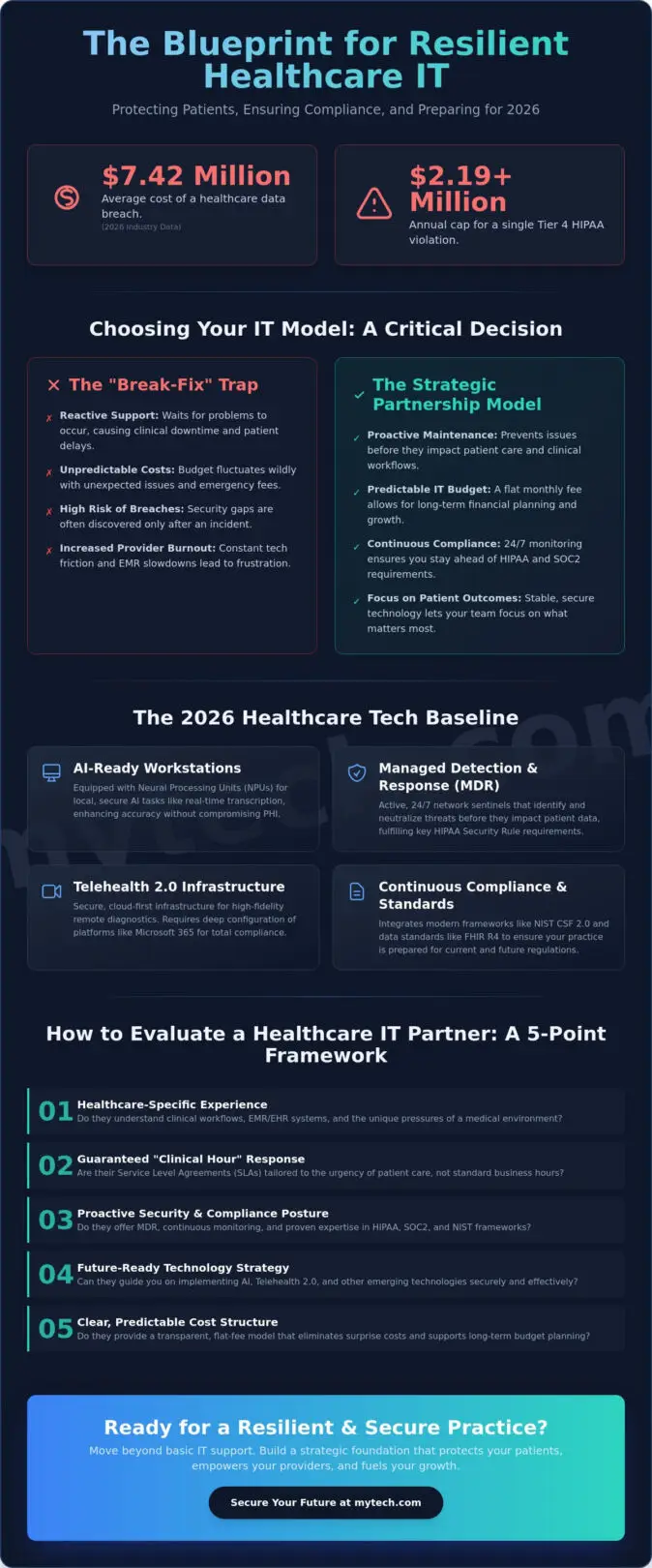
Did you know that the average cost of a healthcare data breach has reached $7.42 million according to 2026 industry data? For many practices, a single security lapse or a Tier 4 HIPAA violation, which now carries an annual cap of over $2.19 million, can be catastrophic. Finding reliable it support for healthcare providers is no longer about basic maintenance. It’s about building a resilient foundation that protects your patients and your reputation.
We understand the anxiety that comes with rising ransomware threats and the frustration of EMR systems that slow down your patient volume. You deserve a clinical environment where technology works as hard as you do. This guide explains how to select a strategic IT partner that manages HIPAA compliance, secures patient data, and leverages the latest FHIR R4 standards to improve outcomes. You’ll learn how to achieve zero-downtime operations and create a predictable IT budget that supports your long-term growth. We will examine the essential steps to integrate telehealth seamlessly and modernize your cybersecurity using the NIST CSF 2.0 framework.
Key Takeaways
- Move beyond basic help desk support to a strategic model where it support for healthcare providers aligns directly with clinical workflows and patient safety.
- Prepare your practice for the 2026 landscape by deploying AI-ready workstations and multi-layered cybersecurity like Managed Detection and Response (MDR).
- Protect your organization from the legal and financial risks of the “break-fix” trap by adopting proactive maintenance that stops technical issues before they reach the exam room.
- Evaluate potential partners using a disciplined framework that prioritizes healthcare-specific experience and response time guarantees tailored to the “clinical hour.”
- Shift your focus from operational stress to patient outcomes by establishing a secure, stable foundation that provides long-term confidence and growth.
Why Healthcare IT Support Requires a Specialized Strategic Approach
Modern medicine doesn’t happen in a vacuum; it happens on a network. While traditional help desks focus on fixing broken printers, effective it support for healthcare providers focuses on clinical alignment. This means your technology shouldn’t just exist. It should actively facilitate better patient outcomes. In 2026, 24/7 system availability has transitioned from a convenience to a non-negotiable patient safety requirement. When a clinician cannot access a patient’s history during a critical moment, the issue isn’t just technical. It’s a direct risk to care.
We view ourselves as a reassuring partner in this journey. We move your practice away from the constant stress of “what if” scenarios toward a state of operational confidence. By eliminating the “Cost of Silence,” the invisible financial and clinical drain caused by minor, recurring glitches, we help you reclaim your focus. This specialized strategic approach ensures that your digital infrastructure remains a catalyst for success rather than a source of anxiety. High-quality it support for healthcare providers creates the stability necessary for long-term growth and practice resilience.
The Patient Journey and the Digital Backbone
Every second of network latency ripples through your practice. It manifests as a patient waiting five extra minutes in the exam room or a provider staying an hour late to finish charting. These delays contribute directly to provider burnout and reduced patient volume. A robust digital backbone ensures that EMR and EHR data flows seamlessly across all your locations. We believe that “good enough” IT is a significant risk factor in modern medicine. Your foundation must support high-speed data exchange without hesitation to protect the integrity of the patient journey.
Compliance as a Continuous Process, Not a Destination
Compliance shouldn’t be a frantic scramble before an annual audit. In the 2026 regulatory environment, we prioritize real-time monitoring to ensure your data remains secure every hour of every day. The intersection of SOC2 standards and HIPAA requirements creates a complex landscape that demands constant vigilance and disciplined management. Our managed IT services in Minneapolis offer a proven blueprint for regional compliance, providing the structure needed to manage these risks effectively. We treat compliance as a living part of your business strategy, ensuring your practice stays ahead of evolving mandates and security threats.
The 2026 Healthcare Tech Baseline: Security, Compliance, and AI
Technology in the clinical space has moved beyond simple digitization. In 2026, the baseline for medical workstations has shifted to include Neural Processing Units (NPUs). These specialized processors allow for local AI data processing, which is essential for real-time medical transcription and diagnostic assistance without sending sensitive data to the public cloud. This hardware evolution is a cornerstone of modern it support for healthcare providers, as it balances the need for advanced computing with strict data privacy. When your hardware is purpose-built for these tasks, your team experiences less lag and greater clinical accuracy.
Cybersecurity has also transitioned from passive defense to active engagement. Simple firewalls are no longer sufficient to protect against sophisticated threats. We now prioritize Managed Detection and Response (MDR) to provide a 24/7 sentry over your network. This proactive stance directly supports HIPAA Security Rule requirements by ensuring that potential breaches are identified and neutralized before they can impact patient care. By moving to a layered security model, we provide the stable foundation your practice needs to operate with confidence.
Telehealth has matured into “Telehealth 2.0,” requiring high-fidelity video conferencing that supports remote diagnostics with crystal clarity. This requires a cloud-first approach that never compromises on compliance. Optimizing platforms like Microsoft 365 for medical use involves more than just a login; it requires deep configuration to ensure every communication remains secure. If you’re unsure if your current cloud setup meets these standards, our managed security services can provide the necessary oversight to protect your digital perimeter.
Protecting PHI in a World of AI-Driven Ransomware
Traditional backups are no longer the final word in safety. Ransomware in 2026 often targets backup files first to eliminate your ability to recover. We implement immutable, air-gapped data recovery solutions that keep a clean copy of your records entirely separate from the main network. Beyond technology, we focus on the human element. We train clinical staff in cities like Denver and Dallas to act as a “human firewall,” recognizing social engineering attempts before they escalate. This is paired with a Zero-Trust Architecture, where every access request is verified, regardless of where it originates.
Interoperability and the Modern Medical Office
A modern office is filled with IoT medical devices, from imaging machines to vitals monitors. Integrating these securely into the main network is vital to prevent them from becoming entry points for intruders. We utilize Wi-Fi 7 to handle the massive bandwidth required for high-resolution medical imaging transfers, ensuring that clinicians aren’t waiting on a progress bar. By standardizing hardware across your practice, we eliminate “Frankenstein fleets” that lead to inconsistent performance and higher maintenance costs. This disciplined approach ensures that your tools remain assets for success rather than obstacles to care.
Beyond digital tools, physical accessibility is a cornerstone of a well-equipped office; you can discover Enhanced Mobility Ltd to find high-quality mobility aids that support your patients’ needs.
Managed Services vs. Break-Fix: Which Model Protects Your Practice?
Many clinics view IT as a utility, only calling for help when a system fails. This reactive “break-fix” model is a significant financial and legal liability. When your network goes down, the clock doesn’t just stop for your IT; it stops for your patients and your revenue. Waiting for a disaster to happen creates a cycle of stress and unpredictable “emergency invoices” that can derail your monthly budget. Effective it support for healthcare providers replaces this chaos with a state of calm authority and operational stability.
In contrast, proactive maintenance focuses on prevention. By utilizing strategic IT support in Denver, you shift the focus from putting out fires to maintaining a high-performing environment. This transition offers the vCIO advantage, where a dedicated advisor provides high-level roadmapping instead of just suggesting “more RAM.” We align your technology with strategic healthcare IT trends for 2026, ensuring your practice is ready for the industry shift from mere innovation to full execution. This disciplined approach transforms your IT from a cost center into a catalyst for success.
Total Cost of Ownership (TCO) in Healthcare IT
Calculating the true cost of IT requires looking beyond the monthly bill. You must factor in provider downtime and lost billable hours. A single hour of downtime for a busy clinic can cost thousands in lost appointments. There is also the “Compliance Tax” to consider. The cost of recovering from a data breach far exceeds the investment required for prevention. Industry professionals report that standardizing your IT environment can reduce support tickets by up to 30%. This allows your staff to stay focused on patient care rather than technical hurdles. When your systems are predictable, your revenue is predictable.
The Partnership Cadence: Quarterly Strategic Reviews
We believe your IT partner should be an extension of your leadership team. Our partnership cadence includes Quarterly Strategic Reviews (QSRs) where we discuss your business goals rather than just ticket counts. If you plan to open new clinics or expand your services over the next three years, your technology must be ready to scale with you. We use data telemetry to predict hardware failure in medical workstations before they fail in the exam room. This proactive it support for healthcare providers ensures that your operations remain smooth and your growth remains purposeful. We work together to ensure your digital foundation is always ready for what’s next.
How to Evaluate a Healthcare IT Partner: A 5-Point Framework
Choosing an IT partner is a high-stakes decision that directly affects your clinical efficiency and legal safety. When you search for it support for healthcare providers, look for a guide who understands the intersection of technology and patient care. This framework helps you move past surface-level promises to find a partner who provides a stable, secure foundation for your practice.
First, verify healthcare-specific experience. A generalist provider might not grasp the complexities of protecting protected health information (PHI). Ask for samples of their Business Associate Agreement (BAA) and confirm their history with similar medical practices. Second, assess their response time guarantees using the ‘Clinical Hour’ standard. This ensures that technical issues are resolved before they disrupt patient appointments. Third, evaluate the depth of their security stack. You need a partner who offers Managed Detection and Response (MDR) and vCISO consulting to proactively manage risks.
Fourth, check for local support availability. Having technicians in cities like Minneapolis, Denver, San Antonio, or Dallas is crucial for issues that require physical intervention. Finally, review their strategic alignment. A true partner should understand how to leverage it services and support to facilitate your practice’s long-term growth and success.
The ‘Boots on the Ground’ Test
Remote support is efficient for software updates, but it fails when a critical imaging sensor or label printer goes down. Physical proximity matters. Evaluating the distance between your partner’s technicians and your primary clinical locations ensures you receive rapid on-site assistance when it’s needed most. A local partner who understands the business climate in your specific region provides a level of reliability that remote-only firms cannot match. This presence is a vital component of robust it support for healthcare providers.
Certifications and Compliance Credentials
Look for objective evidence of a provider’s commitment to excellence. This includes Microsoft Gold Partner status and SOC2 Type II certifications, which prove they maintain rigorous internal security controls. The Business Associate Agreement (BAA) is the most critical document in your contract. It formalizes the partner’s legal responsibility to protect your data. Always ask for healthcare-specific references in your metro area to verify their ability to handle clinical workflows. If you want to see how strategic leadership can transform your practice, consider exploring our strategic IT support options.
Mytech Partners: Reassuring IT Leadership for Healthcare Providers
We believe that technology should be an invisible engine for clinical excellence. Our “Calm Authority” approach is designed to replace the friction of technical failure with the freedom of a stable foundation. We understand that medical stakeholders face immense operational stress, from regulatory shifts to cybersecurity threats. By providing specialized it support for healthcare providers, we alleviate that burden. We position ourselves as an essential partner in your growth, ensuring that your operational tools are catalysts for success rather than obstacles to care.
Our presence is felt most strongly through our local expertise. We maintain dedicated teams in Minneapolis, Denver, Long Beach, San Antonio, and Dallas to provide the “boots on the ground” support your clinic requires. This local focus allows us to respond rapidly to physical hardware needs while maintaining a high-level strategic perspective. We bridge the gap between executive leadership and technical management by translating complex digital landscapes into tangible business outcomes. The Mytech Strategic Roadmap ensures your technology remains aligned with your clinical goals and your three-year growth plan.
A Shared Journey Toward Better Care
We view our relationship with your practice as a shared journey. We use first-person plural pronouns because we act as a seamless extension of your medical team. Our proactive monitoring works while you sleep, ensuring your systems are fully operational and ready for the first patient at 7:00 AM. We have a proven track record of reducing downtime for regional healthcare groups, allowing providers to focus entirely on patient interactions. This collaborative spirit ensures that your digital infrastructure supports the high standards of care your patients expect.
Getting Started with a Strategic IT Assessment
The path to a more secure and efficient practice begins with a comprehensive Mytech healthcare IT audit. During this assessment, we look beyond the surface to identify “hidden” security gaps and interoperability bottlenecks in your current infrastructure. We evaluate your compliance posture and your readiness for 2026 technical standards. This process provides a clear baseline for your future it support for healthcare providers and establishes a disciplined path forward. We invite you to take the first step toward operational confidence and long-term health for your organization.
Ready to transform your clinical technology?
Building a Resilient Foundation for Clinical Excellence
The transition from reactive troubleshooting to proactive strategy is the most critical step a medical practice can take in 2026. By choosing a partner who understands the nuances of the “clinical hour,” you protect both your patients and your profitability. We’ve explored how specialized it support for healthcare providers moves beyond simple fixes to provide real-time compliance monitoring and AI-ready infrastructure. This disciplined approach ensures that your tools remain catalysts for growth rather than sources of operational anxiety.
Success in the modern healthcare landscape requires a partner who is genuinely invested in your long-term health. With over 20 years of healthcare IT experience and local support in six major US metro areas, we are ready to lead your practice through these complex digital shifts. As Microsoft Gold Partners and HIPAA specialists, we provide the calm authority you need to focus on what matters most: your patients.
Secure Your Practice with a Strategic IT Roadmap and experience the confidence that comes from a stable, secure foundation. We look forward to joining you on this journey toward better care and sustainable growth.
Frequently Asked Questions
What is a Business Associate Agreement (BAA) and why do I need one?
A Business Associate Agreement (BAA) is a legally binding contract between a healthcare provider and a service provider that handles protected health information (PHI). You need one to satisfy HIPAA requirements and ensure your partner accepts legal liability for data protection. Without a signed BAA, you’re at risk for significant fines during an audit. We prioritize these agreements to establish a secure foundation for our shared journey in patient care.
How does managed IT support help with HIPAA compliance?
Managed IT support transforms compliance from a stressful annual event into a continuous, automated process. We implement real-time monitoring, multi-layered encryption, and strict access controls to protect patient records. This proactive approach to it support for healthcare providers ensures that your practice meets evolving regulatory standards without disrupting clinical workflows. By maintaining a stable environment, we help you avoid the massive fines associated with HIPAA violations and data breaches.
Can an MSP help us migrate our EMR to the cloud securely?
Yes, our Cloud Services and Project Services teams specialize in secure EMR migrations. We focus on data integrity and security during the transition to ensure your records remain protected at rest and in transit. By optimizing your cloud environment for HIPAA standards, we provide a stable platform that supports telehealth and remote diagnostics. This strategic migration allows your staff to access vital information securely from any authorized location.
What is the average response time for healthcare IT emergencies in Minneapolis?
While response times vary based on the severity of the issue, we prioritize the “clinical hour” to minimize patient disruption. For healthcare providers in Minneapolis, we aim to address critical emergencies with a sense of urgency that reflects the importance of patient safety. Our local technicians provide the “boots on the ground” support necessary for physical hardware failures. We focus on rapid resolution to ensure your practice maintains a steady, predictable rhythm.
Do I really need 24/7 IT support for a small private practice?
Even a small private practice requires 24/7 monitoring in the current threat landscape. Cybercriminals often launch ransomware attacks after hours to maximize disruption and leverage. Continuous oversight ensures that patches are applied and threats are neutralized while your office is closed. This proactive stance means your systems are secure and ready for your first appointment at 7:00 AM, providing you with long-term peace of mind.
How does Mytech Partners handle medical device integration?
We handle medical device integration through secure network segmentation and rigorous IoT protocols. By isolating imaging machines and vitals monitors from the main administrative network, we prevent these devices from becoming entry points for cyber threats. Our team ensures that data flows seamlessly from your devices to your EHR without compromising security. This disciplined approach protects your digital perimeter while facilitating high-fidelity data exchange for better diagnostics.
What is a vCIO and how do they help healthcare providers?
A virtual Chief Information Officer (vCIO) provides Strategic IT Consulting to align your technology with your clinical and business goals. They move beyond basic troubleshooting to create long-term roadmaps for growth and efficiency. By acting as a seasoned guide, a vCIO helps you bridge the gap between executive leadership and technical management. This ensures your technology investments are catalysts for success rather than just managed assets.
Is it more expensive to hire a healthcare-specialized IT company?
Hiring a specialized firm is a strategic investment that often lowers your Total Cost of Ownership. While generalists might offer lower initial rates, they frequently lack the expertise to prevent costly HIPAA violations and data breaches. Specialized it support for healthcare providers reduces the hidden costs of downtime and clinical errors. By building a secure, stable foundation from the start, you avoid the financial and reputational damage of a major security event.