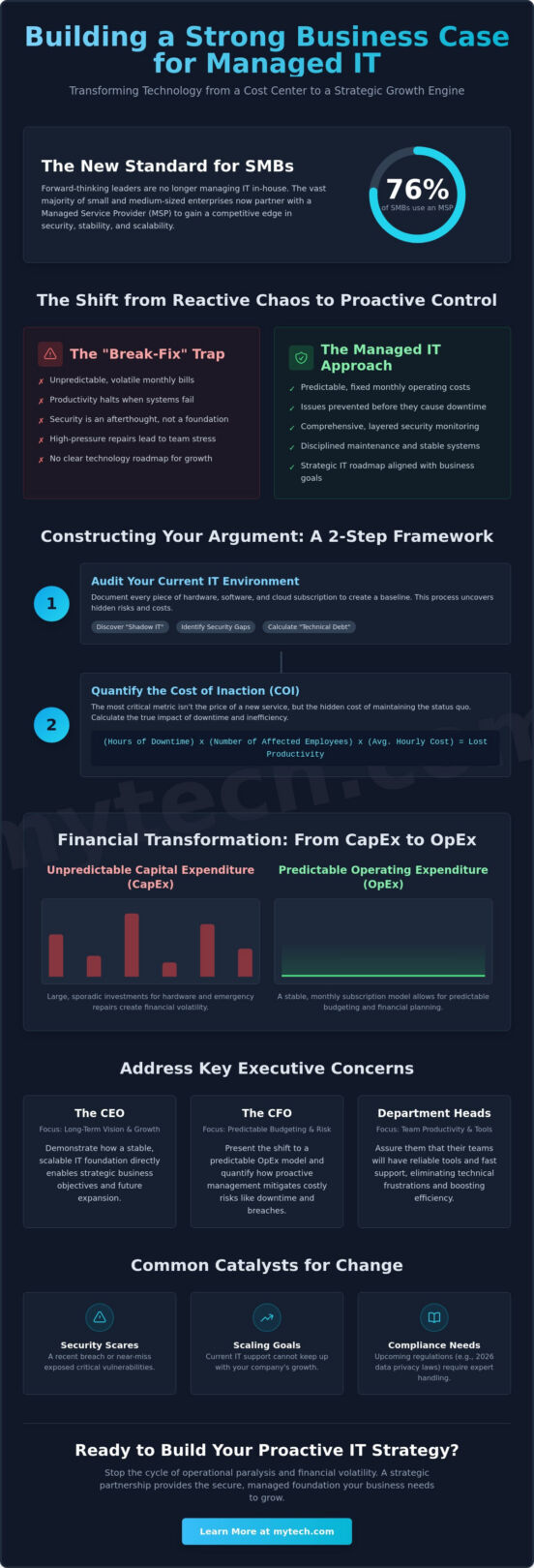
According to data from Jumpcloud, 76% of small and medium-sized enterprises now rely on a managed service provider for their critical IT functions. This widespread adoption happens because forward-thinking leaders realize that building a business case for managed IT is the first step toward transforming technology into a catalyst for success. You’ve likely felt the frustration of unpredictable monthly bills. You might even worry that your current security won’t hold up against a modern breach. It’s difficult to lead with confidence when slow support and a lack of a clear roadmap hold your team back.
We understand that securing executive buy-in requires more than just a list of technical needs. You need to prove that proactive management leads to predictable budgeting and reduced operational risk. In this guide, you’ll learn how to quantify the tangible value of managed services and present a data-driven argument to your leadership team. We’ll walk through a step-by-step framework that moves your organization toward a more stable, secure, and growth-oriented future.
Key Takeaways
- Shift your organizational perspective by viewing technology as a strategic value driver rather than a reactive cost center.
- Master the essential steps of building a business case for managed IT by auditing technical debt and quantifying the hidden costs of downtime.
- Learn how to stabilize your financial planning by transitioning from unpredictable capital expenditures to a predictable monthly operating model.
- Overcome common executive objections regarding cost and control with evidence-based strategies and performance-backed service agreements.
- Discover how a strategic partnership provides a clear technology roadmap that aligns your IT infrastructure with long-term business objectives.
Defining the Strategic Need for a Managed IT Business Case
Many small and medium-sized organizations view technology as an unavoidable expense, much like a utility bill or a lease payment. However, building a business case for managed IT requires a fundamental shift in perspective. You aren’t simply asking for a new tool or a one-off project. You’re proposing a strategic transition that moves IT from a reactive cost center to a proactive value driver. A well-constructed business case serves as the bridge between technical requirements and organizational objectives, proving that a stable digital foundation is a catalyst for success rather than a drain on resources.
To secure executive buy-in, you must engage the right stakeholders from the beginning. The CEO needs to see how technology enables the company’s long-term vision. The CFO requires evidence of predictable budgeting and risk mitigation. Department heads want to know their teams will have the tools and support needed to remain productive. At the heart of your document is the Executive Summary. This is the most critical component because it distills complex operational needs into clear, tangible business outcomes. It ensures that leadership understands the shared journey toward a more secure and disciplined organization.
The Shift from Reactive to Proactive IT
Most businesses start in the “break-fix” trap. In this model, you only address technology when it fails. This reactive approach creates a cycle of operational stress and unpredictable spending. When systems go down, productivity stops, and your team’s morale suffers as they struggle with recurring technical frustrations. Managed IT Services replace this chaos with a continuous partnership focused on prevention. By establishing a secure, stable foundation, we eliminate the frantic pace of high-pressure repairs. This proactive stance gives your leadership team the confidence to focus on growth, knowing that your infrastructure is monitored and maintained by a disciplined partner.
Identifying Your Organization’s ‘Why’
Every successful business case is built on a specific catalyst. You must identify the primary driver behind your request. Is it a recent security scare that exposed vulnerabilities? Is it the realization that your current support can’t keep up with your scaling goals? Perhaps it’s the need to comply with new 2026 data privacy regulations in states like Indiana or Kentucky. Whatever the reason, you must align these needs with your current year business goals. If your objective is to expand into new markets, your business case should demonstrate how a scalable IT roadmap makes that expansion possible without increasing technical debt.
Main Pain Point: Our goal is to eliminate the operational paralysis and financial volatility of reactive support by implementing a secure, managed foundation that protects our data and empowers our employees to work without interruption.
Step-by-Step: Constructing Your IT Outsourcing Argument
Moving from a conceptual need to a formal proposal requires a structured methodology. You cannot rely on vague frustrations when presenting to a CFO or Board of Directors. Instead, you must build an evidentiary trail that connects current technical limitations to measurable business risks. Building a business case for managed IT is a process of discovery, where you uncover the hidden inefficiencies that currently hinder your organization’s growth.
Auditing Your Current IT Environment
The first step involves a comprehensive inventory of your digital estate. You must document every piece of hardware, every software license, and every active cloud subscription. This process often reveals “Shadow IT,” which consists of applications or services employees use without formal approval. These unauthorized tools create significant security vulnerabilities and represent fragmented, hidden spending that drains your budget. By identifying these gaps, you establish a baseline of “Technical Debt” that your business case will address. This audit transforms abstract concerns into a concrete list of liabilities that require professional management.
Quantifying the Cost of Inaction (COI)
Many leaders focus solely on the price of a new service, but the more critical metric is the cost of doing nothing. To calculate this, you must determine the hourly cost of your workforce. If a network outage prevents twenty employees from working for three hours, the loss isn’t just the repair bill. It’s the total of those sixty lost productive hours plus the potential revenue those hours would have generated. Beyond the ledger, consider the reputational damage of a customer-facing outage. The Cost of Inaction is the compounded financial and operational price of maintaining the status quo while risks escalate.
Once you’ve quantified these risks, map specific managed IT features to your desired outcomes. For example, implementing Managed IT Services directly addresses the need for 24/7 monitoring and automated patching. This transition allows you to compare the Total Cost of Ownership (TCO) of an internal hire versus an outsourced team. While a single internal IT employee requires a salary, benefits, and ongoing training, a managed partner provides a full spectrum of expertise for a predictable fee. According to Jumpcloud’s 2026 data, 57% of IT teams report that their MSP has significantly enhanced their effectiveness, proving that this model delivers more than just support; it delivers results.
Finally, present the “Future State” of your organization. Use a strategic technology roadmap to show how a secure, stable foundation enables future projects like AI integration or remote workforce expansion. This long-term vision shifts the conversation from a simple purchase to a disciplined investment in your company’s future health.
Financial Analysis: ROI, CapEx, and OpEx in Managed IT
The financial heart of building a business case for managed IT lies in the transition from volatile Capital Expenditures (CapEx) to predictable Operating Expenditures (OpEx). Traditional IT management often resembles a “sawtooth” pattern on a ledger. You face massive, periodic spikes in spending when servers fail or hardware reaches its end of life, followed by periods of relative quiet. This volatility makes cash flow management difficult for SMB leaders who need to plan for the long term. By adopting a managed model, you flatten that line into a consistent monthly fee. This predictability allows you to allocate capital toward growth initiatives rather than emergency technology rescues.
Predictable Budgeting vs. Emergency Spending
A monthly service fee replaces a collection of fragmented and often hidden costs. You no longer need to worry about surprise invoices for emergency onsite repairs or the high interest financing associated with sudden hardware replacements. While large scale upgrades may still involve fixed fee project implementation charges, these are planned and budgeted well in advance. This disciplined approach ensures that your technology costs align with your revenue cycles. It provides the financial stability needed to scale your operations with confidence and clarity.
The Hidden Costs of ‘Doing it Yourself’
Managing IT in house carries significant burdens that often go uncounted in a standard budget. Recruiting, training, and retaining high tier technical talent is increasingly expensive. When an internal IT manager leaves, your organization loses institutional knowledge and faces the steep cost of a new search. Additionally, managing multiple hardware and software vendors consumes valuable leadership time that should be spent on core business objectives. Strategic it support and services reduce this internal overhead by providing a team of experts for less than the cost of a single full time executive hire.
The ROI of this transition becomes even clearer when you examine risk mitigation and the cost of downtime. Industry estimates suggest the cost of IT downtime can reach $5,600 per minute depending on the organization’s size. Investing in prevention through Managed Security Services is a fraction of the cost of a catastrophic breach. Data from Cycore Secure shows that deploying a vCISO can reduce cybersecurity incidents by up to 30% in the first year. Beyond direct savings, consider the “soft” benefits. Reliable technology improves employee retention and accelerates onboarding, ensuring your team remains focused and productive from day one.
Mitigation and Strategy: Addressing Executive Objections
Every successful leader approaches new investments with a healthy degree of skepticism. When building a business case for managed IT, you will likely encounter two primary objections: the perceived high cost and the fear of losing control over internal systems. Addressing these concerns requires a shift in focus from technical features to strategic risk management. Rather than viewing managed services as an external handoff, present them as a disciplined extension of your team that operates under strict, SLA-backed performance standards. This ensures that leadership maintains full oversight while offloading the operational stress of daily maintenance.
The objection “we can’t afford this right now” is often a misunderstanding of risk. In reality, the cost of a single security failure or a prolonged system outage far outweighs the investment in proactive care. For example, organizations utilizing specialized cybersecurity services in San Antonio and other major hubs have found that professional oversight is the most effective way to reduce the financial impact of modern threats. By integrating Strategic IT Consulting into your proposal, you demonstrate that the goal isn’t just to spend money, but to protect the organization’s long-term viability through expert guidance and resource optimization.
Cybersecurity as a Business Continuity Strategy
Security is no longer just a technical feature; it’s a fundamental business continuity strategy. With new 2026 data privacy laws in effect in states like Indiana and Rhode Island, compliance is now a legal and financial mandate. A managed partnership provides the rigorous monitoring needed to prevent “extinction-level” ransomware events that could permanently damage your brand’s reputation. We frame security as insurance for your company’s future. Data from Cycore Secure indicates that deploying a virtual CISO can lead to a 30% reduction in cybersecurity incidents in the first year, proving that prevention is a measurable value driver.
The vCIO: Your Strategic Guide
One of the most valuable components of managed services is the vCIO, or Virtual Chief Information Officer. This role bridges the gap between technical tasks and high-level business objectives. Instead of focusing on individual support tickets, a vCIO works with your leadership to build a comprehensive tech roadmap that supports long-term growth. This strategic partnership ensures that every technology investment aligns with your company’s primary goals, from improving employee productivity to entering new markets. It moves the conversation away from “fixing what’s broken” toward “building what’s next.”
Ready to transform your technology into a competitive advantage? Explore how our Strategic IT Consulting can help you align your digital infrastructure with your organizational vision.
Partnering for Success: How Mytech Simplifies the Transition
Successfully building a business case for managed IT is a significant milestone for any SMB leader. It represents a commitment to organizational health and long term growth. However, the transition from an existing provider or an internal model often causes hesitation. At Mytech, we simplify this process by acting as a disciplined guide. We focus on creating a stable foundation that allows your team to work with confidence. Our presence in Minneapolis, Denver, and Dallas ensures that you have access to local experts who understand the unique operational needs of your region.
We understand that the onboarding process is the most sensitive phase of this transition. Our team follows a structured, proactive methodology to migrate your systems without disrupting your daily operations. This disciplined approach alleviates the stress often felt by stakeholders during a change in service. By establishing clear communication channels and setting measurable milestones, we ensure that your new IT foundation is secure from day one. This partnership moves your organization away from reactive fixes and toward a future defined by strategic optimism.
Local Expertise, Global Standards
While remote support is efficient for many tasks, certain situations require boots on the ground. Whether you are undergoing a hardware refresh or need help navigating industry specific regulations in healthcare, legal, or manufacturing, having a managed service provider near me offers a layer of security that purely remote firms cannot match. Our unique approach to managed it services minneapolis combines this local responsiveness with global security standards. This hybrid model ensures that your infrastructure remains resilient and your team remains supported, regardless of the complexity of the challenge.
Next Steps: Requesting an IT Assessment
The most effective way to finalize your business case is through a professional IT assessment. Mytech helps you gather the objective data needed to validate your internal findings. This third party audit provides the clarity your executive team requires to make an informed decision. We identify hidden vulnerabilities and quantify technical debt, turning abstract concerns into a clear technology roadmap. This assessment serves as the final piece of evidence for your proposal, proving the tangible value of a managed partnership. Start your roadmap today and lead your organization toward a more secure, predictable, and successful future.
Securing Your Organization’s Digital Future
The journey toward a more resilient organization begins with a fundamental shift in perspective. By building a business case for managed IT, you move beyond the limitations of reactive support and embrace a model that prioritizes stability and long term growth. You now have the framework to audit technical debt, quantify the true costs of downtime, and address executive concerns with data driven strategies. This disciplined approach ensures that technology remains a catalyst for your success rather than a source of operational stress.
Mytech stands ready to serve as your strategic partner. With over 20 years of proactive IT experience and local support in six major US hubs, we bring specialized expertise in Microsoft 365 and cybersecurity to every engagement. We help you navigate complex digital landscapes with the calm authority of a seasoned guide. Our mission is to provide the secure foundation your team needs to thrive without interruption.
Take the next step toward a more predictable future. Build your business case with a free Mytech IT Assessment and discover the confidence that comes from a strategic, managed approach to technology. We look forward to partnering with you on this journey.
Frequently Asked Questions
What are the essential components of a business case for managed IT?
A comprehensive business case must include an executive summary, a technical debt audit, a financial ROI analysis, and a strategic technology roadmap. These elements work together to bridge the gap between technical requirements and organizational goals. By presenting a clear vision of the future state, you provide leadership with the confidence needed to approve a long term partnership focused on stability and growth.
How do I calculate the ROI of outsourcing our IT support?
Calculate your ROI by comparing the total cost of inaction against the fixed monthly service fee. You should factor in the hourly wages of employees during downtime, the cost of emergency repairs, and the potential financial impact of a security breach. When building a business case for managed IT, demonstrating these avoided costs proves that proactive management is a value driver rather than a simple expense.
Is managed IT more expensive than hiring an internal IT person?
For most SMBs, managed IT is more cost effective than hiring a full time internal professional. A single hire requires a salary, benefits, and ongoing training, yet they only offer one person’s worth of availability and expertise. A managed partner provides an entire team of specialists and 24/7 monitoring tools for a predictable fee, delivering a broader range of disciplines at a lower total cost.
How does managed IT improve employee productivity?
Managed IT eliminates the recurring technical frustrations that slow down your team’s daily workflow. By maintaining a stable foundation through automated patching and proactive monitoring, we reduce the frequency of system outages. When issues do arise, your employees receive fast, expert support, allowing them to return to their primary objectives without the stress of prolonged downtime or unreliable tools.
What is the difference between a business case and a budget request?
A business case justifies a strategic investment by focusing on business outcomes, while a budget request is a tactical document that seeks funding for specific items. While a budget request might ask for a new server, a business case for managed IT explains how professional oversight reduces risk and enables company growth. The business case provides the “why” that makes the budget request meaningful to executive leadership.
Can a business case help with cybersecurity compliance?
Yes, a business case serves as a formal justification for the tools and processes needed to meet strict regulatory requirements. With new 2026 data privacy laws in effect in states like Rhode Island, compliance is now a critical business risk. Your business case should outline how Managed Security Services provide the necessary documentation, encryption, and monitoring to protect your brand from legal and financial liabilities.
How long does it take to see the benefits of switching to managed IT?
You will experience the benefits of increased stability immediately during the onboarding process. Within the first 30 to 90 days, the proactive monitoring and maintenance begin to reduce the volume of support tickets and emergency repairs. As the partnership matures, the focus shifts from stabilizing your infrastructure to executing the strategic technology roadmap that supports your long term organizational goals.
Should I include ‘soft benefits’ like employee morale in my business case?
You should definitely include soft benefits because they have a direct impact on your company’s bottom line. Reduced technical frustration leads to higher employee morale and better retention rates, which saves your organization the high cost of recruiting and training new staff. Highlighting the freedom and confidence your team gains from reliable technology makes your argument more compelling to stakeholders who value a healthy corporate culture.