


The most expensive IT bill your company will ever pay isn’t the invoice from your vendor; it’s the hidden cost of a technology strategy that only reacts to fires instead of preventing them. Research from the 2023 Ponemon Institute study indicates that organizations with high levels of security automation save $1.76 million compared to those with manual processes. You likely already feel the weight of this tech anxiety, especially when unpredictable outages or cybersecurity compliance hurdles interrupt your team’s momentum. It’s frustrating when IT costs continue to rise while business value remains stagnant. Choosing between different managed it providers shouldn’t feel like a gamble on who can fix a broken server the fastest.
We believe technology should be your greatest catalyst for success, not a source of stress. This guide will show you how to identify a partner who prioritizes strategic alignment and proven business outcomes over simple troubleshooting. You’ll learn how to secure a stable technology roadmap that ensures predictable monthly spending and leverages tools like Microsoft 365 to boost employee productivity. We’ll explore the specific criteria necessary to move from reactive maintenance to a proactive partnership that empowers your organization to thrive.
Key Takeaways
- Learn why moving beyond the reactive “break-fix” model to a “Trusted Navigator” partnership is essential for navigating digital complexity and driving sustainable growth.
- Evaluate managed it providers based on their ability to deliver layered, proactive cybersecurity and scalable cloud infrastructure that supports a productive remote workforce.
- Discover a proven methodology for identifying hidden technical bottlenecks through comprehensive assessments that transition your IT environment from chaos to stability.
- Utilize a strategic decision-maker’s checklist to audit a provider’s security stack, focusing on critical services like MDR, vCISO guidance, and AI-driven threat detection.
- Understand how a disciplined IT strategy empowers small and mid-sized businesses to thrive by aligning technology investments with measurable business outcomes.
What Defines a Strategic Managed IT Provider?
The traditional “break-fix” model of technology support has become a relic of the past. In that outdated framework, you only heard from your IT vendor when a server crashed or an application failed. This reactive cycle keeps your business in a state of perpetual recovery. Modern managed it providers have evolved into strategic growth partners. They don’t just fix problems; they prevent them while aligning every technical decision with your long-term commercial goals.
We view this role as a “Trusted Navigator.” The digital landscape is cluttered with complex choices regarding cloud architecture, cybersecurity, and data management. A strategic partner clears this fog. They ensure technology acts as a catalyst for success rather than a line-item cost center. Research from CompTIA in 2023 indicates that 42% of businesses now leverage a Managed service provider (MSP) specifically to increase operational efficiency, moving beyond simple maintenance. This shift transforms IT from a burden into a competitive advantage.
The Difference Between Support and Strategy
Basic support keeps the lights on; strategy illuminates the path to expansion. A help desk can reset a password, but it won’t prevent the accumulation of technical debt. According to a 2022 IDC report, companies can lose up to 20% of their productive capacity to inefficient legacy systems. Strategic IT is the calculated intersection where your business objectives meet your technical capabilities to drive measurable growth. It’s the difference between having a tool and having a plan to win. We focus on building a roadmap that scales with your ambitions.
Alleviating Tech Anxiety for Business Leaders
Business owners often carry a heavy burden of “tech anxiety,” fearing the next security breach or system outage. We replace that stress with calm authority. By implementing reliable, redundant infrastructure, we allow executives to move from asking “What broke today?” to “How can we thrive tomorrow?” Proactive management reduces corporate stress levels by creating a predictable environment. When your systems are secure and your roadmap is clear, you gain the freedom to focus entirely on your core mission. Our goal is to provide the stability that fuels executive confidence.
- Proactive Monitoring: Identifying vulnerabilities before they impact your bottom line.
- Business Alignment: Ensuring every software seat and hardware purchase serves a specific growth metric.
- Risk Mitigation: Protecting your reputation through 24/7 security oversight.
A strategic partnership is built on the idea that your success is our success. By choosing managed it providers who prioritize your business outcomes, you’re not just buying a service; you’re investing in a more resilient future.
The 4 Pillars of a High-Performance MSP
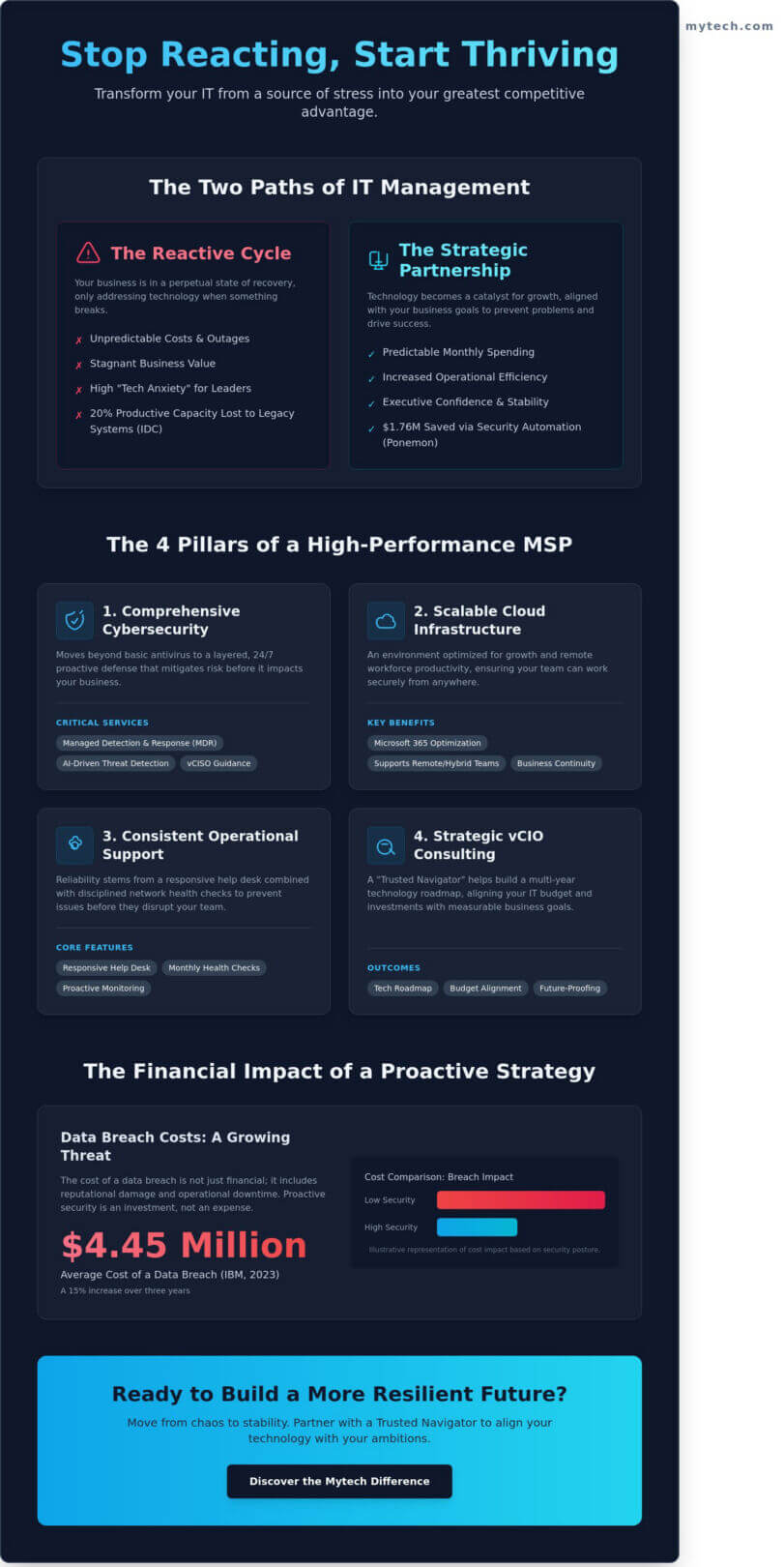
High-performance managed it providers don’t just fix broken hardware; they build the digital foundation for your company’s future. A truly strategic partner moves beyond the reactive “break-fix” cycle to deliver a framework that supports long-term scaling. This evolution requires four specific pillars: proactive cybersecurity, cloud maturity, consistent operational support, and strategic foresight. When these elements align, technology transforms from a source of friction into a catalyst for growth.
- Comprehensive Cybersecurity: This moves beyond basic antivirus to a layered, proactive defense that monitors for threats 24/7.
- Cloud Infrastructure: Your environment should be optimized for scalability and remote workforce productivity, ensuring your team can work securely from anywhere.
- Operational Support: Reliability stems from a responsive help desk combined with monthly network health checks to prevent issues before they occur.
- Strategic Consulting: Using vCIO services helps you build a multi-year technology roadmap, aligning your IT budget with your business objectives.
Managed Security and Risk Mitigation
Security is no longer a peripheral concern for small and mid-sized firms. According to IBM’s 2023 Cost of a Data Breach Report, the average cost of a breach reached $4.45 million, which represents a 15% increase over a three-year period. Effective providers implement continuous monitoring and strict protocol management to protect your brand reputation. For organizations in healthcare or legal sectors, this includes maintaining rigorous HIPAA or SOC2 compliance standards to ensure data integrity remains absolute.
Microsoft 365 and Cloud Optimization
Many companies pay for a Microsoft 365 subscription but only utilize about 20% of its actual capabilities. Optimization involves configuring SharePoint for secure document management and leveraging Teams as a unified communication hub rather than just a chat tool. This transition empowers your workforce to stay productive while maintaining high security standards. As your business grows, a well-managed cloud environment scales with you, eliminating the need for expensive hardware refreshes every few years. You can explore our cloud strategies to see how this impacts your daily efficiency.
The most effective managed it providers serve as strategic partners to their customers by providing vCIO (Virtual Chief Information Officer) services. This role involves creating a clear roadmap that anticipates your needs months or years in advance. Instead of reacting to tech failures, you gain the freedom to focus on your core mission, knowing your infrastructure is handled by experts who are genuinely invested in your success.
From Chaos to Stability: A Proven Methodology
Many businesses operate in a state of reactive anxiety, waiting for the next server failure or security breach to dictate their schedule. Top-tier managed it providers break this cycle by shifting from firefighting to strategic oversight. This transition begins with a rigorous audit of your digital environment. We identify hidden risks like end-of-life hardware or unpatched software that contribute to the 82% of data breaches caused by system vulnerabilities. By establishing a baseline, we align your infrastructure with the official EU definition of a managed service provider, ensuring your operations meet international standards for security and resilience.
Our implementation phase prioritizes business continuity. We execute network refreshes or cloud migrations during off-peak hours, ensuring your team remains productive while we modernize your stack. This approach replaces unpredictable repair bills with a fixed monthly investment. It transforms technology from a recurring headache into a reliable engine for growth. You gain the confidence to scale, knowing your foundation is secure and your costs are predictable.
The Onboarding Experience
A professional transition for a mid-sized business is a disciplined 90-day process. During the first 30 days, we focus on deep documentation, capturing every asset and credential to eliminate “tribal knowledge” risks. By day 60, we implement monitoring tools that track system health in real-time. We move beyond simple ticket response times. Instead, we set KPIs like Mean Time to Recovery (MTTR) and percentage of proactive vs. reactive tasks. This ensures our success is measured by your operational uptime and long-term stability.
Case Study Evidence of Success
Consider a 65-person distribution firm that faced recurring network outages. By implementing proactive patch management, we identified and neutralized a critical vulnerability 48 hours before it was exploited globally, preventing a potential 72-hour shutdown. Through a three-year strategic roadmap, this client successfully integrated two new warehouse locations without increasing their internal IT headcount. This strategy reduced their average employee downtime by 40% in the first year alone. The quantifiable result was an additional 1,200 hours of annual productivity across their workforce. Expert managed it providers don’t just fix computers; they reclaim lost time for your entire organization. For a deeper look at how this proactive approach specifically benefits growing companies, our guide on managed IT services for small businesses outlines the steps to replace reactive tech habits with a strategy built for expansion.
How to Vet Managed IT Providers: A Decision-Maker’s Checklist
Selecting a partner requires a rigorous evaluation of their operational DNA. You need to verify that managed it providers follow a documented, proactive maintenance schedule rather than simply reacting to emergencies. This consistency prevents the 37% increase in downtime often seen in unmanaged environments. A robust security stack is non-negotiable. Ensure they utilize AI-driven threat detection and Managed Detection and Response (MDR) to stay ahead of sophisticated attacks. In 2023, the average cost of a data breach reached $4.45 million according to IBM, making vCISO services an essential component for high-level governance and risk mitigation.
- Strategic Roadmap: Demand Quarterly Business Reviews (QBRs) that align technology with your fiscal goals.
- Industry Expertise: Seek out success stories from firms in your specific vertical to ensure they understand your compliance needs.
- Cultural Integration: Your provider should function as a seamless, collaborative extension of your internal team.
Strategic alignment is the difference between a vendor and a partner. When you evaluate their process, look for a clear tech roadmap that spans at least 24 months. This forward-thinking approach ensures your infrastructure scales ahead of your growth, preventing the “tech debt” that slows down 60% of mid-market companies. A disciplined provider doesn’t just fix what’s broken; they build a foundation that empowers your employees to work with confidence. To further support this growth, many leaders partner with Amplify Yourself, LLC to find skilled virtual assistants who can thrive within a well-managed digital environment.
Questions to Ask During the RFP Process
Focus your inquiries on long-term outcomes. Ask how they align IT recommendations with your 3-year business plan to ensure your infrastructure doesn’t become a bottleneck. Inquire about their specific process for Microsoft 365 security updates; this is critical since 80% of data breaches involve compromised credentials. Request concrete examples where they successfully reduced a client’s risk profile, such as a 25% reduction in insurance premiums through improved security controls. If your organization is based in the region, reviewing a resource like our managed IT services Minneapolis strategic guide can help you benchmark local provider standards against your specific requirements.
Understanding Pricing Models
Pricing structures impact your bottom line and operational flexibility. Per-user monthly fees provide clear predictability as your headcount grows. Per-device models can become complex if employees use multiple workstations and mobile tools. We recommend fixed-fee project implementation to eliminate the budget surprises associated with hourly billing. Transparency in hardware procurement is equally vital. It ensures your capital expenditures remain focused on performance rather than hidden vendor margins.
Build a foundation for sustainable growth with a partner who understands your vision. Discover how our strategic IT approach empowers your business.
The Mytech Difference: Empowering Your Business to Thrive
Choosing between various managed it providers is a pivotal leadership decision that dictates your company’s trajectory for years. Mytech Partners serves as your Trusted Navigator, moving beyond the traditional role of a vendor to become a disciplined architect of your success. We focus specifically on the needs of small and mid-sized businesses, where a 15% increase in operational uptime can directly correlate to significant revenue growth. By maintaining regional offices, we provide the high-touch, personalized service your team deserves, while our national resource network ensures you have access to enterprise-grade security and infrastructure.
Our Proactive Philosophy
We believe technology should work for you, not the other way around. Our team uses an active voice in technology management to stay ahead of emerging threats and hardware lifecycles. We call this the Shared Journey. When we discuss your infrastructure, we use “we” because your success is our primary metric. This collaborative spirit defines our consultative partnerships. We don’t just fix problems; we educate your staff on best practices. This approach reduces tech anxiety and fosters a culture of security throughout your organization. Our goal is to transform your IT from a source of frustration into a reliable catalyst for efficiency.
Next Steps: Your Strategic IT Assessment
The path to a stable environment begins with a professional IT assessment. This deep dive identifies critical gaps in your current setup, from outdated backup protocols to hidden security vulnerabilities. Once we understand your unique challenges, we help you build a 12 to 24-month roadmap designed for long-term scalability. This strategic plan ensures your technology budget is an investment in growth rather than a series of emergency expenses. You can stop worrying about the “what-ifs” of digital disruption. It’s time to empower your team with a stable technical foundation that supports your highest ambitions.
- Identify hidden security risks before they impact your operations.
- Align your technology spending with actual business outcomes.
- Create a clear path for scaling your workforce and services.
Selecting the right partner among managed it providers is about more than just finding a help desk. It’s about finding a guide that understands your vision. Let’s start building your secure, optimized future today. Reach out to our team to schedule your initial consultation and take the first step toward a more resilient business.
Take Control of Your Digital Future
Technology shouldn’t be a source of constant anxiety. It’s a catalyst for your success when managed with discipline and foresight. You now understand that a strategic partnership relies on the four pillars of performance and a proven methodology that shifts your focus from daily fires to long-term scalability. Selecting the right team among managed it providers means finding a navigator who truly understands your business roadmap. You need a partner that prioritizes stability so you can focus on growth.
Since 2000, Mytech Partners has applied decades of disciplined experience to help organizations thrive. We provide proactive vCIO services that align every technical decision with your specific business goals. Our specialized focus on Microsoft 365 optimization and layered security ensures your infrastructure remains resilient against modern threats. You deserve a stable environment where productivity is the standard and technical hurdles are a thing of the past. It’s time to build a secure foundation that empowers your team to reach its full potential.
Schedule your strategic IT assessment with Mytech Partners today.
We’re ready to lead you toward a more confident and productive future.
Frequently Asked Questions
What exactly do managed IT providers do for small businesses?
Managed IT providers act as your comprehensive technology partner, managing everything from 24/7 network monitoring to long-term strategic roadmaps. We handle the daily maintenance of your servers, cloud environments, and end-user devices so your team can focus on core business objectives. By shifting from a reactive model to a proactive one, we eliminate the tech anxiety that stems from unexpected downtime and security vulnerabilities.
How much should I expect to pay for managed IT services per month?
Pricing for these services typically follows a per-user or per-device model. According to the 2023 Kaseya MSP Benchmark Report, the industry average ranges from $100 to $250 per user each month. This investment covers your security stack, help desk support, and strategic consulting. This predictable monthly cost allows you to scale your budget alongside your actual headcount growth without hidden capital expenditures.
What is the difference between a help desk and a managed service provider?
A help desk provides reactive support to fix immediate technical issues, while managed IT providers offer a holistic, proactive strategy for your entire infrastructure. Help desks focus on closing tickets; we focus on preventing them through continuous system optimization and security patches. This strategic approach ensures your technology aligns with your 3-year growth plan rather than just surviving the current workday.
Can a managed IT provider help with cybersecurity compliance?
We directly assist businesses in meeting rigorous standards such as HIPAA, SOC 2, or the NIST Cybersecurity Framework. Our team implements the specific technical controls, encryption protocols, and audit logs required by these three regulatory bodies. By maintaining 100 percent compliance readiness, we protect your organization from legal penalties and build trust with your enterprise level clients who demand high security standards.
How long does it take to transition to a new managed IT provider?
A successful transition typically takes between 30 and 90 days to ensure a seamless transfer of knowledge and control. During the first 30 days, we conduct a deep-dive audit of your existing systems and document every network component. This deliberate pace prevents service interruptions and ensures that our team understands your unique workflows before we take full responsibility for your environment.
What is a vCIO and why does my business need one?
A vCIO, or Virtual Chief Information Officer, provides the high-level technical leadership your business needs to thrive without the $200,000 annual salary of a full-time executive. Your vCIO develops a technology roadmap that synchronizes your IT investments with your business goals. They ensure you don’t waste capital on redundant software and help you navigate complex decisions like cloud migrations or hardware refresh cycles.
Do managed IT providers handle hardware procurement?
We manage the entire hardware lifecycle, from initial procurement and configuration to final decommissioning. By leveraging our established partnerships with vendors like Dell, HP, and Cisco, we often secure better lead times and enterprise-grade equipment that fits your specific budget. This end-to-end service ensures that every new laptop or server arrives pre-configured with your security settings, saving your team hours of setup time.
How does an MSP improve employee productivity?
We boost productivity by eliminating the technical friction that slows down your workforce. A 2022 IDC study found that managed services can reduce unplanned downtime by 85 percent, allowing employees to stay focused on their primary tasks. By providing fast, 15-minute response times for support requests and ensuring all software is updated, we empower your team to work efficiently from any location without technical interruptions.