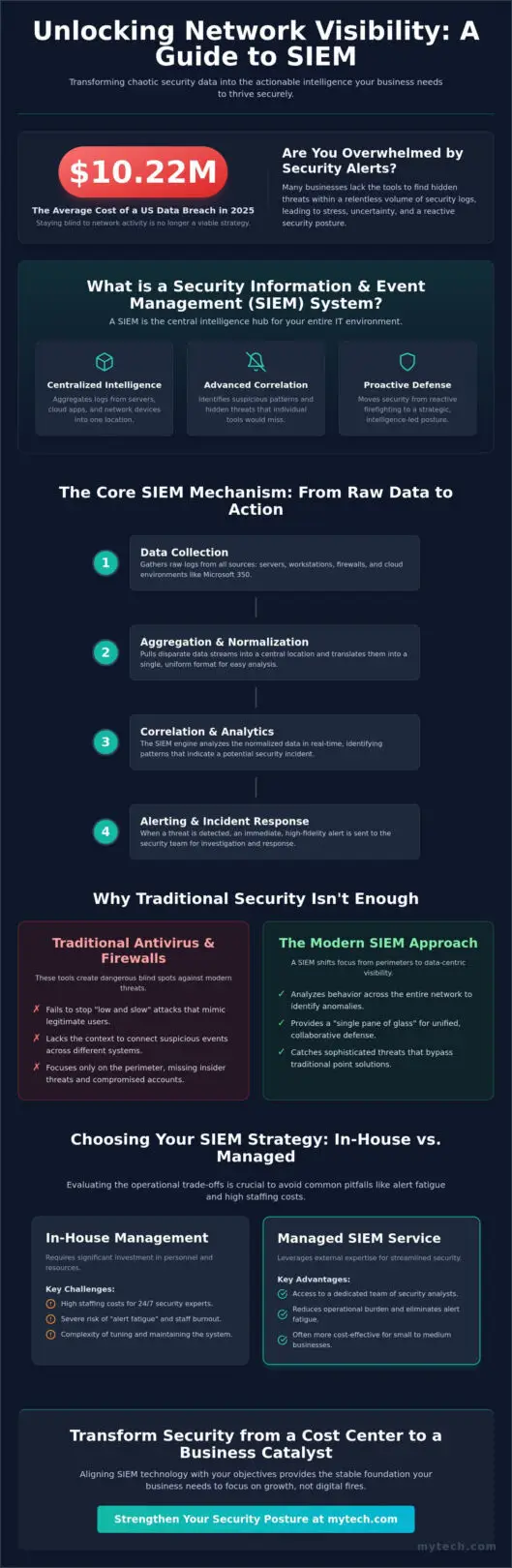
With the average cost of a data breach in the US reaching $10.22 million in 2025, staying blind to your network activity is no longer a viable strategy. Many executives and IT managers find themselves asking, “what is a security information and event management system,” as they struggle to maintain visibility while meeting strict compliance standards like HIPAA or SEC requirements.
It’s understandable to feel overwhelmed by the relentless volume of security alerts hitting your desk. You’ve likely experienced the stress of knowing a threat might be hiding in your logs, yet lacking the tools to find it. We promise to help you move past this uncertainty by showing how SIEM technology transforms chaotic data into actionable intelligence. This article explores the strategic value of SIEM, provides a framework for choosing between managed and in-house solutions, and outlines how to strengthen your security posture without creating operational burnout. Together, we can build a stable foundation that lets your business focus on growth instead of digital fires.
Key Takeaways
- Define what is a security information and event management system as a centralized intelligence hub that correlates data from across your entire IT environment.
- Understand how normalizing data from cloud applications and local servers into a single database provides the visibility needed to spot hidden threats.
- Identify the strategic role SIEM plays in satisfying strict regulatory compliance requirements like HIPAA and CMMC for modern organizations.
- Evaluate the operational trade-offs between in-house management and managed services to avoid the common pitfalls of alert fatigue and high staffing costs.
- Learn how aligning SIEM technology with your broader business objectives transforms security from a cost center into a catalyst for operational success.
Defining SIEM: More Than Just a Log Management Tool
To understand what is a security information and event management system, you have to look beyond simple data storage. A SIEM acts as a centralized security hub that correlates data from across your entire IT environment, turning millions of individual events into a clear, actionable story. It has evolved from a basic repository for logs into a sophisticated engine for real-time threat intelligence and automated response. This transformation allows businesses to move away from reactive firefighting and toward a proactive, strategic security posture.
Think of the SIEM as the “brain” of a modern Security Operations Center (SOC). While other tools monitor specific doors or windows, the SIEM watches the entire estate, analyzing patterns that individual sensors might miss. This high-level visibility provides the stable foundation your organization needs to grow with confidence, ensuring that your operational tools are catalysts for success rather than burdens to be managed.
The Marriage of SIM and SEM
The term Security Information and Event Management (SIEM) represents the convergence of two distinct disciplines. Security Information Management (SIM) handles the long-term storage and analysis of log data, which is essential for meeting industry compliance standards like HIPAA or SEC regulations. Security Event Management (SEM) provides the real-time monitoring and immediate notification required to stop an active incident in its tracks.
By combining these functions, a SIEM creates a “single pane of glass” for your business security. Instead of jumping between a dozen different dashboards, your team gains a unified view of every server, workstation, and cloud application. This integration eliminates the operational stress of managing fragmented tools and allows for a more disciplined, collaborative defense strategy.
Why Traditional Antivirus Isn’t Enough in 2026
Relying solely on traditional antivirus or firewalls leaves dangerous blind spots in your infrastructure. Modern cyber threats have moved away from loud, obvious attacks that trigger simple alarms. Instead, attackers use “low and slow” methods that bypass perimeter-based filters by mimicking legitimate user behavior over weeks or months. Point solutions simply don’t have the context to recognize these subtle shifts in behavior.
A SIEM fills these gaps by shifting your focus from the perimeter to data-centric visibility. It doesn’t just look for known “bad” files. It analyzes behavior across your entire network to identify compromised accounts or insider threats. This approach is vital for maintaining a secure foundation in a digital-first economy. By implementing a SIEM, you gain the freedom and confidence that come from knowing your network is monitored by a system designed to catch what others miss.
The Core Mechanism: How a SIEM System Processes Security Data
To grasp the full value of what is a security information and event management system, we must look at how it handles the massive influx of data generated by your business every second. It’s not a passive storage tank; it’s an active processing engine. The system follows a disciplined path to turn raw logs into actionable intelligence. This journey begins with Data Collection, where logs are gathered from servers, workstations, firewalls, and cloud environments like Microsoft 365. This provides the raw material needed for total network visibility.
Once collected, the system performs Data Aggregation, pulling these disparate streams into a central location. This leads into the critical phase of Correlation and Analytics, where the SIEM identifies patterns that suggest a security breach. Finally, Alerting and Incident Response ensures that when a predefined threshold is crossed, your team receives an immediate notification to take action. If you’re looking to enhance this visibility, our managed security services can help streamline these complex processes.
The Importance of Data Normalization
Your firewall, your cloud apps, and your local servers all “speak” different technical languages. Without normalization, your IT team would spend hours manually translating logs just to understand a single event. A SIEM acts as an essential translator, converting these disparate formats into a single, searchable database. Normalization allows a small team to manage large data sets by providing a uniform view of activity. This structured approach aligns with IRS guidelines on SIEM systems, which emphasize the importance of maintaining organized, protected data for both security and compliance.
Understanding Correlation Rules and AI
Modern systems have moved beyond simple “if-then” rules to advanced User and Entity Behavior Analytics (UEBA). Traditional filters might miss a single failed login, but correlation rules look at the bigger picture. For example, if a user account has a failed login in Dallas and then a successful login in Minneapolis five minutes later, the SIEM recognizes this “impossible travel” as a high-risk event.
AI helps reduce alert fatigue by learning the “normal” rhythm of your business operations. It filters out the noise, so your team only spends time on genuine threats. This precision provides the freedom and confidence to focus on strategic growth rather than chasing false alarms. By automating the detection of these anomalies, we create a more stable foundation for your organization’s digital future.
Why Modern Businesses in Minneapolis, Denver, and San Antonio Need SIEM
Organizations in growing hubs like Denver, Minneapolis, and San Antonio face a unique set of challenges. While digital expansion brings opportunity, it also invites sophisticated cyber threats that target mid-market businesses. Understanding what is a security information and event management system is the first step toward building a resilient defense. However, the real struggle for many local firms isn’t just the technology. It’s the scarcity of specialized talent. Finding in-house security experts in these competitive markets is increasingly difficult, leaving many networks vulnerable to “low and slow” attacks that bypass basic filters.
By implementing a SIEM, you gain a seasoned guide through these complex digital landscapes. This technology doesn’t just manage assets; it acts as a catalyst for success by providing the visibility needed to survive a digital-first economy. It alleviates the operational stress felt by stakeholders who worry about what might be hiding in their network logs.
Regulatory Compliance and Audit Readiness
Whether you are a healthcare provider in Minneapolis or a defense contractor in San Antonio, regulatory demands are intensifying. Compliance frameworks like HIPAA and CMMC require more than just a locked digital door. You must provide documented proof of your security activities. A SIEM automates the reporting required for insurance renewals and industry audits, bridging the gap between simply “being secure” and actually proving your posture to stakeholders. Many businesses utilizing it support denver firms rely on this automation to maintain audit readiness without draining their internal resources. This strategic approach removes the operational stress of manual log reviews and ensures you are always prepared for a surprise audit.
Reducing Mean Time to Detect (MTTD)
The most critical metric for survival today is “detection time.” While the average cost of a data breach in the US climbed to $10.22 million in 2025, the most alarming statistic is how long a breach remains undetected. Industry data suggests it takes over 200 days for the average organization to realize they’ve been compromised. A SIEM shrinks this window from months to minutes by analyzing how SIEM works to correlate events in real-time.
By integrating these insights into cybersecurity services in San Antonio, businesses can prevent data exfiltration before it becomes a catastrophic financial loss. Rapid detection protects your reputation and provides the freedom to operate with confidence. When you understand what is a security information and event management system in the context of your specific market, you move from a position of vulnerability to one of proactive strength.
Managed SIEM vs. In-House: Overcoming the Complexity Barrier
Understanding what is a security information and event management system is only half the battle. The real challenge lies in the execution. Many organizations purchase a high-end SIEM platform only to realize they’ve acquired a sophisticated engine without a driver. This often leads to the “Alert Fatigue” trap. Without a dedicated team to tune the system and investigate every notification, the tool becomes a source of noise rather than security. Eventually, the alerts are ignored and the investment is wasted.
Building an in-house Security Operations Center (SOC) is a monumental undertaking. It requires significant capital for hardware and licensing; however, the human cost is the most substantial hurdle. For businesses seeking a strategic alternative, managed it services in Minneapolis provide SIEM as a service. This model shifts the burden of management to a seasoned partner, allowing your internal team to focus on high-level business objectives rather than technical troubleshooting.
The Resource Reality Check
The math of 24/7/365 security is often surprising to stakeholders. To provide around-the-clock monitoring, you typically need at least four to five full-time security analysts to cover rotations, vacations, and sick leave. In a market with a global cybersecurity workforce gap of 4.8 million unfilled positions, as reported by UnderDefense in February 2026, finding and retaining this talent is both difficult and expensive.
Choosing a managed approach transforms security from a variable capital project into a predictable monthly expense. It eliminates the stress of maintaining complex software updates and ensures your defenses stay sharp against evolving threats. This steady, deliberate approach provides the freedom and confidence that come from a stable foundation. If you are ready to move beyond the complexity, we invite you to explore our Managed Security Services to see how we can lead your shared journey.
What to Look for in a SIEM Partner
Selecting the right partner is a strategic decision that impacts your long-term health. You need more than a vendor; you need a guide who understands your specific landscape. A proactive partner doesn’t just notify you after a breach has occurred. They actively hunt for threats and continuously refine correlation rules to match your unique business processes.
- Integration Depth: Ensure the partner can seamlessly ingest data from your existing Microsoft 365 environment and cloud infrastructure.
- Local Context: A partner with a physical presence in regions like Dallas or Long Beach understands the local business climate and regulatory pressures.
- Actionable Intelligence: Look for a team that provides clear, crisp direction rather than just forwarding raw logs.
A true partnership focuses on tangible operational outcomes. By aligning security technology with your primary objectives, we ensure your SIEM acts as a catalyst for growth rather than a source of operational burnout. This linguistic bridge between technical data and business goals ensures that executive leadership and IT managers remain on the same page.
Strengthening Your Security Posture with Mytech Partners
Understanding what is a security information and event management system is a significant step toward maturity, but the true value lies in how that system integrates with your overall organizational strategy. At Mytech Partners, we don’t view security as a standalone project or a simple software installation. Instead, we weave advanced security logging and monitoring into our comprehensive managed it support and services. This holistic approach ensures that your security posture supports, rather than hinders, your primary business objectives.
Our team acts as a seasoned guide, providing the disciplined oversight necessary to manage complex digital landscapes. We alleviate the operational stress of security management by offering a stable, secure foundation. This proactive stance allows you to move forward with forward-thinking optimism, knowing that your operational tools are catalysts for long-term success. We focus on the tangible outcomes of risk management, ensuring your leadership team has the clarity needed to make informed decisions.
Aligning Technology with Business Growth
We believe that technology should serve your growth. When we implement a SIEM, we use the resulting data to inform your strategic technology roadmap. This isn’t just about catching threats; it’s about understanding the health and behavior of your entire environment. By analyzing trends in your network traffic and user activity, we identify opportunities for optimization and efficiency. This strategic consulting turns security data into a business asset.
Partnering with us provides the peace of mind that comes from reliability. We maintain a steady, deliberate cadence of monitoring and maintenance, ensuring your defenses evolve alongside the threat landscape. This collaborative journey means you’re never left to interpret complex security events alone. We provide the professional polish and technical expertise to translate raw data into strategic action, protecting both your reputation and your bottom line.
Getting Started: Your Security Assessment
The path to a more resilient posture begins with a clear understanding of your current state. During a Mytech security review, we look beyond the surface to identify critical gaps in your visibility. We examine how data flows through your organization and where a SIEM could provide the most immediate impact. This assessment is not a high-pressure sales tactic. It’s a consultative process designed to ground your security strategy in reality.
We help you identify which compliance standards apply to your specific industry and geography, ensuring your technology alignment meets every requirement. Whether you are struggling with alert fatigue or simply need a more stable foundation for your cloud environment, we are here to help. Schedule your strategic technology consultation today to discover how a managed approach to security can empower your organization’s future.
Secure Your Digital Future with Strategic Visibility
Adopting a SIEM is more than a technical upgrade; it’s a strategic commitment to the long-term health of your organization. By centralizing your security data, you gain the visibility required to stay ahead of modern threats and satisfy rigorous compliance audits. We’ve seen how this technology acts as a catalyst for success, providing executive leadership with the confidence to pursue growth without the constant fear of digital disruption. Understanding what is a security information and event management system is the first step toward reclaiming your operational focus.
With over 20 years of experience in managed IT and local offices in MN, CO, TX, and CA, Mytech Partners is uniquely positioned to be your seasoned guide. Our expertise in Microsoft 365 and layered security ensures your foundation remains stable and proactive. We invite you to Schedule a Strategic Technology Consultation with Mytech Partners today. Let’s work together to transform your security posture into a source of strength and reliability. Your journey toward a more secure and optimized future starts with a single, disciplined step.
Frequently Asked Questions
Is SIEM the same as a SOC?
No, a SIEM is a technology platform while a SOC, or Security Operations Center, is the team of professionals who operate it. Think of the SIEM as a sophisticated flight recorder and the SOC as the pilots and ground crew who interpret the data to ensure a safe journey. While the SIEM provides the visibility, the SOC provides the human intelligence required to respond to complex threats.
Does a small business with fewer than 50 employees really need a SIEM?
The need for a SIEM is driven by your data sensitivity and regulatory requirements rather than your headcount alone. If your organization handles protected health information or defense contracts, you likely need the visibility a SIEM provides to meet audit standards. Small businesses are often targets because they lack the robust monitoring that larger enterprises maintain, making them attractive to opportunistic attackers.
How much does a SIEM system typically cost?
Pricing for a SIEM varies significantly based on the volume of data your organization generates and the complexity of your environment. Most modern providers use either a data-volume model based on gigabytes ingested or a per-user subscription. When evaluating costs, it’s vital to consider the total investment, including the specialized talent required to manage the platform and respond to alerts 24/7.
Can SIEM detect insider threats or only external hackers?
A SIEM is highly effective at detecting insider threats by using behavioral analytics to spot deviations from normal activity. It monitors for unusual data access patterns, unauthorized file transfers, or logins at strange hours that don’t match a user’s typical routine. This internal visibility helps protect your organization from both malicious actors and accidental data exposure by well-meaning employees.
What is the difference between SIEM and EDR (Endpoint Detection and Response)?
EDR focuses specifically on individual devices like laptops and servers, while a SIEM provides a holistic view of your entire digital environment. While EDR is excellent for stopping malware on a specific workstation, it doesn’t see suspicious activity in your cloud applications or firewall logs. Integrating both tools into your strategy creates the layered defense necessary for a stable security foundation.
How long does it take to implement a SIEM system?
Implementation timelines depend on whether you choose a cloud-native or on-premises solution. A cloud-based SIEM can often begin ingesting data in a matter of days, though fine-tuning the correlation rules typically takes several weeks of observation. A managed partner can accelerate this process by applying pre-built templates and experienced insights to move you toward a secure posture more quickly.
Does SIEM work with cloud-based applications like Microsoft 365?
Yes, modern SIEM systems are designed to integrate seamlessly with cloud platforms like Microsoft 365 and Azure. This integration is a critical component of what is a security information and event management system in a modern business context. By pulling logs from your cloud environment, the SIEM ensures you have visibility into account compromises and unauthorized configuration changes across your entire digital footprint.
Will a SIEM system slow down my network performance?
A SIEM won’t noticeably impact your network performance because it primarily collects log data rather than sitting in the direct path of your active traffic. Logs are typically sent in small, compressed batches that require minimal bandwidth. This allows the system to provide deep visibility without creating the technical frustrations or latency issues often associated with older security tools.