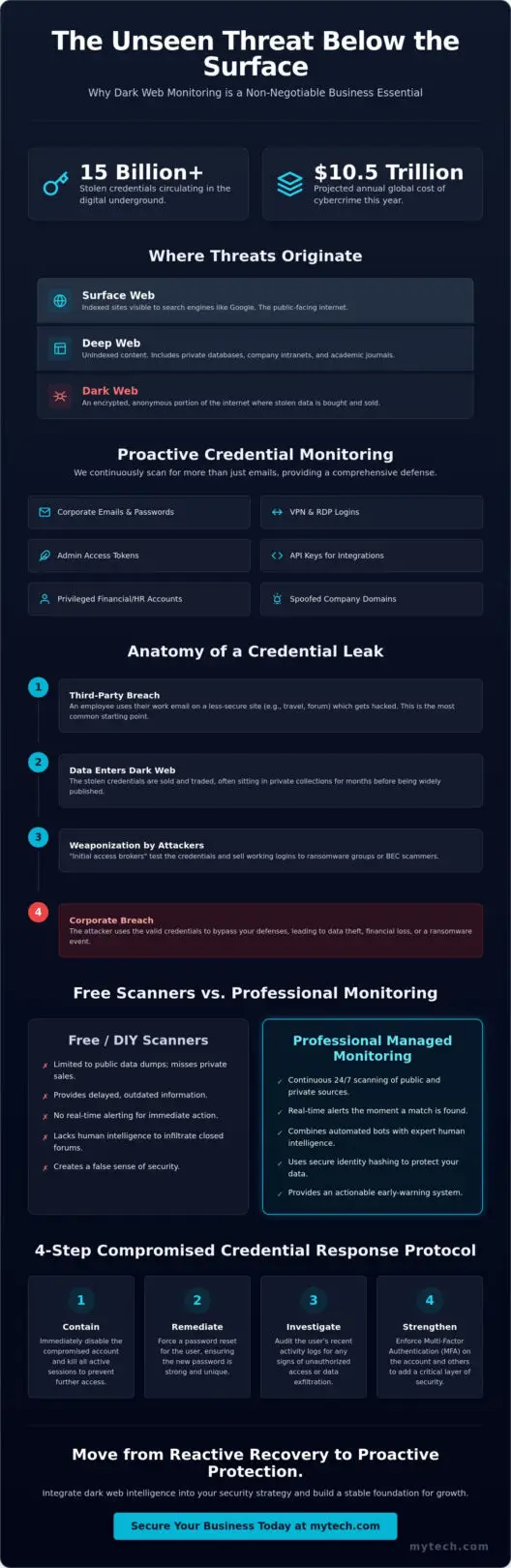
With over 15 billion stolen credentials currently circulating in the digital underground, the question for most leaders is no longer if their data is exposed, but when it will be used. As the global cost of cybercrime is projected to reach $10.5 trillion this year, dark web monitoring for business credentials has evolved from a niche security tool into an essential early-warning system. We understand the pressure you face from clients and insurance providers to maintain a hardened perimeter, especially when a single compromised password can lead to a multi-million dollar ransomware event.
You deserve to lead your organization with confidence rather than constant operational stress. This guide will help you move past the confusion of basic scanners to understand how professional monitoring fits into a strategic IT budget. We’ll outline a clear protocol for responding to credential leaks and demonstrate how 24/7 vigilance provides the stable foundation your business needs to grow. By the end of this article, you’ll have a roadmap to protect your digital identity and ensure your team stays focused on innovation instead of recovery.
Key Takeaways
- Understand how dark web monitoring for business credentials acts as a proactive early-warning system to identify threats before they escalate into ransomware events.
- Discover the critical differences between the surface web and the hidden forums where professional intelligence gathering identifies private data sales.
- Learn why “free” scanners often fail to provide the depth of data required for enterprise-grade security and operational stability.
- Establish a clear response protocol to neutralize compromised credentials through immediate technical actions like session kills and MFA audits.
- See how integrating dark web intelligence into your broader managed security strategy creates a stable foundation for long-term business growth.
What is Dark Web Monitoring for Business Credentials?
To protect a modern organization, you must first understand the environment where threats originate. Most of us spend our time on the surface web, which consists of indexed sites visible to search engines. Below that is the deep web, a massive layer of unindexed content including private databases and company intranets. Finally, there’s the dark web. For those focused on understanding the dark web, it’s best viewed as an encrypted portion of the internet where users remain anonymous. It’s here that stolen data is bought, sold, and traded with impunity.
Dark web monitoring for business credentials is a proactive digital risk protection service. It doesn’t just wait for an alarm to go off within your network. Instead, it actively patrols these hidden marketplaces to find your company’s proprietary access data before a criminal can use it. This isn’t a “one-and-done” scan that you perform once a year during an audit. Because new breaches occur daily, effective monitoring must be a continuous, 24/7 operation that alerts you the moment a match is found.
When we discuss “business credentials,” we’re looking for more than just basic email addresses. A comprehensive monitoring strategy tracks several critical data points:
- Corporate email addresses and associated passwords.
- VPN and remote desktop (RDP) login information.
- Administrative access tokens for cloud environments.
- API keys used for software integrations.
- Privileged account details for financial or HR portals.
Why Credentials are the Currency of the Dark Web
Stolen logins are the primary tools used to bypass expensive security perimeters. They facilitate Business Email Compromise (BEC), where an attacker enters your system using a valid password to divert wire transfers or steal sensitive client files. We often see “initial access brokers” who specialize in the first stage of a breach. These actors don’t want to steal your data themselves; they simply want to verify a working login and sell that access to the highest bidder, often a ransomware collective. In 2026, credential stuffing remains a dominant threat for SMBs as attackers use automated scripts to test billions of leaked login combinations across various business platforms simultaneously.
The Anatomy of a Credential Leak
Most leaks don’t start with a direct attack on your server. They usually begin with a third-party breach. If an employee uses their work email to register for a travel site or a professional forum that gets hacked, those credentials enter the dark web ecosystem. The information often sits in private “collections” for months before it’s ever published on a public forum. This delay gives you a window of opportunity. By identifying the leak early, you can reset passwords and audit accounts before the data is weaponized. This strategy bridges the gap between employee personal habits and corporate risk, ensuring that a single reused password doesn’t become a catalyst for operational failure.
How Professional Dark Web Monitoring Works for SMBs
Effective protection requires a multi-layered approach that combines persistent technology with expert analysis. Understanding What is dark web monitoring requires looking at the dual approach of automation and human intelligence. Automated bots act as the first line of defense, tirelessly crawling known repositories of stolen data. However, the most dangerous threats often hide in private, invite-only forums or encrypted chat channels like Telegram and Discord. Human-led intelligence gathering is essential here, as experts can infiltrate these closed communities to identify breaches before they’re widely advertised.
Once a match is found, professional services deliver real-time alerts to your IT team. This process relies on identity hashing, a cryptographic method that allows the monitoring service to search for your data without ever storing your actual passwords or sensitive plain-text information. This ensures that the monitoring process itself doesn’t become a security risk. By focusing on real-time delivery, we give your team the head start needed to lock down accounts before a criminal actor can initiate a session.
Scanning Beyond Just Passwords
Modern surveillance extends beyond simple login pairs. We look for domain spoofs where attackers register look-alike URLs to deceive your clients or employees. We also track leaked digital certificates and sensitive internal documents that might have been uploaded to public repositories by accident. This broad visibility helps protect your brand reputation and intellectual property from being exploited in sophisticated social engineering campaigns.
The Role of AI and Machine Learning in 2026
AI and machine learning have fundamentally changed how we handle threat intelligence in 2026. These systems analyze vast datasets to identify emerging trends, such as a sudden spike in “stealer log” availability for a specific software your company uses. By filtering out repetitive or low-risk data, these tools prevent the alert fatigue that often plagues internal IT departments.
When you integrate dark web monitoring for business credentials into a comprehensive Security Operations Center (SOC) model, you gain a unified view of your risk profile. This holistic approach allows for predictive analysis, where security teams can harden specific systems before an attacker even attempts a login. Aligning these tools with your Managed Security Services ensures that every alert is met with a strategic, expert response.
Comparing DIY Scanners vs. Managed Monitoring Services
Many leaders begin their search for protection by entering a corporate email into a public search bar. It’s a natural first step. However, relying on consumer-grade tools for enterprise security can create a false sense of safety while inadvertently increasing your risk profile. While free tools offer a glimpse into public breach history, they lack the depth and proactive defense required for a resilient organization.
The primary gap lies in the visibility of the data. Free “pwned” databases typically aggregate information only after a breach has become public knowledge. By that time, the credentials have likely been circulated in private circles for months. Professional dark web monitoring for business credentials focuses on the pre-public stage. It identifies your data while it’s still being auctioned in private forums or shared in “stealer logs” before it hits the mainstream. This early detection is what allows you to change a password before an attacker ever attempts a login.
The Risk of Unverified Free Scans
Malicious actors often use “free scanner” websites as lead-generation tools. When you input your corporate domain or specific email addresses into an unverified portal, you might be providing hackers with a verified list of active targets for phishing campaigns. These consumer tools also lack real-time alerting. A business-grade solution requires domain-level verification to ensure that only authorized stakeholders see the data. This disciplined approach prevents sensitive leak information from falling into the wrong hands within your own organization.
Why Managed Services Provide Better ROI
The true value of a security partner isn’t just the data they find; it’s the noise they filter out. DIY tools often trigger alerts for old, deactivated accounts or “junk” data that doesn’t pose a current threat. This leads to alert fatigue, where internal IT staff begin to ignore notifications. A managed approach provides expert validation to determine which leaks are actionable and which are irrelevant.
By linking this intelligence to our managed security services, you ensure that every alert is met with a prepared response. We help you move beyond simple detection to a strategic protocol that includes session kills and MFA audits. This collaborative model transforms a technical alert into a business-wide security win, allowing your team to stay focused on growth while we watch the perimeter.
A Response Protocol for Compromised Business Credentials
Detection without a plan is just a countdown to a crisis. While dark web monitoring for business credentials provides the necessary visibility, your organization’s resilience depends on how you handle the data once it surfaces. We recommend establishing a First Response team that includes IT leadership, HR, and executive stakeholders. This group ensures that remediation happens quickly while maintaining clear lines of communication across the company. Having a pre-defined team removes the “what now?” hesitation that often leads to costly delays.
When an alert arrives, the technical response must be surgical. We focus on immediate session kills to boot any unauthorized users out of active environments. This is followed by a mandatory password rotation and a comprehensive multi-factor authentication (MFA) audit. It’s vital to speak with the affected employee calmly. In most cases, the leak originated from a third-party site they used years ago, not a direct lapse in their current judgment. Reassurance keeps morale high while you secure the perimeter. This collaborative approach turns a potential disaster into a routine security update.
The Immediate 4-Step Remediation Plan
- Step 1: Validate the leak. Identify the specific account and determine if the password is current or historical.
- Step 2: Isolate and rotate. Kill all active sessions across Microsoft 365 and cloud apps; then force an immediate password change.
- Step 3: Audit activity. Review recent login logs for lateral movement, unusual file access, or new mail forwarding rules.
- Step 4: Update policies. Use the incident to refine your security awareness training or adjust conditional access policies.
When to Notify Stakeholders and Clients
Transparency is a powerful tool for maintaining trust. Your legal requirements for notification often depend on your industry and the type of data exposed. While not every credential leak requires a public announcement, insurance providers often have specific reporting timelines you must follow to maintain coverage. We help clients navigate these nuances through Strategic IT Consulting, ensuring your response is both compliant and professional. Proactive honesty with your board and clients demonstrates that your digital foundation is being watched 24/7, which ultimately strengthens your brand reputation.
A post-incident analysis is the final, crucial step. We look at how the leak happened to identify systemic vulnerabilities. Was it a result of password reuse on a personal site, or a sophisticated phishing attempt? Understanding the “why” allows us to harden your defenses further. This cycle of monitoring, responding, and refining ensures that your dark web monitoring for business credentials stays ahead of evolving threats in 2026.
Securing Your Business Foundation with Mytech Partners
We believe technology should be a catalyst for your success, not a source of constant worry. While many providers treat security as a series of disconnected software purchases, we integrate dark web monitoring for business credentials directly into your long-term IT roadmap. This strategic alignment ensures that your defensive posture evolves alongside your business goals. By maintaining a local presence in Minneapolis, Denver, and San Antonio, we provide the personalized, hands-on support that global vendors simply cannot match. Our local teams understand the specific challenges facing businesses in our communities, offering a level of accountability that builds a true partnership.
Moving from tool-based security to strategy-based security means looking at the entire digital landscape. Credential protection isn’t just about stopping a single leak; it’s the first critical step toward a zero-trust environment. In this model, we verify every access attempt, regardless of where it originates. This disciplined approach builds a secure foundation that allows your leadership team to focus on innovation and expansion. When you know your credentials are secure, you gain the operational freedom to pursue new opportunities without the lingering fear of a hidden breach.
Our Proactive Approach to Credential Security
We don’t just hand you a report and leave you to figure out the next steps. Our team combines continuous monitoring with Microsoft 365 optimization and robust multi-factor authentication (MFA) protocols to create a hardened perimeter. Having a dedicated partner to filter and act on threats means your internal staff won’t suffer from alert fatigue. We take the time to validate every finding, ensuring that only actionable intelligence reaches your desk. Mytech helps businesses align their technology investments with their primary growth objectives, ensuring every security measure serves a greater operational purpose and provides a clear return on investment.
Ready to Secure Your Digital Identity?
The freedom to grow comes from knowing your digital perimeter is being watched by experts who care about your long-term health. A stable, secure IT foundation isn’t built overnight, but it starts with a clear understanding of your current risk profile. We invite you to move beyond the stress of the unknown and embrace a proactive security posture that supports your vision. Taking this step now protects your brand reputation and your operational stability for years to come. Contact Mytech for a comprehensive security review to identify your vulnerabilities and begin building a more resilient future for your organization.
Building a Resilient Digital Future
Proactive vigilance is the cornerstone of modern security. By moving beyond the limitations of unverified scanners, you gain the ability to identify risks while they’re still manageable. Implementing dark web monitoring for business credentials ensures your leadership team isn’t blindsided by stolen access data, allowing you to maintain operational stability and focus on your core objectives. A secure perimeter isn’t just a technical requirement; it’s the foundation that grants you the freedom to innovate with confidence.
Mytech Partners has supported organizations across Minneapolis, Denver, and Texas since 2000. As specialists in Microsoft 365 security optimization, we provide vCISO-level strategic guidance that aligns your IT roadmap with your primary growth goals. We’re here to lead you through the complexities of the digital landscape with disciplined, experienced support. Get a Strategic Security Assessment from Mytech Partners to verify your defenses and protect your organization’s long-term health. Your journey toward a more secure and stable foundation starts today.
Common Questions About Credential Security
Is dark web monitoring worth it for a small business?
Yes, dark web monitoring for business credentials is a strategic investment for smaller organizations that often lack large internal security teams. Attackers frequently target small businesses because they assume the digital perimeter is less defended. Identifying a leak early allows you to prevent a breach that could otherwise result in significant financial and reputational damage.
What happens if my business credentials are found on the dark web?
If your credentials appear in a report, it means you have a window of opportunity to act before an attacker uses them. You should immediately trigger your response protocol, starting with session kills and password rotations to neutralize the threat. This proactive approach ensures that even if a password is leaked, it becomes useless to a criminal actor.
Can dark web monitoring prevent a ransomware attack?
It acts as a critical preventive layer by identifying the stolen logins that ransomware actors use to gain initial access. While it doesn’t stop the encryption process itself, it removes the “keys” that criminals need to enter your network. By cutting off access at the source, you significantly reduce the risk of a full-scale ransomware event.
How is dark web monitoring different from a standard antivirus?
Antivirus software protects individual devices from malicious files within your network, while dark web monitoring looks beyond your network perimeter. It identifies exposed data that lives in external databases, forums, and encrypted chat channels. Both are necessary components of a modern security strategy, but they serve entirely different functions in your defense.
Do I need to monitor my employees personal email addresses?
Business monitoring focuses on your corporate domain and official email addresses to protect company assets. However, we recommend educating employees on the risks of using work credentials for personal accounts. This training helps prevent personal leaks from bleeding into your corporate environment and creating unnecessary risk.
How often should a business run a dark web scan?
A business should move beyond manual, periodic scans and implement 24/7 continuous monitoring. Because breaches occur daily, a one-time scan might miss a leak for months. Continuous vigilance ensures that your IT team receives alerts the moment a match is found, allowing for immediate remediation.
What is the cost of dark web monitoring for a mid-sized company?
The investment for a mid-sized company typically scales with the number of users and the complexity of the digital environment. Most organizations find the best value by integrating this service into their broader Managed Security Services. This approach provides a predictable monthly cost while ensuring that the monitoring is managed by experts who can validate and act on every alert.
Can a business remove its information from the dark web once it is there?
It is generally impossible to remove information from the dark web once it has been published or sold. Instead of trying to delete the data, we focus on making the credentials useless through immediate technical action. Changing passwords and updating multi-factor authentication tokens ensures that the leaked information no longer provides a path into your systems.