


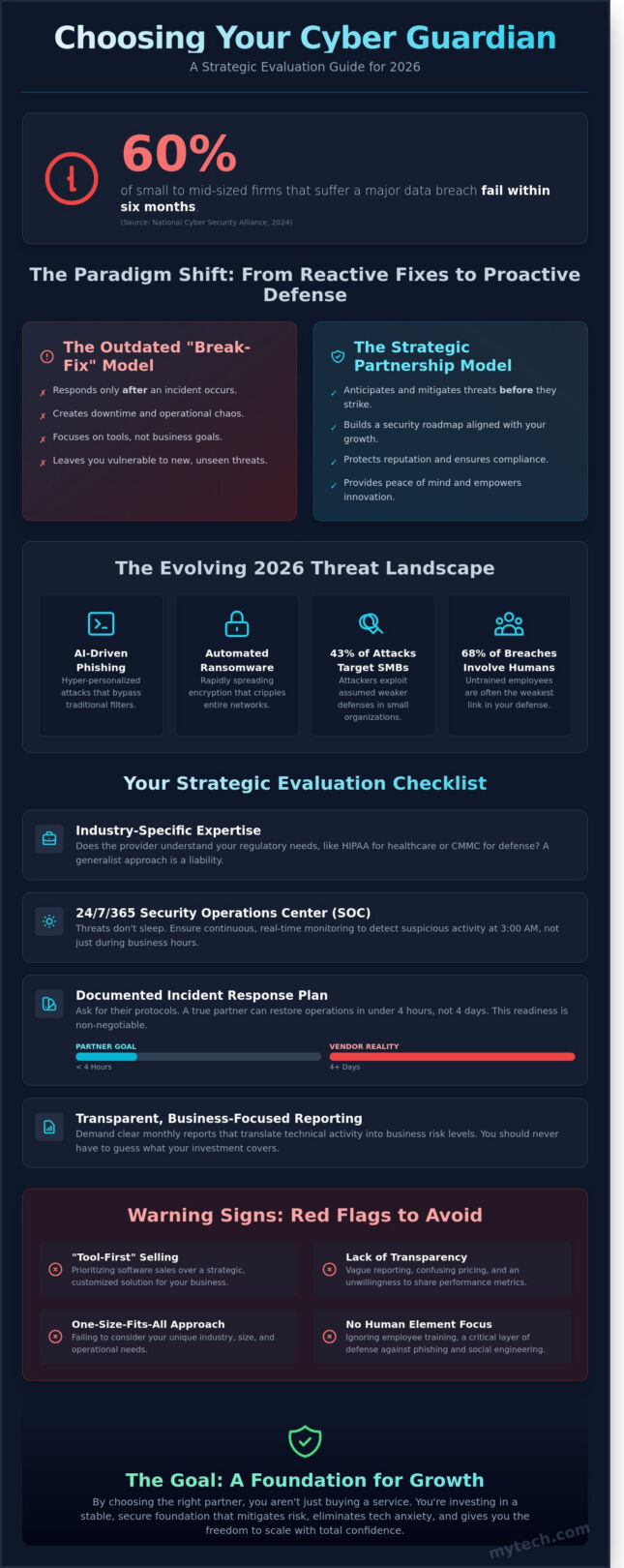
Did you know that 60% of small to mid-sized firms that suffer a major data breach fail within six months of the incident? This 2024 statistic from the National Cyber Security Alliance transforms digital safety from a technical chore into a fundamental requirement for your company’s survival. You’ve probably felt the pressure of this reality while reviewing complex proposals from various cyber security providers. It’s frustrating to decode technical jargon when you just want to know that your data is safe and your budget isn’t being wasted on unnecessary tools.
We believe your security should empower your growth, not hinder it. This article provides a strategic evaluation checklist for 2026 that aligns your defense with your specific business objectives. We’ll outline how to identify a partner who offers a proactive roadmap for your infrastructure, ensuring you move forward with total confidence.
Key Takeaways
- Learn how to transition from reactive “break-fix” security to a proactive risk management strategy that protects your long-term business goals.
- Discover the essential checklist for evaluating cyber security providers to ensure their technical stack and industry experience align with your unique needs.
- Gain clarity on the differences between MSPs and MSSPs to determine which service model provides the right level of defense for your current growth stage.
- Identify critical red flags, such as “tool-first” selling and lack of transparency, to avoid partners that prioritize software over strategic solutions.
- Understand how to build a comprehensive security roadmap that mitigates risk and empowers your team to thrive in a complex digital landscape.
What Are Cyber Security Providers and Why Does Your Business Need One?
Modern cyber security providers act as strategic architects rather than emergency responders. In 2026, the traditional “break-fix” model is obsolete. It’s no longer enough to patch a server after an incident occurs. You need a roadmap that anticipates threats before they disrupt your business operations. Digital transformation, specifically the move to cloud environments like OneDrive, has empowered your team to work from anywhere. However, this shift also expanded your attack surface. Every remote login and shared file represents a potential entry point for unauthorized users.
Internal IT teams are often stretched thin by daily operations and hardware maintenance. They prioritize productivity and uptime, which are vital for growth. However, the specialized nature of modern threats requires a dedicated focus that internal teams rarely have the bandwidth to maintain. Partnering with external specialists allows your internal staff to focus on innovation while Mytech Partners handles the complex task of securing your infrastructure. Mytech Partners provides the freedom and confidence you need to scale without the constant weight of tech anxiety.
The Evolving Threat Landscape in 2026
The digital environment has changed significantly over the last few years. AI-driven phishing and automated ransomware are now standard tools for bad actors. These attacks are highly personalized and difficult to detect with traditional filters. Small and mid-sized businesses are primary targets. In fact, statistics from the 2024 Verizon Data Breach Investigations Report indicate that 43% of all cyberattacks target small organizations because attackers assume their defenses are less robust. The cost of a breach is rarely limited to a ransom payment. Downtime can halt operations for days, and the damage to your professional reputation can take years to repair.
Core Responsibilities of a Strategic Security Partner
A strategic partner provides more than just software. They offer a comprehensive shield that includes:
- Continuous 24/7 Monitoring: Real-time threat detection that identifies suspicious activity at 3:00 AM, not just during business hours.
- Regulatory Compliance Management: Navigating the complexities of HIPAA, GDPR, or CMMC to ensure your data handling meets legal standards.
- Human-Risk Mitigation: Since 68% of breaches involve a human element, Mytech Partners provides ongoing employee training to turn your staff into a first line of defense.
By choosing the right cyber security providers, you aren’t just buying a service. You’re investing in a stable foundation for your company’s future. Mytech Partners serves as a trusted navigator, leading you through the complexities of the digital landscape so your business can thrive with total peace of mind.
The Ultimate Evaluation Checklist for Selecting a Provider
Choosing between different cyber security providers involves more than comparing line-item costs. You’re selecting a partner to safeguard your San Antonio company’s digital assets and long-term reputation. Start by assessing their depth of experience in your specific industry. A provider who understands HIPAA compliance for healthcare or CMMC requirements for defense contractors brings more value than a generalist. They must demonstrate a layered security approach that protects every entry point, from OneDrive cloud storage to local mobile devices.
Shift your focus from reactive “break-fix” models to proactive service delivery. Research from the 2023 IBM Cost of a Data Breach Report shows that organizations using security AI and automation saved $1.76 million compared to those that didn’t. Your partner should prioritize active threat hunting over simple troubleshooting. Ask for their documented incident response and disaster recovery protocols. If a ransomware attack hits, you need a team that restores operations in under 4 hours, not 4 days. This level of readiness differentiates a vendor from a true partner.
Transparency builds the foundation of a secure infrastructure. Effective cyber security providers deliver clear, monthly reports that translate technical activity into business risk levels. This ensures you’re never left wondering what your investment covers or where your vulnerabilities remain. Clear communication prevents “tech anxiety” and keeps your leadership team focused on growth rather than infrastructure failures.
Operational and Technical Requirements
Verify if the provider operates a 24/7 Security Operations Center (SOC) to monitor your environment for anomalies around the clock. Ask about their patch management cycle; critical updates should be deployed within 24 to 48 hours of release to close security gaps. Demand hard data on their performance metrics. A reliable partner tracks their “Time to Detect” and “Time to Respond” with precision, aiming to mitigate threats before they escalate into outages.
Business and Cultural Alignment
Technology should empower your organization, not create confusion. A great partner speaks in business outcomes like productivity and scalability instead of hiding behind technical jargon. They should participate in long-term strategic planning to align your IT roadmap with your specific growth goals. Before signing, request references from San Antonio businesses of a similar scale. Hearing how they handled a real-world crisis provides the best insight into a provider’s reliability. If you’re ready to move beyond basic support, evaluating a strategic security partnership can stabilize your infrastructure for the long haul.
Comparing Service Models: MSP vs. MSSP vs. Security Vendors
Selecting the right defense strategy requires understanding the distinct roles of modern cyber security providers. A Managed Service Provider (MSP) serves as your operational backbone. They manage the daily health of your environment, ensuring OneDrive remains accessible and systems stay patched. This model works well for organizations that need reliable uptime and basic protection. However, as your data footprint grows, basic protection often falls short of modern requirements.
Managed Security Service Providers (MSSPs) step in when your risk profile demands constant vigilance. They offer 24/7 monitoring through a Security Operations Center (SOC). While an MSP keeps the lights on, an MSSP watches the perimeter for intruders. Relying only on software vendors like Microsoft or Google creates a false sense of security. These vendors secure the “cloud,” but you remain responsible for securing your data “in the cloud.” Without proper configuration, even the best software remains vulnerable to human error or credential theft.
The strategic “Sweet Spot” involves a hybrid approach. This model combines the proactive maintenance of an MSP with the advanced vigilance of a security firm. This ensures your technology isn’t just working; it’s actively defending your bottom line. It bridges the gap between simple technical support and complex risk management.
The Managed IT Services Advantage
Integrating IT support and security creates a cohesive environment where technology empowers growth. We act as a Trusted Navigator for your organization, providing a single point of contact for every technical challenge. This unity prevents the finger-pointing that often occurs between separate IT and security teams. Integrated models provide clear cost-efficiencies. Research from 2023 indicates that businesses consolidating their IT and security vendors see a 22% improvement in incident response times. You receive a comprehensive roadmap that aligns your hardware lifecycle with your security goals. Understanding how strategic IT business support drives corporate stability can help you make the most informed decision when selecting an integrated partner.
When Specialized Security Firms Are Necessary
Certain scenarios require the surgical precision of specialized security firms. These organizations are essential for:
- Regulatory Compliance: Navigating complex frameworks like CMMC 2.0 or HIPAA which require rigorous documentation.
- Forensic Audits: Conducting deep-dive investigations after a suspected breach to identify exactly what data was accessed.
- vCISO Leadership: Accessing executive-level strategy through a Virtual Chief Information Security Officer to guide long-term risk posture.
Specialized firms provide the objective validation needed for high-stakes environments. If your San Antonio business manages sensitive government data or critical intellectual property, these deep-dive services ensure you meet every legal and ethical obligation. Most businesses find that a strong relationship with an integrated partner covers 95% of their needs, while specialized firms fill the final, most critical gaps. To fully understand how IT support and managed services work together to protect your organization, reviewing a comprehensive breakdown of both disciplines can sharpen your vendor selection process.
Red Flags: Signs a Cybersecurity Provider Isn’t the Right Fit
Selecting the wrong partner can leave your San Antonio organization more vulnerable than having no partner at all. Many cyber security providers focus on selling a stack of software licenses rather than delivering a strategic business outcome. This “tool-first” approach treats security as a product you buy instead of a process you manage. If a provider cannot explain how their specific tools map to your business risks, they are likely just a reseller in disguise. You need a partner who understands that technology serves your growth, not the other way around.
Transparency serves as the foundation of a healthy partnership. You deserve clear, jargon-free reporting that highlights both vulnerabilities and measurable progress. If your support tickets disappear into a “black box” with no clear communication or timeline, your operational continuity is at risk. According to the 2023 IBM Cost of a Data Breach Report, the average time to identify and contain a breach is 227 days. You cannot afford a partner who lacks the urgency or the visibility to catch threats before they escalate into disasters.
The Danger of One-Size-Fits-All Security
Generic security templates often fail because they ignore the unique nuances of your local operations. A San Antonio medical clinic has vastly different compliance requirements than a logistics firm near Port San Antonio. During the initial discovery phase, watch for providers who skip deep-dive interviews. A true partner builds a customized roadmap that aligns with your specific scalability goals. If they offer a quote before asking about your data flow or user habits, they aren’t looking at your long-term health.
Inadequate Incident Response Planning
A provider without a documented “Day Zero” plan is a liability. You must know exactly who does what when a breach occurs. Don’t just take their word for it. Ask for proof of their internal security posture and how often they test their own recovery systems. We believe that reliable cyber security providers demonstrate their value by showing you how they protect their own infrastructure first. Testing your backups shouldn’t be an annual event; it should be a core part of your strategic rhythm.
Finally, avoid providers who ignore the human element. The 2022 Verizon Data Breach Investigations Report found that 82% of breaches involved a human element, such as social engineering or simple errors. If your provider doesn’t prioritize ongoing employee training, they are leaving your front door unlocked. Security is a culture that we build together, ensuring your team feels empowered rather than intimidated by their digital tools. Exploring a comprehensive approach to business tech help that moves from troubleshooting to long-term strategy can help you identify whether your current partner is truly building that culture with you.
Is your current provider giving you a roadmap or just a bill? Schedule a strategic security assessment to ensure your infrastructure is built for success.
Building a Strategic Security Roadmap with Mytech Partners
Technology should fuel your business growth, not create a bottleneck of persistent worry. Many San Antonio business owners face a common hurdle: tech anxiety. This feeling stems from the constant threat of data breaches and the complexity of modern cloud environments. Mytech Partners acts as your navigator through this shifting digital terrain. We move beyond basic troubleshooting to provide a clear, strategic path forward. Our team ensures your technology investments align directly with your bottom-line goals, turning your infrastructure into a competitive advantage.
We utilize a disciplined Problem-Solution-Result framework to drive measurable progress. For example, a firm might struggle with disorganized data permissions in OneDrive, creating a high risk of internal leaks. We implement a structured governance model and automated sensitivity labels. The result is often a 40 percent reduction in unauthorized data exposure incidents within the first six months. By relying on experienced cyber security providers to lead the way, you gain the freedom to focus on your core operations while we handle the technical complexities.
Our Proactive Managed Security Approach
Our methodology integrates Microsoft 365 optimization with advanced security layers. We don’t just “turn on” OneDrive; we configure it to meet rigorous compliance standards. Strategic IT business support plays a vital role here. We identify hidden risks in your current setup before they become costly liabilities. Unlike many cyber security providers that focus solely on reactive fixes, we build stable infrastructure that empowers your team to thrive. This proactive stance significantly reduces downtime, allowing your staff to work with total operational confidence.
Next Steps: Securing Your Business Future
Securing your organization starts with a comprehensive security assessment. This evaluation provides a baseline of your current posture and identifies critical gaps in your OneDrive and Microsoft 365 environment. From there, we collaborate with you to create a multi-year technology roadmap. This plan ensures your IT capabilities scale alongside your business growth, preventing technical debt from accumulating. A well-defined roadmap provides a predictable budget and a clear vision for the future.
- Identify vulnerabilities through a professional security audit.
- Align your IT spend with long-term corporate objectives.
- Build a resilient culture through ongoing employee security training.
Secure Your Path to Digital Resilience
Selecting the right partner for your digital defense determines how effectively your business scales in an increasingly complex threat landscape. You now have the tools to distinguish between standard vendors and true strategic partners by using a rigorous evaluation checklist. By identifying red flags early and understanding the nuances between MSP and MSSP models, you protect your bottom line and your reputation. Choosing among cyber security providers is a high-stakes decision that requires a long-term perspective and a commitment to constant improvement.
Mytech Partners has acted as a Trusted Navigator since 2000, bringing 26 years of managed IT experience to mid-sized organizations. We specialize in Microsoft 365 optimization and layered security to turn your IT infrastructure into a catalyst for growth rather than a source of stress. Our team eliminates tech anxiety by building stable, proactive environments that let you focus on your core mission. We’ve spent decades refining a process that prioritizes your business outcomes and long-term scalability.
Empower your business with a strategic security roadmap from Mytech Partners.
Your journey toward a more secure and productive future starts with a single strategic step, and we’re ready to lead the way.
Frequently Asked Questions
What is the difference between a cyber security provider and an IT company?
An IT company focuses on your technology’s daily performance and uptime, while cyber security providers specialize in protecting your data from external and internal threats. Gartner reports that security spending is now a distinct strategic priority from operational IT budgets in 2024. While your IT team ensures OneDrive is synced, security experts implement zero-trust architectures to prevent unauthorized access. This strategic layer of protection allows your business to scale with confidence.
How much should a small business spend on cybersecurity providers?
Small businesses should allocate 10% to 15% of their overall IT budget to security initiatives to ensure adequate protection. According to Deloitte’s 2023 Global Survey, high-performing organizations prioritize this specific investment range to build long-term resilience against ransomware. We help you create a roadmap where every dollar spent on security directly supports your operational stability. This approach transforms security from a simple cost center into a strategic business advantage.
Can a cyber security provider guarantee my business won’t be hacked?
No provider can guarantee a 100% hack-proof environment because digital threats evolve every single day. Instead, a professional partner builds layers of defense that reduce the likelihood of a successful attack by over 80% based on current CIS Benchmarks. We focus on rapid detection and recovery strategies to ensure your business stays resilient. This ensures that if an incident occurs, your San Antonio business resumes operations in hours rather than weeks.
What are the most important services a cybersecurity provider should offer?
Effective cyber security providers must offer 24/7 managed detection and response, multi-factor authentication, and regular employee awareness training. These three core services address the 82% of breaches that involve a human element according to the 2023 Verizon Data Breach Investigations Report. By securing these critical areas, you empower your team to work securely from any location. This comprehensive approach mitigates risk while fostering a culture of digital safety.
How often should a cybersecurity provider perform a risk assessment?
You should conduct a comprehensive risk assessment at least once every 12 months to maintain a secure and reliable posture. Organizations that undergo quarterly reviews see a 40% improvement in their ability to detect threats compared to those that wait for an annual audit. Regular assessments ensure your OneDrive configurations and user permissions align with the latest industry standards. This proactive cadence keeps your business ahead of emerging digital threats and operational risks.
Is it better to have a local or national cyber security provider?
A local provider offers on-site support and understands the specific regulatory environment of the San Antonio business community. While national firms provide scale, local experts deliver a personalized partnership that aligns with your specific growth goals and regional challenges. We act as your trusted navigator, providing the immediate, face-to-face accountability that remote-only firms often lack. This proximity ensures your infrastructure remains stable and your team feels supported.
What is a vCISO and do I need one for my business?
A vCISO is a virtual Chief Information Security Officer who provides executive-level security leadership on a part-time or fractional basis. You need one if your business handles sensitive data but doesn’t require a full-time executive with a typical six-figure salary. This role bridges the gap between technical tasks and business strategy. It provides a clear roadmap for your digital transformation while keeping your overhead costs manageable and your strategy focused.
How do cybersecurity providers help with regulatory compliance?
Providers help you achieve compliance by mapping your current IT controls to specific frameworks like HIPAA or CMMC 2.0. They document every security protocol to ensure you meet the 110 practices required for federal contracting or healthcare privacy standards. This structured approach simplifies the audit process and protects your brand reputation from potential fines. You gain the freedom to pursue new contracts without the stress of navigating complex regulatory hurdles alone.